The Senior Mathematical Challenge concluded on 8 October 2026. For students now turning toward the British Mathematical Olympiad, the gap between these two UKMT competitions is not merely a step up in difficulty. It is a change in the entire nature of mathematical work. SMC presents problems in multiple-choice format, where reasoning leads to selecting one correct option; BMO demands that you construct an argument so complete that no reasonable reader could doubt its conclusion. The central task of SMC to BMO Proof Writing is to replace the plausible pattern with the complete argument.
This article focuses on the specific mechanism: how a pattern noticed in small cases can be transformed into a deductive proof, and what happens when that transformation fails. For a broader overview of how to structure complete proofs in the BMO context, see our companion guide BMO Infinite Descent: How to Write a Complete Proof. Here, we work through concrete applications of the principle named in the title.
Why SMC Success Does Not Guarantee BMO Success
In the SMC, a student might observe that n³ − n is divisible by 6 for n = 1, 2, 3, check that the pattern continues for n = 4, 5, and select the correct option with confidence. The answer is correct, and the reasoning process—testing cases, looking for structure, eliminating distractors—does involve genuine mathematical thinking. However, the SMC answer format makes this reasoning invisible to the marker. The format does not require you to justify why the pattern holds; it only requires you to identify that it does.
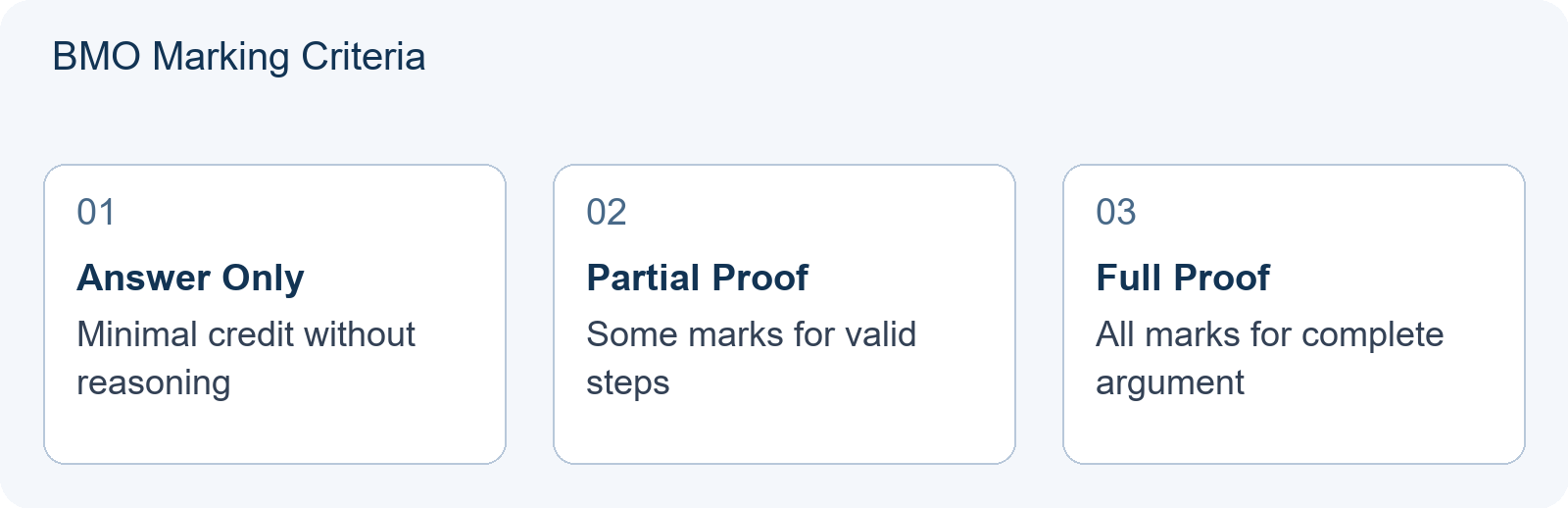
BMO Round 1 changes this entirely. The competition consists of six questions, each worth 10 marks, across 3.5 hours. According to UKMT structure, solutions must include complete reasoning, and the marking scheme awards credit for demonstrated logical steps even when the final answer remains incomplete. A response consisting only of a numerical answer earns minimal or no credit, since value is placed on the reasoning chain rather than on the final number alone. A student who proves that n³ − n factors into n(n−1)(n+1), then shows this product must contain both a multiple of 2 and a multiple of 3, earns substantial marks even if a final arithmetic slip occurs.
The shift from SMC to BMO Proof Writing is therefore a shift from verification to construction. You are no longer selecting among options that package reasoning for you. You are building a structure that makes the conclusion unavoidable.
The Specific Mechanism: From Pattern to Proof
The danger of the plausible pattern is subtle. It feels like mathematics. You notice something, you test it, you gain confidence. But confidence is not proof. The mechanism for replacing a pattern with a proof involves three distinct moves:
First, isolate the claim. State precisely what must be proved. Vague intuitions cannot be proved; only propositions can. Write the claim in full sentences with all conditions explicit.
Second, identify the gap between observation and deduction. Ask: what would have to be true for this pattern to hold in all cases? Usually, this involves finding a general property that explains the specific observations. The gap is the space between “it works for these examples” and “it must work for every case.”
Third, construct a bridge using established results. Use definitions, theorems, and logical rules to connect the general property to the conclusion. Each step must be justified by something already known or already proved. The bridge turns a collection of examples into an unavoidable conclusion.
This mechanism is what distinguishes How BMO Solutions Are Marked: Writing Proofs That Score (2026-2027) from SMC scoring. Markers read for logical flow, not for final answers alone. Understanding this mechanism is the core of effective SMC to BMO Proof Writing.
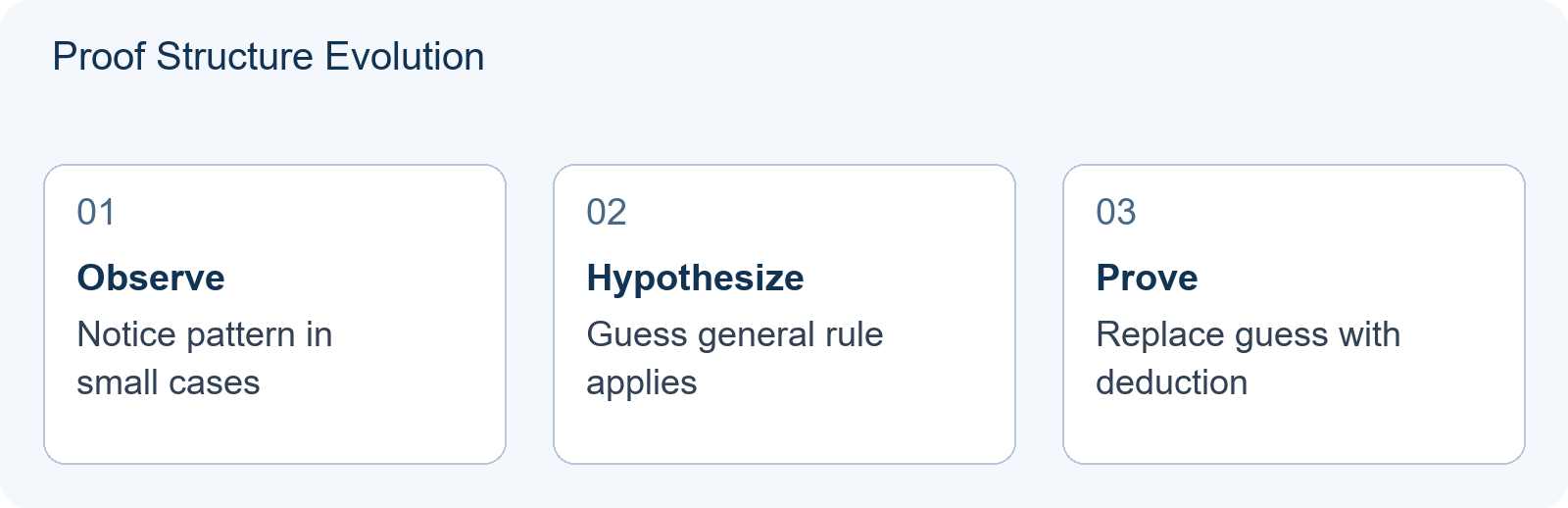
Worked Teaching Illustration 1: Proving Divisibility
The following is a hypothetical teaching illustration designed to show the structural difference between SMC-style pattern recognition and BMO-style proof. It is not an actual contest problem.
Claim: The product of any three consecutive positive integers is divisible by 6.
Incomplete approach (the plausible pattern):
Test n = 1: 1 × 2 × 3 = 6, divisible by 6.
Test n = 2: 2 × 3 × 4 = 24, divisible by 6.
Test n = 3: 3 × 4 × 5 = 60, divisible by 6.
Conclusion: The pattern holds for all positive integers n.
This argument fails in BMO because it provides no reason why the pattern should persist beyond the tested cases. It replaces proof with enumeration.
Complete argument (the replacement):
Consider three consecutive integers: n, n+1, n+2.
Step 1: Divisibility by 2. Among any two consecutive integers, exactly one is even. Therefore, among n, n+1, n+2, at least one is even. The product n(n+1)(n+2) contains a factor of 2.
Step 2: Divisibility by 3. Any integer n leaves remainder 0, 1, or 2 upon division by 3. If n ≡ 0 (mod 3), then n is divisible by 3. If n ≡ 1 (mod 3), then n+2 ≡ 0 (mod 3). If n ≡ 2 (mod 3), then n+1 ≡ 0 (mod 3). In every case, one of the three factors is divisible by 3.
Step 3: Synthesis. Since 2 and 3 are coprime, and the product contains both 2 and 3 as factors, it is divisible by 2 × 3 = 6.
This second version replaces the plausible pattern with logical necessity. Each step appeals to a general property (parity, modular arithmetic) rather than specific instances. The conclusion follows inevitably from the premises, not tentatively from observation.
Worked Teaching Illustration 2: Bisecting Diagonals in a Quadrilateral
The following is a hypothetical teaching illustration designed to show how a geometric pattern must be replaced by a proof based on triangle congruence. It is not an actual contest problem.
Claim: In a convex quadrilateral ABCD, if the diagonals AC and BD bisect each other—that is, they intersect at a point O with AO = CO and BO = DO—then ABCD is a parallelogram.
Incomplete approach (the plausible pattern):
Draw several quadrilaterals with bisecting diagonals. Measure opposite sides: they appear equal. Measure opposite angles: they appear equal. Conclude ABCD is a parallelogram.
This fails because measurement and appearance do not constitute proof. The pattern is suggestive but not deductive.


Complete argument (the replacement):
Assume ABCD is a nondegenerate convex quadrilateral with diagonals intersecting at O, where AO = CO and BO = DO.
Step 1: Prove triangle congruence using SAS. Consider triangles AOB and COD. We are given AO = CO and BO = DO. The angles AOB and COD are vertical angles, hence equal. By the SAS (Side-Angle-Side) congruence criterion, triangle AOB is congruent to triangle COD.
Step 2: Derive matching alternate angles. From the congruence, corresponding angles OAB and OCD are equal. These are alternate angles formed by transversal AC crossing lines AB and CD.
Step 3: Conclude opposite sides parallel. Since alternate angles are equal, AB is parallel to CD. Repeating the argument with triangles BOC and DOA shows that angles OBC and ODA are equal, giving BC parallel to AD. A convex quadrilateral with both pairs of opposite sides parallel is a parallelogram.
This argument replaces the plausible visual pattern with deductive necessity. Each step appeals to a specific congruence criterion or parallel-line theorem, not to measurement or appearance.
Contrasting Teaching Illustration: When the Pattern Deceives
The following is a hypothetical teaching illustration designed to show why pattern-matching can lead to false conclusions. It is not an actual contest problem.
False claim (induced by pattern): For all positive integers n, the number n² + n + 41 is prime.
Plausible pattern: Test n = 1: 1 + 1 + 41 = 43 (prime).
n = 2: 4 + 2 + 41 = 47 (prime).
n = 3: 9 + 3 + 41 = 53 (prime).
Continuing: n = 4 gives 61 (prime), n = 5 gives 71 (prime), and so on. The pattern holds for the first 40 values.
However, at n = 40: 40² + 40 + 41 = 1600 + 40 + 41 = 1681 = 41 × 41, which is not prime.
Why this matters for BMO: A student relying on pattern-matching might conjecture that n² + n + 41 is always prime, or worse, might use this unproven conjecture as a lemma in a larger proof. In BMO, such an error would be penalized heavily. The correct approach, if this expression appeared in a problem, would be to analyze it algebraically: n² + n + 41 = n(n+1) + 41. For n = 40, this becomes 40 × 41 + 41 = 41(40 + 1) = 41², revealing the factorization directly.
This contrasting case demonstrates that plausible patterns can persist for many cases before failing. BMO proof writing requires you to resist the temptation to trust early observations and instead seek the structural reason.
Diagnostic Application: Testing Your Proof Gaps
After attempting a BMO practice problem, apply this three-question diagnostic to your written solution:
Question 1: Did I prove the statement for all cases, or only verify some? If your argument contains phrases like “it works for n = 1, 2, 3, so it probably holds,” you have not completed the proof. Replace with a general argument.
Question 2: Does each step follow from a definition, theorem, or previously established result? If any step relies on “it looks like” or “the pattern suggests,” you are still in SMC mode. Identify the logical rule that justifies the transition.
Question 3: Could a skeptical reader construct a counterexample to my implicit assumptions? If you divided by a variable, did you handle the zero case? If you assumed a function was continuous or a polynomial had integer coefficients, did the problem guarantee this? Explicitly state or verify every condition.
Scoring yourself: 3 clear answers means your draft is likely BMO-ready. 2 answers means one section needs expansion. 1 or fewer means you need to restructure from observation toward deduction before submitting to Writing BMO Proofs in English: A Phrasebook and Style Guide for Second-Language Candidates for feedback.
What the Diagnostic Means for Your Next Step
If your diagnostic reveals gaps, the specific next task depends on which question failed. Failure on Question 1 suggests you need practice with universal statements: how to phrase “for all n” arguments using induction, contradiction, or direct algebraic manipulation. Failure on Question 2 indicates you need to review which theorems are admissible in BMO; our State It or Prove It? A Lookup Table of Named Results You Can Use in a BMO Write-Up can help. Failure on Question 3 points to a habit of implicit assumptions, common among students transitioning from timed multiple-choice formats.
Useful feedback on your practice proofs should identify not just where you lost marks, but which logical move was attempted but incomplete. A comment like “expand this step” is less valuable than “you assumed gcd(a,b) = 1 here without proving it—use the Euclidean algorithm or state the given condition.” Seek feedback that names the missing justification, not just the missing mark.
Preparing for BMO Round 1 on 19 November
With BMO Round 1 approaching on 19 November 2026, students who sat SMC earlier this month should now shift from speed drills to proof construction. The 3.5-hour format rewards depth over breadth. Attempting all six questions superficially earns fewer marks than completing three or four with full reasoning.
China-region students may enter BMO Round 1 directly without SMC qualification. This direct entry path makes BMO accessible, but it also means many students lack the gradual transition that UK students experience through earlier UKMT rounds. The mechanism described in this article—replacing plausible patterns with complete arguments—is therefore especially critical for direct entrants.
Focus your remaining preparation on writing out full solutions to past problems, not merely solving them mentally. The gap between knowing a solution and writing a solution that earns full marks is where SMC to BMO Proof Writing lives.
Frequently Asked Questions
What is the most common proof-writing mistake when transitioning from SMC to BMO?
Treating pattern verification as sufficient proof. SMC-style checking of small cases builds intuition but not deduction. The specific fix is to identify the general property that explains the pattern, then justify it using definitions or theorems. For example, noticing that n³ − n is divisible by 6 for several values is only the first step; the proof requires showing n(n−1)(n+1) always contains factors of 2 and 3.
How much detail is required in a BMO proof?
Every logical step must be justified to a standard mathematician. Partial credit is awarded for correct reasoning even when the final answer is incomplete, but unsubstantiated claims receive minimal or no credit. The official UKMT guidance emphasizes complete written solutions with full reasoning. A good rule: if a step uses a theorem, name it; if it uses a definition, state it; if it assumes a condition, verify it.
Can I use results from advanced mathematics in BMO?
Only established results that are within the standard pre-university curriculum may be used without proof. Our article on named results provides a lookup table of which theorems you may state directly and which you must prove within your solution. When in doubt, prove the result from more basic principles rather than risk assuming something outside the permitted range.