A BMO script is a piece of written English as well as a piece of mathematics. Candidates educated partly or wholly in Chinese-medium mathematics regularly arrive at Round 1 with the reasoning fully intact and the language of proof missing — and the marker can only credit what is on the page. The fix is small, teachable and almost entirely vocabulary and structure.
The gap that is not mathematical
UKMT describes BMO Round 1 as a 3½-hour paper with six problems and Round 2 as a 3½-hour paper with four problems. Confirm the current format on bmos.ukmt.org.uk. In both, what you submit is prose: a written argument in English that another person has to be able to follow without asking you questions. Our overview of what the British Mathematical Olympiad is sets out how the rounds fit together.
This is worth separating clearly from mark schemes and grading policy. The point here is not how many marks a partial solution earns; it is that two candidates with identical mathematics can produce scripts of very different legibility, and legibility is not a fixed property of your English level. It is a property of about a dozen sentence patterns.
The gap is also not a deficiency. Mathematical writing conventions genuinely differ between traditions. Many Chinese-medium classrooms teach a highly compressed solution style: a chain of equalities with symbolic connectives, minimal prose, and the reader expected to reconstruct the logic. That style is efficient and internally consistent. It simply is not the style a British olympiad marker is reading for, which is closer to an argued paragraph than a worked calculation.
The sentences that carry a proof
An olympiad proof in English is built from a surprisingly small stock of sentence openers. Each one tells the reader what kind of step is coming, which is why they are load-bearing rather than decorative.
| Phrase | What it signals to the reader | Use it when |
|---|---|---|
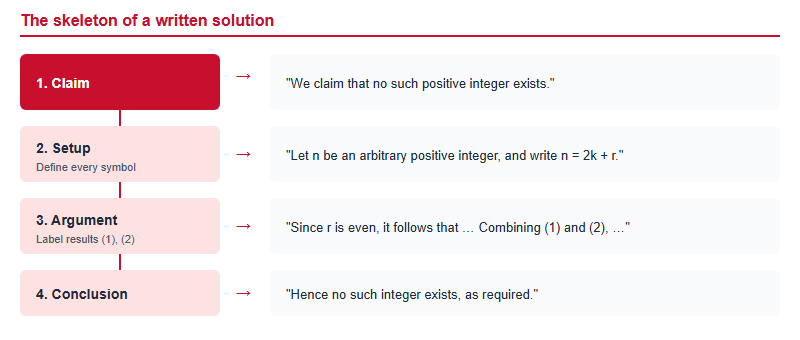
| We claim that … | A statement is about to be proved, not asserted | Opening any solution, and any sub-argument |
| Suppose, for contradiction, that … | Everything that follows is provisional | Starting an impossibility argument |
| It suffices to show that … | The goal is being replaced by an easier equivalent | Reducing the problem before attacking it |
| Without loss of generality, assume … | A case has been chosen and the rest are symmetric | Only when you can say why they are symmetric |
| Let n be an arbitrary … | The argument covers every case, not one example | Proving a universal statement |
| Since …, it follows that … | This step depends on that specific earlier fact | Every deduction that uses a named prior result |
| Combining (1) and (2), we obtain … | Two labelled results are being joined | Any multi-strand argument |
| Conversely, … | The other direction of an equivalence begins here | "If and only if" problems, and characterisations |
| Hence …, as required. | The proof is finished and matches the question | The final sentence of every solution |
Two notes on using this list. First, "without loss of generality" is the phrase most often misused by strong candidates: it is a claim that the remaining cases follow by symmetry, and a reader is entitled to see the symmetry named. Writing it to avoid doing a second case is visible. Second, the closing sentence matters more than it looks. A proof that ends on an equation, with no sentence restating what has been established, forces the reader to decide for themselves whether you finished.
Habits that travel badly across languages
The following are not errors of English. They are conventions that work in one written tradition and read as gaps in another.
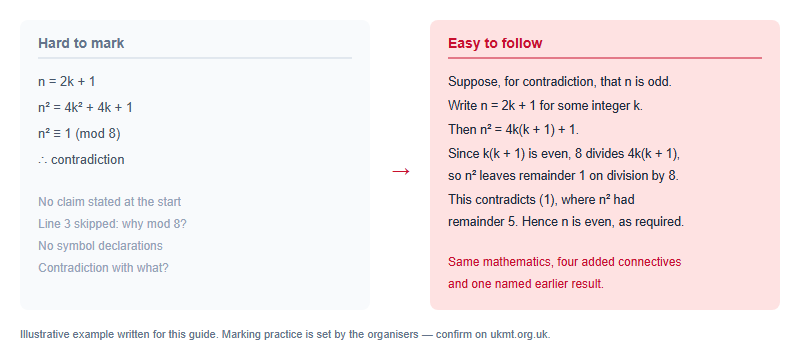
- The bare computation chain. A column of equalities with no words between them. In a compressed style, the reader infers the justification; in an olympiad script, an unexplained step is an unjustified step. The repair is one clause per line: since, because, by the factor theorem.
- "Obviously" and "it is easy to see". These are direct translations of a standard textbook connective, and in English olympiad writing they read as a request to skip the proof. If the step really is immediate, giving the one-line reason costs nothing; if it is not, the phrase draws attention to the gap.
- "From the conditions of the problem, we obtain …" A very common opener in translation. It does not identify which condition, so the reader has to re-read the question to check the step. Name the condition: "Since the sum of the three numbers is fixed, …".
- Symbolic connectives used as prose. The "therefore" and "because" triangle symbols are standard in some school traditions and rare in British olympiad writing. Arrows for implication are acceptable inside a displayed line of working, but a script written entirely in arrows is hard to mark. Write the words.
- Undeclared symbols. Introducing a letter mid-argument without saying what it ranges over. Every symbol needs a home: "let p be a prime divisor of n", not simply an appearance of p.
- Answer without characterisation. Stopping once a value is found. Many problems ask for all solutions, and a script that finds one and stops has answered a different question. The closing sentence should mirror the question's own quantifier.
Conventions worth adopting deliberately
A handful of formatting habits make a script markedly easier to read, and all of them are free.
- Number your results. Any equation or fact you will refer to again gets a label in brackets on the right. Then refer to it by number rather than by "the above".
- Write in full sentences with full stops. Displayed mathematics still lives inside a sentence; a line of algebra usually ends with a comma or a full stop like any other clause.
- Signal case splits explicitly. "Case 1: n is even." and "Case 2: n is odd." as headed paragraphs, plus a closing line confirming the cases are exhaustive.
- Keep rough work separate. Exploration and the final argument are different documents. If both appear on the page, mark clearly where the proof begins.
- State the conclusion in the question's own terms. If the question asks you to determine all pairs, the last sentence should say that these are all the pairs — not merely present the last equation you derived.
Training this without a coach
Proof-writing is trainable alone, because unlike problem-solving it has an objective check: give your script to someone who has not solved the problem and see whether they can follow it. A workable four-week routine:


| Week | Drill | Time | What to check |
|---|---|---|---|
| 1 | Rewrite five old solutions you already have, adding connectives only | 2 hours | Every step has a stated reason |
| 2 | Write the first and last sentence of ten problems — nothing else | 1 hour | The last sentence answers the actual question |
| 3 | Translate three compressed solutions into full prose | 2 hours | No undeclared symbols remain |
| 4 | Two timed problems, then an untimed rewrite the next morning | 3 hours | The differences between the two versions |
Week 2 is the highest-value hour on the table and the one everybody skips. Writing only the opening claim and the closing sentence for ten problems, without solving any of them, trains the two habits that structure a whole script — saying what you are about to prove, and confirming you proved it.
For material, work from real papers rather than textbook exercises, because the phrasing of olympiad questions is itself what your final sentence has to mirror. We keep a gathered pack of BMO past papers with worked solutions for many of the years, and comparing your prose against a model write-up is the fastest way to hear the register. Read the model solutions for their sentence structure at least once, rather than only for their mathematics.
One practical note before you build a term around this. Entry runs through your school as a registered centre, so confirm early that you can be entered at all — our eligibility guide for international students covers the requirements that decide it, and current conditions should be checked on ukmt.org.uk.
Frequently asked questions
Will poor English cost me marks on the BMO?
Marking practice is set by the organisers and their published mark schemes are the authority. What is certain is that an argument a reader cannot follow cannot be credited, so clarity is what matters, not elegance.
Can I use symbols instead of words like "therefore"?
Inside displayed working, yes. A whole script written in symbolic connectives is much harder to read; write the linking words as prose.
How long should a BMO solution be?
There is no target length. A complete solution states its claim, defines its symbols, justifies each step and closes by answering the question asked.
Is "without loss of generality" safe to use?
Only when you can name the symmetry that makes the other cases equivalent. Otherwise write the second case out in full.
This is an independent editorial guide operated by Hanlin Education for China-based international-school students. We are not affiliated with, endorsed by, or sponsored by UKMT or the BMO Subtrust. Competition formats, dates, eligibility and mark schemes are set by the organisers and can change — confirm current details on ukmt.org.uk. Errors reported to our editorial desk are corrected within 7 working days.