Short answer: for BMO1 Diophantine equations, factor first when a two-variable integer equation can be rewritten as a product equal to a fixed integer, especially a difference of squares. Bound first when a square or a growth comparison traps one variable in a finite range; if neither factoring nor bounding closes the proof, try a modulus. In either case, the proof is unfinished until you have stated the domain and shown why the case list is complete. For the 2026–27 season, Hanlin’s 15 October 2026 competition note gives the China-region BMO Round 1 time as 19 November 2026, 17:00–20:30.
This article is independent editorial guidance and is not affiliated with UKMT, which administers the British Mathematical Olympiad. For current paper logistics and regulations, the official BMOS site is the authority: official BMOS site.
What BMO1 marking rewards
Hanlin’s 15 October 2026 note (Hanlin Courses; English rendering of the source title: “2026 BMO Maths Olympiad registration closes 9 November — G5 STEM applicants…”), lists integer solutions of equations within the number-theory content relevant to BMO preparation. The same note describes BMO1 as a proof-based paper: candidates must write complete logical steps, and answers alone do not score. The note also says that correct partial process can earn some credit.
That marking context changes how a Diophantine equation should be attacked. A page containing three factor pairs may contain three true statements and still be an incomplete proof, because it has not shown that no fourth pair exists. A page containing a bound such as y ≤ 6 may be correct and still be incomplete, because it has not shown that all six values were tested. The examiner is not only checking the final pairs; the examiner is checking whether the route to those pairs is exhaustive.
The practical consequence is simple: before calculating, decide which structure the equation exposes. Is it a product in disguise, or is one variable capped? That decision controls the shape of the written proof.
A decision table for BMO1 Diophantine equations
The table below is a coaching judgment, not an official rule. It separates common two-variable forms by the first move that is most likely to close the proof.
| Signal in the equation | First move | Completeness check |
|---|---|---|
| Difference of squares: x² − y² = N | Write (x − y)(x + y) = N. | Use the domain to fix signs and factor order; check parity; substitute every pair back. |
| Sum of two squares: x² + y² = N | Bound each variable by √N, then test integers in range. | State why every solution must lie in the range; test every value, not a sample. |
| One variable linear: xy = x + 3y | Isolate: x = 3y/(y − 1) = 3 + 3/(y − 1). | Use divisibility: y − 1 must divide 3; check each allowed value, respecting the domain. |
| Product plus sum: xy = x + y + 7 | Add 1: (x − 1)(y − 1) = 8. | List all factor pairs, including negative factors if the domain allows them. |
| Exponential separation: 2a − 2b = 48 | Factor out 2min(a,b): 2b(2a−b − 1) = 48. | The odd factor limits the power of 2; list only compatible divisor pairs. |
| No visible factor and no small bound | Try a modulus that makes squares or powers take few residues. | Show that the residue condition fails for every case, not just one example. |
The table is not a script to apply mechanically. A difference of squares that has no solutions still needs a complete argument; a bounded equation over all integers may still have extra sign variants unless the domain is fixed. The next two sections show what complete looks like in the two main routes.
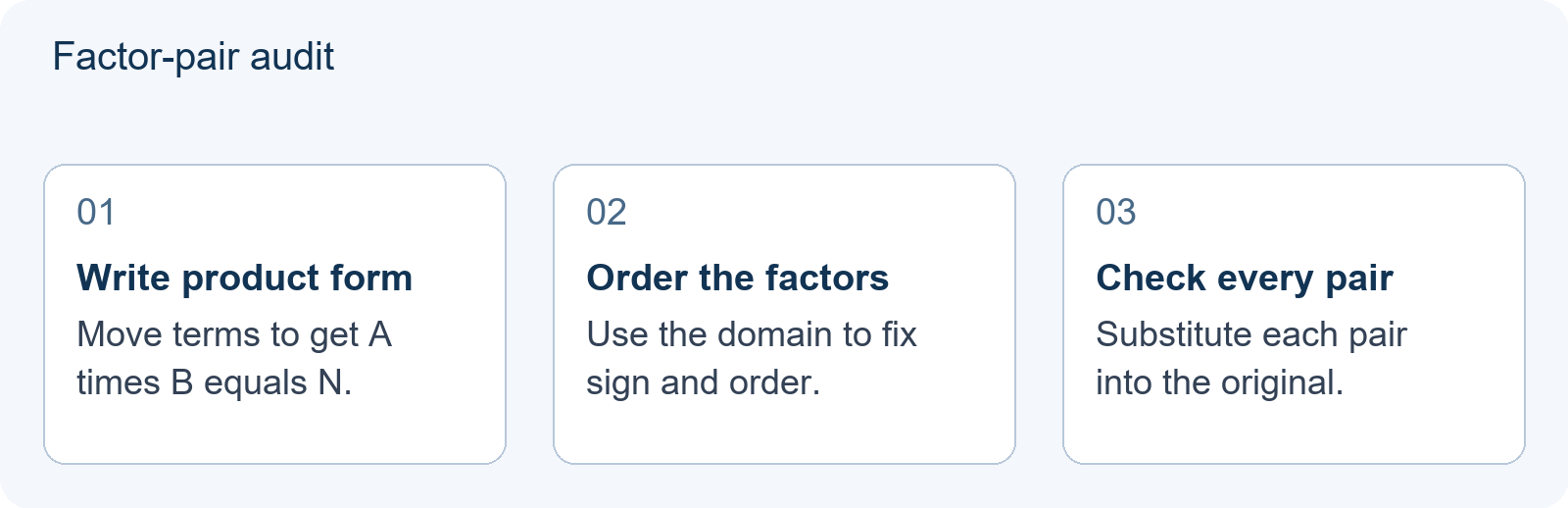
Teaching illustration: a complete factor-pair audit
Teaching illustration, not an official BMO question. Find all positive integers x and y satisfying x² − y² = 45.
Because x and y are positive and x² > y², we have x > y. Put a = x − y and b = x + y. Then a and b are positive integers with a < b and ab = 45. Since 45 is odd, both factors are odd; in this example that is automatic rather than an extra filter. The ordered factor pairs with a < b are (1, 45), (3, 15) and (5, 9).
For each pair, solve x = (a + b)/2 and y = (b − a)/2.
| a | b | x | y | Check in x² − y² |
|---|---|---|---|---|
| 1 | 45 | 23 | 22 | 529 − 484 = 45 |
| 3 | 15 | 9 | 6 | 81 − 36 = 45 |
| 5 | 9 | 7 | 2 | 49 − 4 = 45 |
Every positive factor pair with a < b is listed. Conversely, each pair gives positive integers because a and b are odd, so the halving is exact, and because b > a, so y > 0. Each pair satisfies the original equation by substitution. Therefore the positive-integer solutions are (23, 22), (9, 6) and (7, 2).
The proof has three separate jobs: deriving the product form, listing the possible factor pairs, and confirming that each pair really gives a solution in the stated domain. Missing any one of those jobs weakens the write-up.
The incomplete versions that look finished
The most common incomplete version stops after the first factor pair. It finds (23, 22), checks it, and concludes. That is a true example, not a complete solution: (9, 6) and (7, 2) have been omitted.
A second version lists (9, 5) as a factor pair without ordering the factors. If a = x − y = 9 and b = x + y = 5, then x = 7 and y = −2, which is outside the positive-integer domain. That is not a missing positive case; it is a case created by forgetting the ordering a < b.
A third version ignores parity. For a different positive-integer equation such as x² − y² = 12, the factor pair (1, 12) gives x = 6.5, not an integer; (3, 4) gives x = 3.5; only (2, 6) gives the integer solution (4, 2). A list that includes (1, 12) without a parity check is not a valid integer solution list.


A fourth version quietly changes the domain. “Positive integers” may become “integers” between the statement and the factor list, or the writer may discard negative factors without saying so. The domain is part of the hypothesis, not a presentational detail. If the domain is all integers, the factor-pair audit must include negative factors and sign variants; if it is positive integers, the ordering and positivity arguments must say so.
When bounding beats factorising
Teaching illustration, not an official BMO question. Find all positive integers x and y satisfying x² + y² = 45.
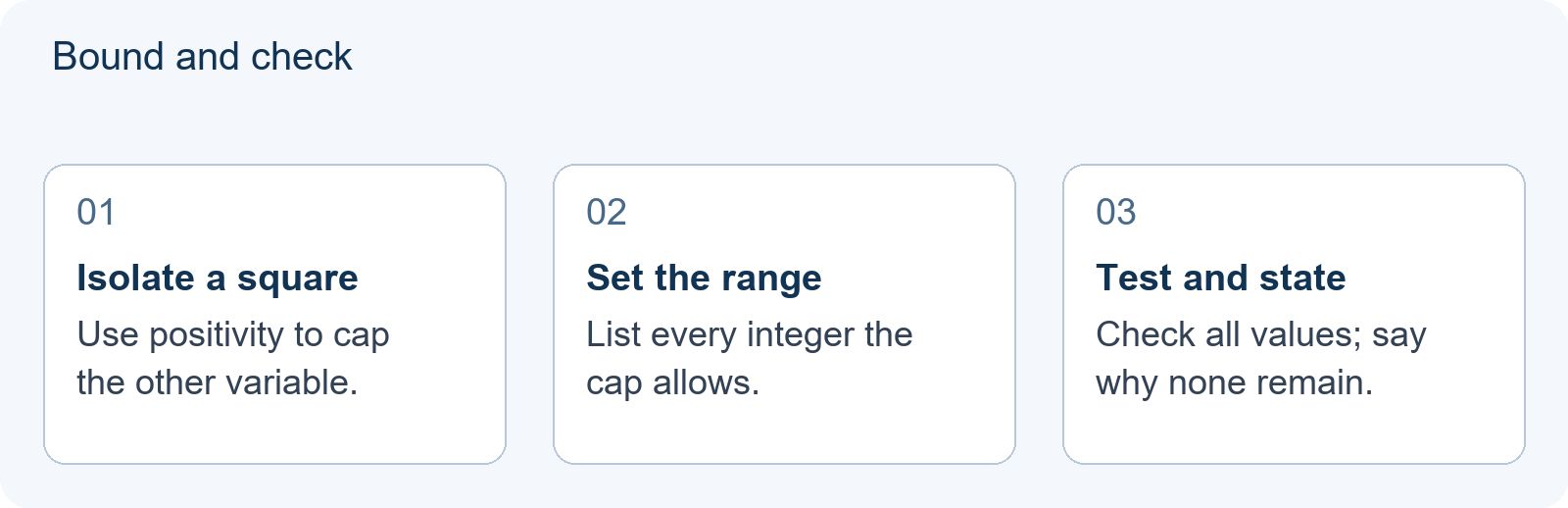
There is no difference of squares to factor. But the equation bounds both variables. Since y² ≥ 1, we have x² ≤ 44, so x ≤ 6. Similarly y ≤ 6. Now test every positive y from 1 to 6.
| y | 45 − y² | Square? |
|---|---|---|
| 1 | 44 | No |
| 2 | 41 | No |
| 3 | 36 | Yes: x = 6 |
| 4 | 29 | No |
| 5 | 20 | No |
| 6 | 9 | Yes: x = 3 |
The positive-integer solutions are (6, 3) and (3, 6). The bound is not a guess: every positive solution has y in {1, 2, 3, 4, 5, 6}, and the table tests every such value. No solution can have y ≥ 7 because 7² = 49 > 45.
If the domain were all integers, each positive pair would also produce sign variants, and the audit would need to include them. If the domain were non-negative integers, y = 0 would need a separate check. The bound itself stays the same; the domain changes the case list. That is why the domain statement belongs at the start of the proof, not in a final footnote.
When modular arithmetic should replace both
Teaching illustration, not an official BMO question. Show that x² + y² = 43 has no integer solutions.
Modulo 4, every square is 0 or 1. Therefore a sum of two squares is 0, 1 or 2 modulo 4. But 43 ≡ 3 modulo 4. The equation is impossible for every integer pair. This is a complete no-solution proof: it does not rely on searching a finite list, and it does not leave a case untested.
Modular arithmetic is the better first move when the equation does not visibly factor and no inequality gives a small range. The modulus should be chosen so that the possible residues are few and the target residue is excluded. This is adjacent to the separate question of how to choose a modulus; see BMO Modular Arithmetic: Choose a Modulus That Rules Out an Integer Solution. In a BMO1 write-up, the modular proof must state the residue facts and show that every possible case fails, not merely exhibit one failed substitution.
Six questions and a feedback record
Before drafting, run these six questions:
- What is the exact domain: positive integers, non-negative integers, or all integers?
- Can the equation be rewritten as a product equal to a fixed integer?
- If so, what order and parity restrictions do the factors have?
- If not, what inequality caps at least one variable, and why must every solution obey it?
- If neither route closes, which modulus makes the possible residues small enough to eliminate all cases?
- Have I substituted every listed case back into the original equation and said why no cases remain?
These questions also form a useful preparation record. Before asking a teacher or a preparation programme for feedback, write one page containing: the original equation, your domain statement, each factor pair or bound, the case you discarded and why, and the final substitution check. That record lets a reviewer diagnose completeness rather than guess at your reasoning. If you are comparing feedback options, ask whether the review will address case completeness and proof structure, not only final answers. A useful readiness check is The BMO1 Readiness Self-Audit: Score Yourself Out of 40 and Fix the Right Thing First, and worked-answer requests can be prepared alongside BMO1 Past Papers Solutions: Requesting Worked Answers and Proof Feedback.
The decision between factoring and bounding is therefore not a matter of taste. It is a decision about which structure makes exhaustiveness visible. Factor when the equation becomes a product of finitely many divisor pairs; bound when a square or a growth condition gives a finite range; switch to a modulus when neither route closes. In every case, write the domain first and the completeness check last.
Frequently Asked Questions
Should I always factor a BMO1 Diophantine equation first?
No. Factor first when a product form is visible, especially a difference of squares. Bound first when a square term caps a variable in a finite range. If neither works, try a modulus. In every route, state the domain before listing cases.
Is listing factor pairs enough for a complete BMO1 proof?
No. Hanlin’s 15 October 2026 note says BMO1 requires complete logical steps and answers alone do not score. A factor-pair list needs an argument that the list is exhaustive, plus a substitution check for each pair.
How do I know a bound is complete?
Derive an inequality that every solution must satisfy, list every integer allowed by that inequality, test each one, and explain why values outside the range are impossible. The bound is complete only when the case list is finite and fully tested.