For students transitioning from multiple-choice competitions to proof-based Olympiads such as the British Mathematical Olympiad (BMO), the shift in thinking is profound. It is not enough to find an answer; one must construct a rigorous argument. A powerful tool is the Extremal Principle: considering the largest, smallest, longest, or shortest element in a set to derive a contradiction or establish a property directly. This article uses original teaching illustrations—hypothetical scenarios designed for learning, not official past-paper questions—to demonstrate correct and incorrect applications.
Why the Extremal Principle Works in BMO Proofs
The core idea is that extreme elements often possess unique properties. By focusing on boundaries, we simplify infinite or large finite sets into manageable cases. For example, if a problem involves a sum of positive integers, examining the largest integer might reveal constraints on the others. If the largest integer were too big, the remaining sum would be negative—impossible. This reasoning appears in many BMO-style problems.
Unlike computational questions where trial and error might suffice, BMO proofs demand deductive certainty. The extremal principle provides a foothold. It transforms a vague “there exists” statement into a concrete “let M be the maximum…” assumption, allowing you to exploit specific inequalities or divisibility conditions.
Worked Teaching Illustration 1: Success via Minimality
Hypothetical Scenario (Teaching Illustration): Let S be a finite set of positive integers with the property that for any two (not necessarily distinct) elements x, y ∈ S, the absolute difference |x − y| is also in S. Prove that all elements of S are multiples of the smallest element.
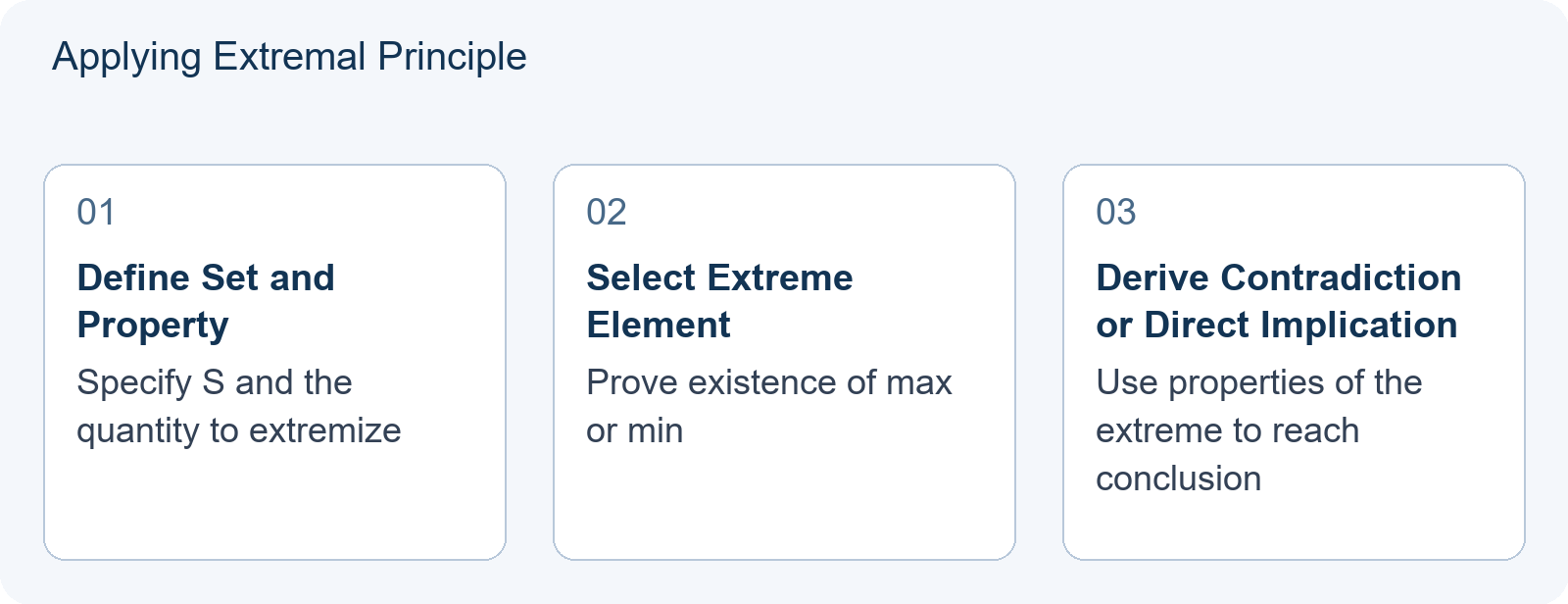
Step 1: Define the Extreme Explicitly. Let m = min(S). Since S is a non-empty finite set of positive integers, m exists and is well-defined.
Step 2: Apply the Condition with Verified Closure. Take any a ∈ S. We want to show m divides a. By the Euclidean algorithm, write a = qm + r with integers q ≥ 0 and 0 ≤ r < m. We prove by induction on k that for each k with 0 ≤ k ≤ q, the element a − km lies in S. The base case k = 0 is a ∈ S. For the inductive step, assume a − km ∈ S for some k < q. Since m ∈ S and a − km ∈ S, the closure property gives |(a − km) − m| = a − (k+1)m ∈ S (positive since k+1 ≤ q). Thus a − (k+1)m ∈ S, completing the induction.
Step 3: Derive Contradiction or Direct Implication. Setting k = q gives a − qm = r ∈ S. If r > 0, then 0 < r < m, contradicting the minimality of m. Therefore r = 0, so m divides a.
Key Lesson: The explicit definition of m and the verified inductive closure—proving each intermediate difference remains in S—make this proof valid. The extremal principle here uses minimality to force the remainder to zero.
Worked Teaching Illustration 2: Success via Maximality
Hypothetical Scenario (Teaching Illustration): Let T be a finite set of points in the plane, no three collinear. A line segment between two points of T is called red if every other point of T lies strictly on one side of the line through those two points. Prove that there exists a point in T that is an endpoint of at least two red segments.
Step 1: Define the Extreme Explicitly. Consider all triangles with vertices in T. Since T is finite, there are finitely many such triangles, so we may choose a triangle △ABC with maximum area among all such triangles.


Step 2: Apply the Condition Systematically. We claim that each side of △ABC is a red segment. Consider side AB. Since no three points are collinear, all other points of T lie either on the same side of line AB as C, or on the opposite side. If some point D lay on the opposite side of AB from C, then △ABD would have area greater than △ABC (since D and C are on opposite sides, the height from D to AB exceeds that from C), contradicting the maximality of △ABC. Thus all other points lie on the same side of AB as C, so AB is red.
Step 3: Derive Contradiction or Direct Implication. By the same argument, BC and CA are also red. Therefore vertex A is an endpoint of red segments AB and AC; similarly for B and C. The maximum-area triangle directly yields the required point.
Key Lesson: Maximality of the area forced all other points to one side of each side, making every side red. The extremal principle here establishes the conclusion directly, without needing contradiction.
Diagnostic Table: Common Pitfalls
| Pitfall | Description | Correction |
|---|---|---|
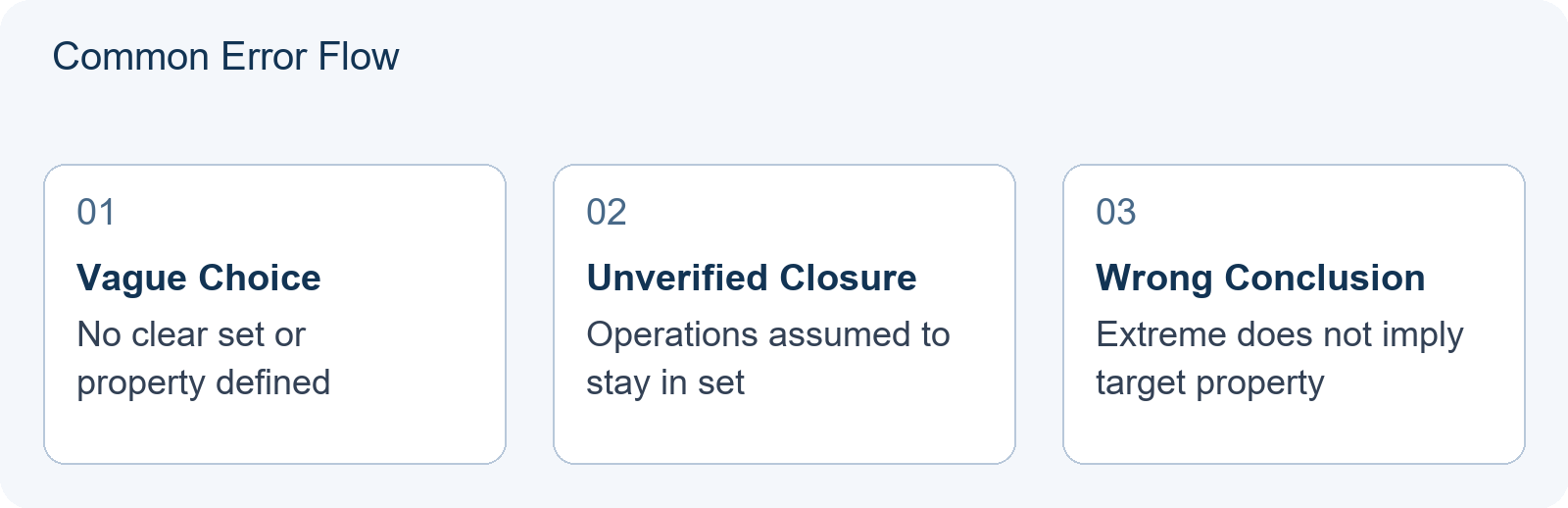
| Vague Selection | Saying “take the biggest number” without defining the set or proving the extreme exists. | Explicitly define S; state “S is finite and non-empty, so max(S) exists.” |
| Unverified Closure | Assuming operations on the extreme element stay in the set without verification. | Prove by induction or direct check that each derived quantity remains in the set. |
| Wrong Quantity | Extremizing a property that does not constrain the conclusion. | Test whether the extreme value’s definition relates to the target property. |
Practice Strategy for BMO Preparation
To internalize this technique, start with simpler combinatorial problems before tackling full BMO papers. Look for keywords like “maximum,” “minimum,” “longest,” or “shortest.” When you see them, pause and ask: “What happens if I pick the object that maximizes or minimizes this quantity?”
For structured preparation, review our guide on BMO Infinite Descent: How to Write a Complete Proof for complementary proof techniques. To understand where BMO fits in your broader mathematical journey, see BMO1 Past Papers Solutions: Requesting Worked Answers and Proof Feedback. For registration and deadline planning, consult BMO Registration China: Direct Entry Rules, Centre Finding, and Deadline Planning for 2026.
Remember, the goal is not just to solve the problem but to write a solution that convinces a skeptical reader. Clear definitions, verified closure properties, and logical flow are paramount.
Frequently Asked Questions
Is the extremal principle always applicable to BMO problems?
No, it is one of several strategies. It works best for problems involving optimization, existence, or discrete structures where boundaries constrain the system. Some problems require induction, invariants, or other techniques instead.
How do I know whether to choose the largest or smallest object?
Experiment mentally. Often, choosing the smallest leads to minimality contradictions, while the largest allows bounding arguments or direct structural conclusions. Try both if unsure, and verify which property propagates correctly through your problem’s constraints.
Does using the extremal principle guarantee full marks?
Not alone. You must clearly justify why the extreme element exists and rigorously prove the resulting implications. Marks are awarded for complete reasoning, not for naming the technique.