The single biggest shock for students moving up from the Senior Mathematical Challenge is that the British Mathematical Olympiad barely cares about your final answer. BMO Round 1 and Round 2 are marked on the full written proof — the logic, not the number. This guide explains how olympiad marking actually works and how international students can write solutions that earn marks instead of leaking them.
From answer-only to proof: what actually changes at the BMO
On the SMC you shade a box; the marker sees only whether it is right. On BMO1 — six problems over roughly 3½ hours — the marker reads every line you wrote and decides whether your argument is complete. That is a total inversion of what most students spend years optimising. A slick student who can find the answer to a hard problem in ninety seconds can still score almost nothing if they cannot prove, in writing, that the answer is correct and complete.
This trips up strong candidates from an answer-only background — including many who arrive from the AMC or AIME track — more than it trips up weaker ones, because the strong students trust their intuition and skip steps they consider “obvious”. In our editorial experience coaching China-based students, the fastest single improvement is not learning harder maths; it is learning to distrust the word “clearly” and to write down the step you were about to skip. If the competition itself is still new to you, read our overview of what the BMO is and how it works first, then return here for the marking detail.
How olympiad marking really works: the all-or-nothing tilt
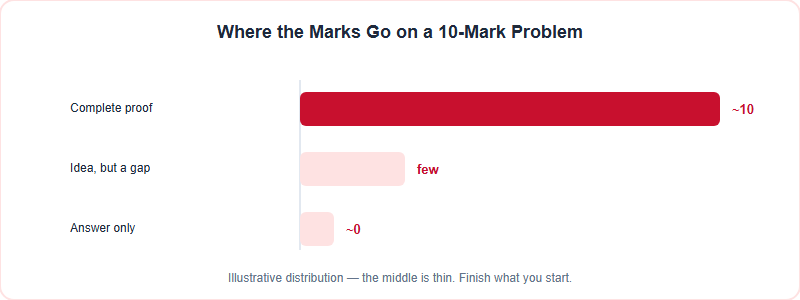
Each BMO problem is worth 10 marks (BMO1 totals 60 over six problems; BMO2 totals 40 over four — confirm current totals and mark schemes on ukmt.org.uk). The number that matters, though, is not the total but the shape of the mark distribution. Olympiad marking tends to be top-heavy and bottom-heavy at once: a complete, rigorous solution scores close to full marks, while a promising-but-incomplete attempt often scores only a little. The middle is thin. Markers are reluctant to award “half marks for a good idea” because a good idea that does not close is, mathematically, not a proof.
The practical consequence is stark and worth internalising: a nearly-finished proof and a barely-started one can score the same handful of marks. That is why examiners repeatedly advise finishing what you start. Three complete solutions beat six half-solutions almost every time. The table below is illustrative — every paper has its own mark scheme — but it captures the philosophy that decides who advances.
| What is on the page | Typical outcome (illustrative) | Why |
|---|---|---|
| Complete, rigorous proof, every step justified | Close to full marks | The argument is airtight and self-contained |
| Correct key idea, but a gap or an unjustified leap | Only a few marks | Progress is credited, but an incomplete proof is not a proof |
| Correct final answer, no valid reasoning | Little or nothing | BMO marks the proof, not the answer |
| "It is obvious that…" hand-waving over a real step | No credit for that step | An assertion is not an argument |
The anatomy of a full solution
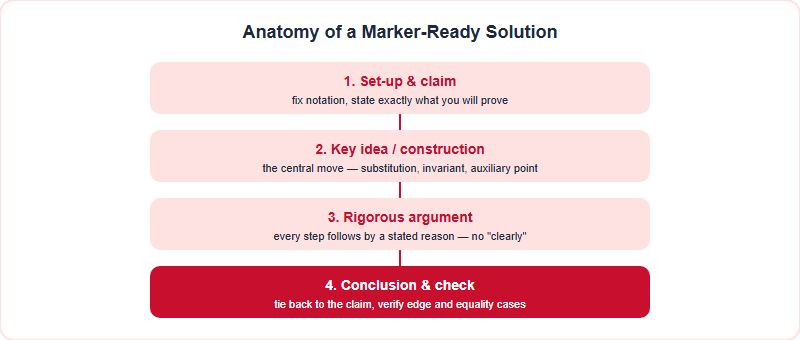
A solution that scores well almost always has the same four-part skeleton, whatever the topic. Writing to this shape does two things at once: it forces you to check your own logic, and it lets a tired marker follow you at speed.
- Set-up and claim. State what you are proving and fix your notation. Name the variables, define the objects, and say plainly what the target is ("We claim the smallest such n is…").
- The key idea or construction. Present the central move — the substitution, the invariant, the auxiliary point, the clever count. If a problem asks you to show something exists, actually construct it.
- The rigorous argument. Justify every step. This is where marks live and die: each line should follow from the previous one by a stated reason, not by hope.
- Conclusion and check. Tie the argument back to the claim, and verify edge cases — the boundary value, the equality case of an inequality, the "what if it equals zero" case. Unverified cases are the most common silent mark-loss.
Seven habits that quietly lose marks — and the fixes
Most lost marks are not from wrong maths; they are from good maths written badly. Watch for these:


- Skipping the "obvious" step. If it is obvious, it takes one line to write — so write it.
- Forgetting a case. Casework must be exhaustive. State that your cases cover everything, then handle each.
- Proving existence without construction. "Such a configuration exists" needs an example or a construction, not an assertion.
- Ignoring the equality case. With inequalities, showing when equality holds is often part of the proof, not an afterthought.
- Undefined notation. Every symbol you use must be introduced. A marker will not guess what your k is.
- Answer buried, no logic shown. Circle a final answer if you like, but the marks are in the paragraphs above it.
- Illegible cross-outs. If the marker cannot read it, it did not happen. Leave space and write your final version cleanly.
Practising with past papers and marking yourself honestly
Proof-writing improves fastest through a brutal feedback loop: attempt a real problem under timed conditions, then mark your own write-up against the official solution as if you were a hostile examiner. Do not ask "did I get the idea?" Ask "would this specific paragraph convince a stranger who is looking for reasons to give me zero?" Work from the genuine BMO past papers archive so that the difficulty and phrasing match the real thing, and read the official solutions twice — once for the method, once for how the rigour is written down.
A powerful drill for international students: after solving a problem, rewrite your solution a second time, cutting every unjustified line and adding every missing one. The gap between draft one and draft two is exactly the gap the marker sees. Do this weekly through the autumn and, by BMO1, writing a complete proof will feel like a habit rather than a scramble.
Frequently asked questions
Does the final answer earn marks on the BMO?
Very few. BMO Round 1 and 2 are marked on the written proof. A correct answer with no valid reasoning typically scores little or nothing.
How many marks is each BMO problem worth?
Each problem is standardly worth 10 marks. Confirm the current totals and mark schemes for each round on ukmt.org.uk.
Is it better to attempt all problems or finish a few?
Finish a few. Because middle marks are scarce, three complete proofs usually outscore six partial attempts.
How do I know if my proof is rigorous enough?
Give it to someone who has not seen the problem. If they cannot follow every line without you explaining, a step is missing.
This is an independent editorial guide operated by Hanlin Education for China-based international-school students. It is NOT affiliated with, endorsed by, or sponsored by UKMT or the BMO Subtrust. Competition formats, mark schemes and totals change each year — always confirm current details on ukmt.org.uk. Any factual error will be corrected within 7 working days.