Infinite descent turns a smallest positive solution into a contradiction by producing an even smaller positive solution to the same equation. Many BMO1 number theory attempts find a divisibility pattern, then stop. This guide shows how to complete the proof: choose the least solution, preserve integers, prove strict decrease, and close the argument. Two training examples demonstrate the full written structure.
What infinite descent actually proves
Infinite descent is a proof by contradiction built on well-ordering. If a set of positive integers has at least one element, it has a least element. To prove that an equation has no positive integer solution, assume one exists and choose a solution that is smallest in a carefully selected positive quantity. Then use the equation to manufacture a new positive integer solution whose selected quantity is strictly smaller. That contradicts minimality. The conclusion is not merely “the numbers look divisible”; it is that no positive solution can exist.
For written BMO-style work, the missing step is often the contradiction itself. The official UKMT BMO1 page confirms that BMO1 requires full written solutions to six problems, so a divisibility observation must be connected to a complete logical chain. Hanlin’s 2026-09-20 BMO briefing also notes that moving from short-answer competitions to proof writing is a key difficulty, especially filling missing steps and writing clearly.
A good written answer names the quantity being minimised. It also checks that the new tuple lies in the same class of solutions. These two sentences prevent the common gap where a divisibility chain is mistaken for a complete proof.
Example 1: no positive integers satisfy x² = 2y²
Claim: there are no positive integers x and y such that x2 = 2y2. This is a standard training example, not an official BMO question and not an original discovery.
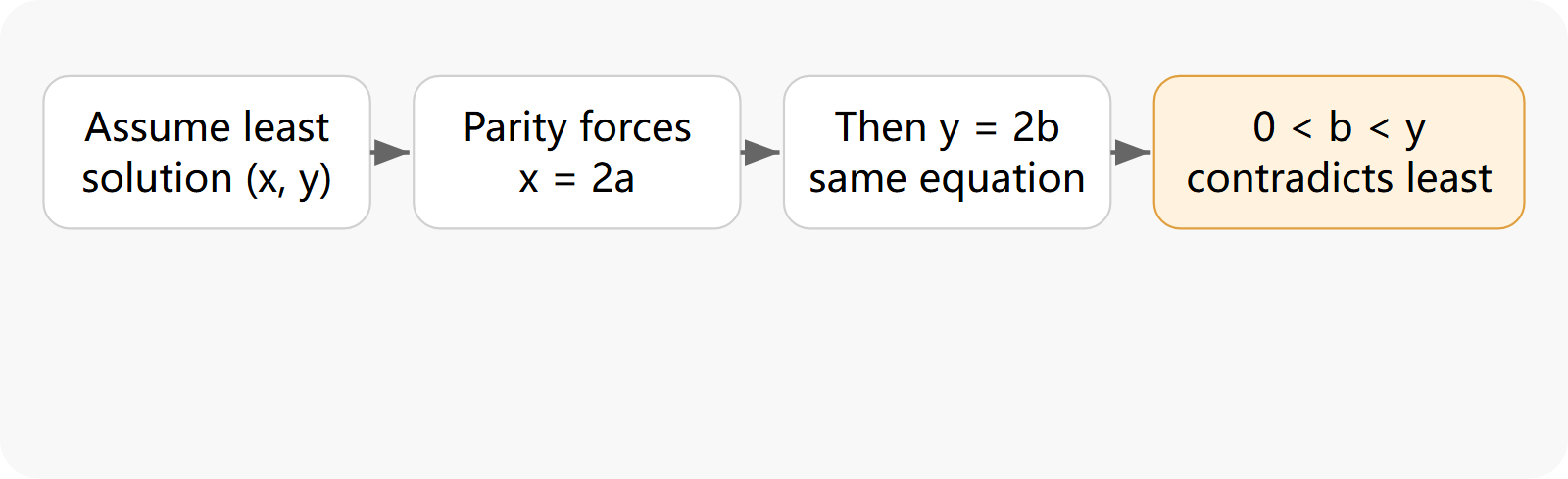
Assume a positive solution exists. Among all positive solutions, choose one with the least possible y. Write it as (x, y). The equation gives x2 = 2y2, so x2 is even. A square is even only when its root is even, hence x = 2a for some integer a. Substitution gives 4a2 = 2y2, so 2a2 = y2. Now y2 is even, so y is even. Write y = 2b. Then 2a2 = 4b2, hence a2 = 2b2.
At this point the descent must be checked, not assumed. Since x = 2a and y = 2b are positive, a and b are positive integers and 0 < b < y. The pair (a, b) satisfies the same equation a2 = 2b2. But b is a smaller positive y-value than the least y chosen at the start. This is impossible. Therefore the original positive solution cannot exist.
The reader should see the contradiction, not infer it. A short final sentence is enough: the assumed least solution cannot be least.
Example 2: no positive integers satisfy x² + y² = 3z²
Claim: there are no positive integers x, y, z such that x2 + y2 = 3z2. Again, this is a training example, not an official BMO question.
Assume a positive solution exists and choose one with least positive z. Squares modulo 3 are 0 or 1. If neither x nor y were divisible by 3, then x2 and y2 would each be 1 modulo 3, so their sum would be 2 modulo 3. But 3z2 is 0 modulo 3. If exactly one of x, y were divisible by 3, the sum would be 1 modulo 3, again impossible. Therefore 3 divides both x and y.
Write x = 3a and y = 3b. Substitution gives 9a2 + 9b2 = 3z2, hence 3(a2 + b2) = z2. This shows z2 is divisible by 3, so z is divisible by 3. Write z = 3c. Then a2 + b2 = 3c2. Because z is positive and z = 3c, c is a positive integer and 0 < c < z. The new triple (a, b, c) satisfies the same equation with a smaller positive third coordinate, contradicting the choice of least z. Hence no positive integer solution exists.


The same checks apply: a, b, and c are integers, positive, and the new triple is a genuine solution.
Why the smallest positive coordinate matters
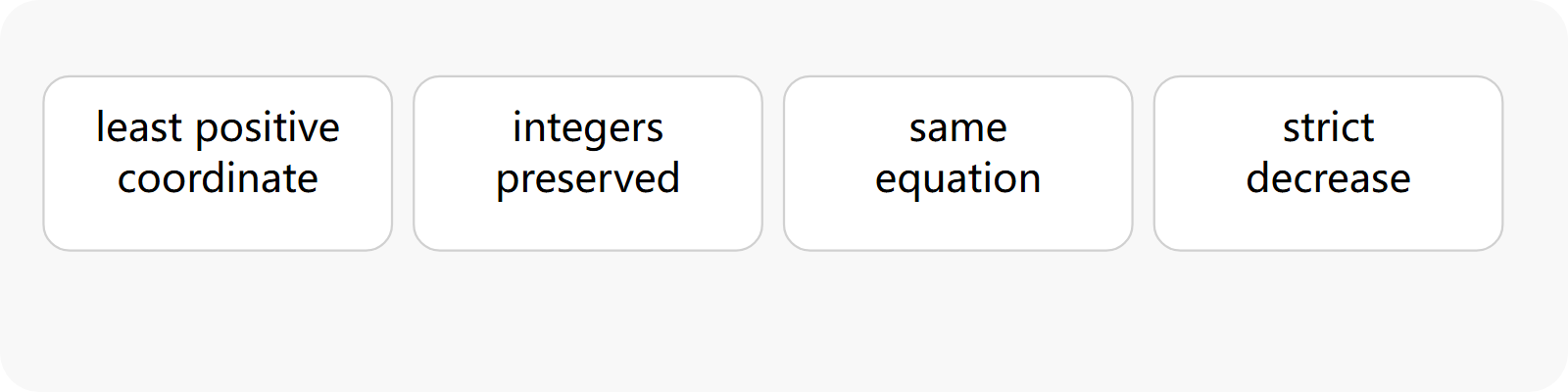
The descent must reduce a positive integer that is part of the solution. The new tuple must stay in the set over which minimality was chosen. Zero is smaller than a positive integer, but it cannot contradict a least-positive choice unless the new selected quantity is also positive. If a problem asks for nonnegative integers, handle the zero cases separately before applying descent. In x2 = 2y2, (0, 0) satisfies the equation, so the claim must specify positive integers. In x2 + y2 = 3z2, (0, 0, 0) also satisfies it. A nonnegative version needs an extra sentence: if z = 0, then x = y = 0; otherwise z is positive and descent applies. If the problem forbids the all-zero triple, the descent can target the least positive z.
This small separation is often the difference between a correct proof and a lost mark.
GCD proofs and descent are not the same
A primitive-solution proof often begins by assuming gcd(x, y) = 1 and then derives a contradiction from divisibility. That is a different logical structure. In descent, you do not start by assuming the solution is coprime. You start by assuming any positive solution exists and choosing one with least coordinate. A primitive-solution proof must justify reducing an arbitrary solution to a coprime one. For these homogeneous equations, dividing all coordinates by their common divisor supplies that justification. Omitting it leaves a logical gap; descent instead makes the least-coordinate choice explicit. The toolkit article on parity, moduli, and invariants explains why these methods can look similar; the marking guide shows why the final contradiction must be written; and the named-results article helps distinguish standard results from invented claims.
Faulty-proof checklist
- Did I state that a positive solution is assumed only for contradiction?
- Did I choose a least positive quantity, not an arbitrary one?
- Did I prove the new variables are integers, not rationals?
- Did I prove the new variables are positive, not merely nonnegative?
- Did I prove the new tuple satisfies the same equation?
- Did I prove the selected quantity strictly decreases?
- Did I finish by saying this contradicts minimality?
If any box is missing, the proof is incomplete.
Short self-test
Question: In the descent for x2 = 2y2, you have shown y = 2b and a2 = 2b2. Why is it not enough to say “b is smaller”?
Answer: You must also show b is a positive integer and that (a, b) is a solution to the original equation. Without positivity, b could be zero; without the same equation, the new pair may not belong to the set from which y was chosen minimal.
FAQ
What is infinite descent in BMO number theory?
Infinite descent is a contradiction proof. You assume a positive integer solution exists, choose a smallest one, and then produce a new positive integer solution with a strictly smaller chosen quantity. The contradiction shows no positive solution exists.
Why do students often lose marks with descent?
They find a divisibility pattern but omit the final minimality argument. Full written solutions need the chain: least positive solution, integer preservation, same equation, strict decrease, contradiction.
Can descent be used for nonnegative integers?
Yes, but zero cases must be handled separately. Descent usually needs a positive quantity that strictly decreases. If zero is allowed, prove the zero solution is impossible or exclude it before applying descent.
Source note: This guide is independent and not affiliated with, endorsed by, or sponsored by UKMT. Official UKMT source checked 2026-09-28: https://ukmt.org.uk/senior-challenges/british-maths-olympiad-round-1 confirms BMO1 lasts 3.5 hours, has six problems, and requires full written solutions. General observation about proof-writing difficulty is attributed to Hanlin’s 2026-09-20 BMO briefing.