We are not aware of any UKMT-published list of theorems you may quote without proof, so any table like this one is editorial judgement rather than a rule. What a table can do is separate the results that standard olympiad write-ups use as ordinary steps from the ones where checking the hypotheses is the whole problem — and show you what you still have to write down when you invoke a name.
There is no official list, so use this test instead
The question every student eventually asks — "am I allowed to just say Cauchy–Schwarz?" — has no published answer that we can find; treat any claim of an official list with suspicion. Round 1 gives you three and a half hours and six problems requiring full written solutions; Round 2, listed by UKMT for January 2027, gives four. Neither paper ships with a permitted-results appendix. Confirm anything you believe about marking practice on ukmt.org.uk rather than on a forum.
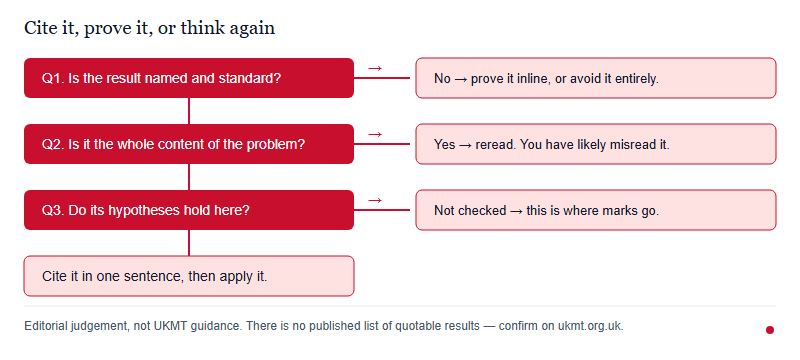
In the absence of a list, one test does most of the work. Ask: is the named result the content of this problem, or a step on the way to it?
- A step on the way. The problem is about something else and the theorem is a standard tool you reach for. Name it, check its hypotheses in writing, apply it, move on. This is what published solutions do constantly.
- The content itself. The problem is, in substance, an instance of the theorem, and quoting it collapses the question to one line. This is where citation stops being efficient and starts being circular. If a single named result makes a Round 1 problem trivial, the safest assumption is that you have misread the problem or that the setter expects the argument, not the label.
The second case is rarer than students fear and the first is more common than they hope. In practice the greater risk around named results is not citing something you should have proved. It is citing something whose hypotheses you never checked. If you are still building a picture of what each round expects from a written solution, our overview of what the British Mathematical Olympiad is covers the shape of the papers.
The lookup table, by topic
"Treat as standard" below means: in ordinary olympiad write-ups this result is used as a step without reproving it. It is a description of convention, not a permission slip. The right-hand column is the part students skip, and it is the part that carries the risk.
| Topic | Named result | Treat as standard? | What you must still write |
|---|---|---|---|
| Algebra | AM–GM inequality | Yes | State that the variables are non-negative. Say which n you are applying it to, and name the equality case if you need it. |
| Algebra | Cauchy–Schwarz | Yes | Write the two sequences explicitly. The choice of sequences is the mathematical content, so it must be visible. |
| Algebra | Triangle inequality | Yes | Nothing beyond correct application, including the reverse form if you use it. |
| Algebra | Jensen’s inequality | With care | Justify convexity or concavity on the interval in question. Asserting it is where this one goes wrong. |
| Algebra | Rearrangement inequality | With care | State the ordering assumption on both sequences before applying it. |
| Algebra | Muirhead, Schur, power mean | Risky | State the exact form you are using, including majorisation or symmetry conditions. Often faster to argue directly. |
| Algebra | Vieta’s formulas, factor theorem, binomial theorem | Yes | Say what the coefficients and roots are. For the factor theorem, name the ring or field you are in if it matters. |
| Number theory | Fermat’s little theorem | Yes | State that p is prime and that p does not divide a. Both conditions, in writing. |
| Number theory | Euler’s theorem | Yes | State that a and n are coprime, and give the value of the totient you are using. |
| Number theory | Chinese remainder theorem | Yes | State that the moduli are pairwise coprime. |
| Number theory | Bézout’s identity, Euclid’s lemma, unique factorisation | Yes | Little: these are foundational. Euclid’s lemma needs the divisor to be prime, so say so. |
| Number theory | Wilson’s theorem | With care | State it correctly and note the primality condition. Rarely the intended route, so check you are not overcomplicating. |
| Number theory | Lifting the exponent, orders modulo n | Risky | State the full hypotheses. Lifting-the-exponent conditions differ for p = 2, and that case is where scripts fail. |
| Geometry | Circle theorems: angle at centre, angles in the same segment, cyclic quadrilateral, alternate segment | Yes | Name the theorem and the circle. The risk is configuration, not the theorem. |
| Geometry | Power of a point | Yes | Say whether the point is inside or outside the circle, and keep the signs or lengths consistent throughout. |
| Geometry | Sine rule, cosine rule, similar triangles | Yes | Identify the triangle. For similarity, state the criterion you are using. |
| Geometry | Ptolemy, Ceva, Menelaus | With care | State the configuration precisely, including which points lie on which segments and any directed-ratio convention. |
| Geometry | Euler line, nine-point circle, radical axis | With care | State the version you are using. Degenerate cases — equilateral, right-angled, collinear centres — need a sentence. |
| Combinatorics | Pigeonhole principle | Yes | Define the pigeons and the holes explicitly. That definition is the proof; the principle is not. |
| Combinatorics | Inclusion–exclusion, handshake lemma | Yes | Define the sets or the graph. For handshake, say what the vertices and edges represent. |
| Combinatorics | Invariants, monovariants, extremal principle | Method, not theorem | Everything. Define the quantity, prove it is invariant or monotone, then draw the conclusion. |
The three sentences that make a citation count
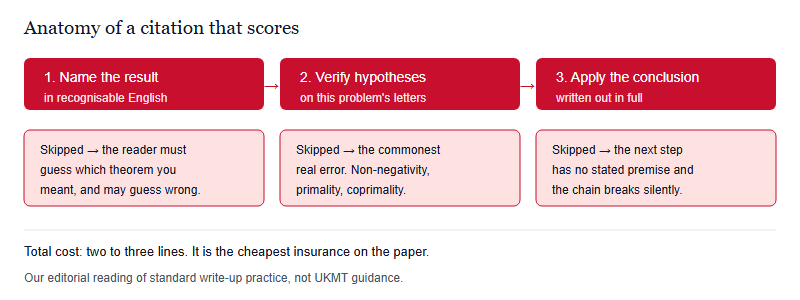
A citation that scores has the same three parts every time, and it fits in two or three lines. Write them in this order and the hypothesis check happens automatically, because there is a slot for it.
- Name it. In English, spelled recognisably. A marker reading at speed should know within four words which result you are invoking.
- Verify the hypotheses on this problem’s objects. Not in general — here, with the letters of this question. "Since a, b, c are positive reals…", "Since p is prime and p does not divide a…"
- Apply the conclusion, written out. State the inequality or congruence you now have, rather than gesturing at it, so the next line of your argument has something to stand on.
A worked shape, with the mathematics left generic: "Since x, y and z are positive reals, AM–GM applied to the three terms gives x + y + z ≥ 3(xyz) to the power one third, with equality if and only if x = y = z. Substituting the constraint xyz = 1 gives x + y + z ≥ 3." Three clauses: name, hypotheses, conclusion. The reader never has to reconstruct what you meant, and the equality case is on the page for when the problem asks about it.
Results that are faster to prove than to cite
Some facts sit in an awkward band: real enough to have a name in a textbook, small enough that proving them costs less than the sentence explaining which version you mean. Prove these inline and remove the question entirely.


- Two-variable AM–GM. One line: (a − b)² ≥ 0 rearranges to what you want. Nothing to check, nothing to name.
- The sum of the first n positive integers, or of the first n squares. Quote the formula and, if it carries weight in your argument, add the one-line induction.
- Parity facts such as the product of two consecutive integers being even. Three words of justification, not a citation.
- Small divisibility observations — that a square is 0 or 1 modulo 4, or 0, 1 or 4 modulo 8. Prove by cases in a line; it is more convincing than a name.
- Anything you can only half-remember. A misstated theorem is worse than no theorem, because the argument built on it is now wrong rather than incomplete.
The reverse habit is worth building too: when you read a published solution and see a result invoked in one clause, note the clause. Reading how an official solution phrases its citations is a faster route to the convention than any table, and our guide to the past-paper pack and how to use it covers how to work through solutions without burning the papers you still want to sit.
What you may never assume
Five things sit outside the whole discussion. None of them becomes citable by being obvious.
- The claim you were asked to prove. It appears in disguised form more often than you would think, usually as an intermediate step that quietly presupposes the conclusion.
- Configuration facts in geometry. That a point lies inside a triangle, that a line meets a segment rather than its extension, that a quadrilateral is convex. If the argument depends on it, it needs a sentence or a separate case.
- That your construction is optimal. Finding a good example proves the bound is attainable, not that it cannot be beaten. That is the second obligation of every optimisation problem.
- Symmetry, invoked as "without loss of generality". The phrase is legitimate, but only after you say which symmetry of the problem lets you reorder or relabel. Used as a shortcut past an asymmetric case, it is an error wearing formal clothes.
- The words "clearly", "obviously" and "it is easy to see". They do not transfer belief to a reader. If a step really is immediate, the justification is short, so write it.
These conventions do not vary by country. The same standard applies whether the script is written in a UK school hall or at a registered centre overseas — a point worth keeping in mind when comparing your write-ups against published solutions, and one covered from the administrative side in our eligibility reality check for international students.
Common questions
Is there an official UKMT list of theorems I can quote?
Not one we are aware of. Treat every table, including this one, as convention rather than rule, and confirm marking practice on ukmt.org.uk.
Will I lose marks for citing something obscure?
The risk is misstating it, not naming it. If you cannot state the hypotheses precisely, argue directly instead.
Do I need to prove standard circle theorems?
No. Name the theorem and the circle. In geometry the marks turn on configuration and case analysis, not on reproving school results.
Can I quote a result I proved earlier in the same script?
Yes. Label it as a lemma, prove it once, and refer back to that label whenever you use it again.
This is an independent editorial guide operated by Hanlin Education for China-based international-school students. It is not affiliated with, endorsed by, or sponsored by the UK Mathematics Trust or the BMO Subtrust. Competition formats, dates and marking practice are set by UKMT and change between cycles — confirm current details on ukmt.org.uk before relying on them. We are not aware of a UKMT-published list of results that may be quoted without proof; the lookup table, the risk ratings and the citation template here are our editorial judgement based on standard olympiad write-up practice, and no table can bind how an individual script is assessed. Errors reported to our editorial desk are corrected within 7 working days.