For the 2026-27 BMO1 cycle, the safest angle-chasing habit is simple: before you add an auxiliary circle, write down the configuration. Name the line, record which side of it each key point lies on, state the order of points along any line you use, and say whether the quadrilateral you are naming is convex in that order. Hanlin Courses’ 15 October 2026 article 2026 BMO Maths Olympiad: 9 November registration deadline — G5 STEM applicants, don’t miss it lists circle laws, including the alternate segment theorem, among BMO1 geometry preparation topics. The same article stresses that BMO1 requires complete logical steps, so a diagram-dependent assertion must be justified in the written proof. The British Mathematical Olympiad official home is the BMOS site at bmos.ukmt.org.uk; this article is a teaching analysis, not an official ruling.
Quick answer: the audit comes before the circle
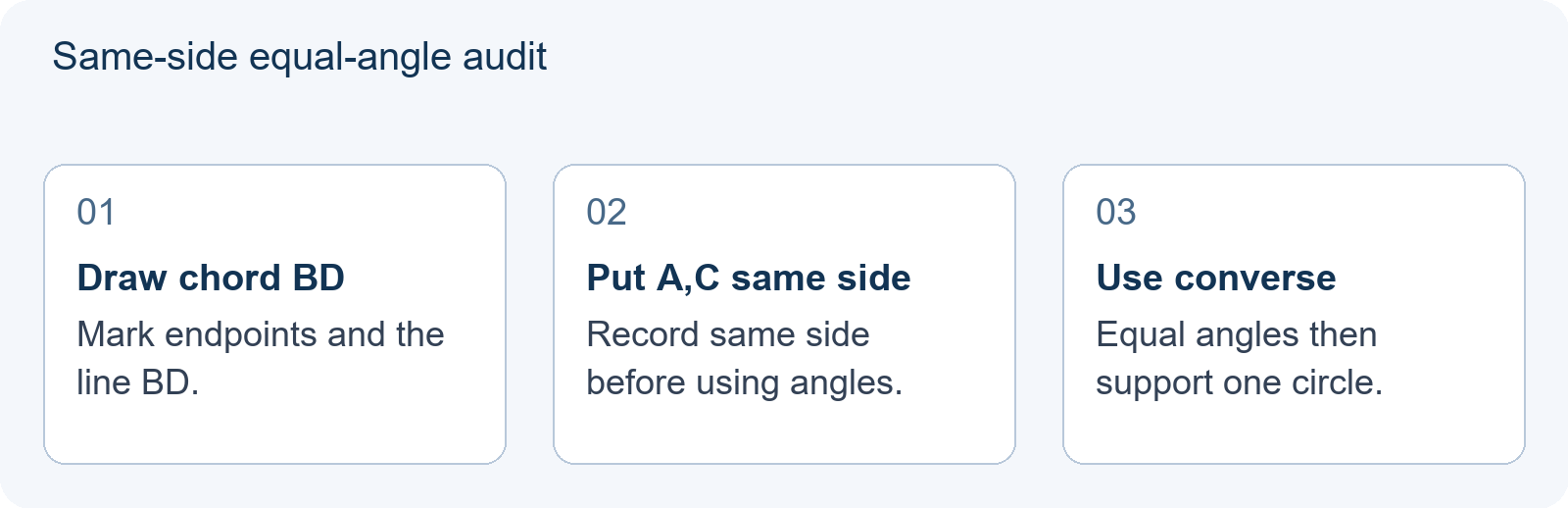
A BMO1 angle chase often fails not at the algebra but at the first legal move. A student sees two equal angles, remembers that equal angles can imply concyclicity, and adds a circle. That is only safe after checking the side condition. For a chord BD and two angle vertices A and C, the ordinary-angle statement has two forms. If A and C are on the same side of line BD and ∠BAD = ∠BCD, the converse of the same-segment theorem supports the claim that A, B, C and D lie on one circle. If A and C are on opposite sides, the cyclic case requires ∠BAD + ∠BCD = 180°; equality alone is not enough, though the special case 90° + 90° is both equal and supplementary. The audit is therefore not red tape. It decides which theorem you are allowed to use.
What the configuration audit checks
Use a three-row audit before the first auxiliary construction. The point is not to write an essay on the diagram; it is to make the hidden assumption visible while it is still cheap to repair.
| Assumption to record | What can go wrong | Legal conclusion to check |
|---|---|---|
| Side of a chord | Two equal angles are treated as a cyclic criterion even though the vertices lie on opposite sides of the chord. | Same side: equal angles can support concyclicity. Opposite sides: supplementary angles are required. |
| Order along a line | The diagram shows a point on a line, but the proof uses it as if it lies between two other points. | Betweenness affects which angle is interior, which segment is used, and whether an angle is ordinary or directed. |
| Convex or crossed quadrilateral | Opposite angles are added to 180° in a naming order that does not match the convex cyclic order. | Name the cyclic order explicitly, or switch to directed angles and translate back with a side/order sentence. |
This is the same discipline that separates a safe auxiliary circle from a speculative one in BMO Geometry Auxiliary Construction: Choosing Between Circle and Line. The question is not whether a circle looks helpful. The question is whether the configuration gives you a legal chord and a legal angle relation.
Why ‘equal angles subtend the same chord’ is conditional
The phrase is a shorthand, and shorthand is where proofs break. For a fixed chord BD, points on the same arc of a circle through B and D subtend equal angles at the chord. The converse is also true in the same-side case: if A and C are on the same side of line BD and the angles are equal, then A, B, C and D are concyclic. The side condition is doing real work.
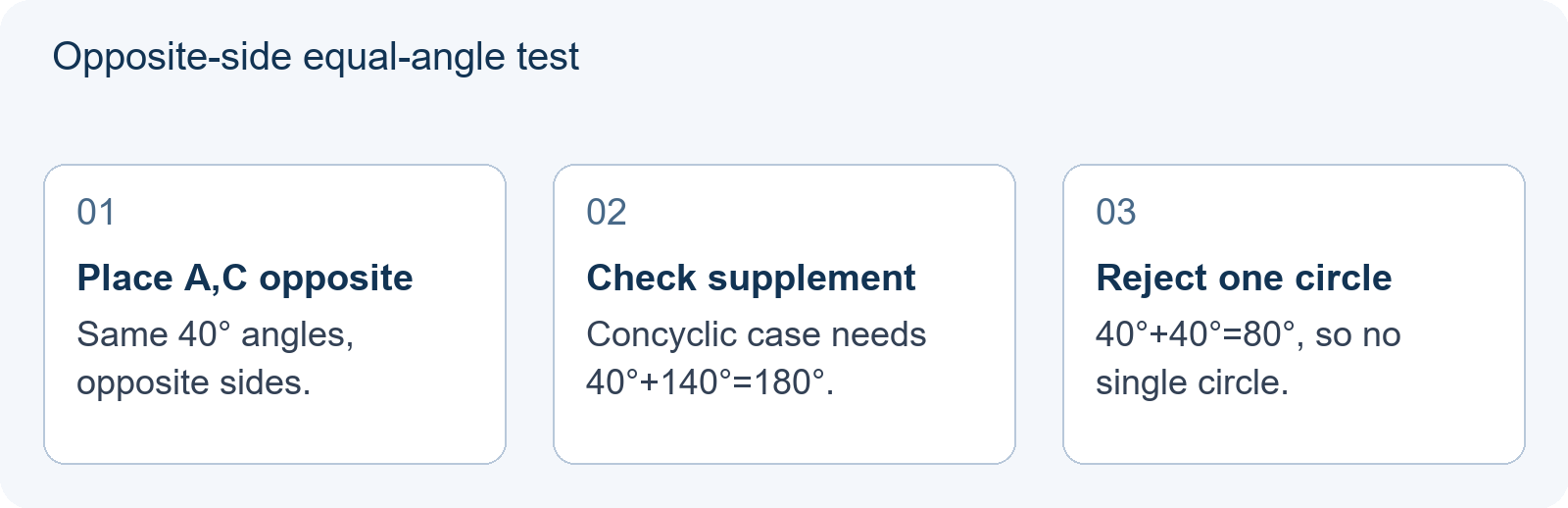
On opposite sides, the geometry changes. If A and C are both on one circle through B and D but on opposite arcs cut off by chord BD, then the two angles are supplementary. Equal 40° angles would require 40° + 40° = 180°, which is false. So the equal-angle data cannot place all four points on one circle in that configuration. The equal angles may still be useful, but they point to two mirror arcs, not one cyclic quadrilateral.
This is also why an angle chase can look correct in the drawn diagram and still be incomplete in the write-up. The diagram may show the same-side case without saying so. The examiner cannot infer the side condition from a sketch. A single sentence, such as ‘A and C lie on the same side of BD, so the equal angles give concyclicity by the converse of the same-segment theorem’, turns a diagram-dependent assertion into a proof step.
Teaching illustration: same chord, same 40° angles, two different conclusions
Teaching illustration, not an official BMO question. Let B and D be distinct points, and let A and C be distinct points not on line BD. Suppose ∠BAD = ∠BCD = 40°.
- Same-side case. If A and C are on the same side of line BD, the same-segment converse supports the claim that A, B, C and D lie on one circle. The equal 40° angles are consistent with both vertices seeing chord BD from the same segment.
- Opposite-side case. If A and C are on opposite sides of line BD, the equal 40° angles do not give one circle through all four points. In a cyclic quadrilateral, the relevant opposite angles would be supplementary. Here 40° + 40° = 80°, not 180°, so the cyclic criterion fails.
The contrast is deliberately small. The numbers are the same; only the side condition changes. That is exactly the kind of hidden assumption a BMO1 proof cannot leave unstated. The illustration is not a counterexample to a theorem. It is a check on which theorem applies.
Directed angles: a compact notation, not a substitute for the side condition
Directed angles modulo 180° can make a proof shorter because they absorb some case distinctions. They do not remove the need to know the configuration. If you use directed angles, write the equality cleanly, then add the sentence that translates back to the ordinary angle you need. For example: ‘Using directed angles modulo 180°, the equality holds. Since A and C are on the same side of BD, this gives ∠BAD = ∠BCD as ordinary angles, so A, B, C and D are concyclic.’


Without that final sentence, a reader may not know whether you are using the same-side form or the supplementary-angle form. The Hanlin Courses note’s emphasis on complete logical steps is relevant here: a directed-angle symbol is not a magic licence to omit the configuration. It is a notation, not a proof by itself.
When to add an auxiliary circle and when to switch to trigonometry
Add a circle when the target is a circle relation or an angle relation, and when you can name a chord plus two angle vertices whose side condition you have checked. Switch away when the circle would introduce a chord with no connection to the given lengths or when the target is a ratio that a trigonometric relation handles directly.
| What the target asks | First move to consider | Reason |
|---|---|---|
| Prove four points are concyclic | Audit side/order, then use equal or supplementary angles | The cyclic criterion is configuration-sensitive. |
| Use a known circle to get an angle equality | Identify the chord and the same segment | The circle must already be justified, not assumed from the sketch. |
| Prove a length ratio or a product relation | Compare sine rule, cosine rule or power of a point | A circle may add a chord that is not connected to the given lengths. |
| Prove collinearity or parallelism | Try directed angles before adding a circle | A circle can obscure a simpler angle chase. |
If the target is a length ratio, compare BMO Trigonometry: When a Geometry Proof Needs Sine Rule Before an Auxiliary Line before forcing a circle into the diagram. The decision is not about which tool is more advanced. It is about which tool has a legal entry point in the configuration you have actually proved.
Five-question diagnostic before the first line of proof
- Which points lie on each relevant line, and in what order?
- For each chord I plan to use, are the two angle vertices on the same side or opposite sides?
- Is the quadrilateral convex in the order I am naming, or am I using a crossed order?
- Have I distinguished directed angles from ordinary angles, and written the translation sentence?
- Does the target need concyclicity, an angle equality, or a length relation?
If any answer is ‘it looks like that in the diagram’, stop and write the assumption. A BMO1 proof cannot rely on the reader seeing the same sketch you saw. The BMO1 Readiness Self-Audit: Score Yourself Out of 40 and Fix the Right Thing First can help you decide whether configuration errors or proof-writing gaps are costing more marks in your current practice.
Preparing a diagram for feedback or a course-fit conversation
If you ask for geometry feedback, send a clean diagram with points labelled in the same order used in your proof, a one-line list of side and order assumptions, and your written angle chase up to the disputed step. That lets a teacher respond to the configuration error rather than rewriting the problem. For a preparation conversation, bring your current BMO1 practice set and the exact point where the diagram stopped matching the text. This is more useful than a general request for ‘geometry help’ because it shows whether the issue is theorem choice, configuration checking, or written justification.
What to remember
BMO1 angle chasing is not only about finding equal angles. It is about earning the right to use them. Before you add an auxiliary circle, record the side of the chord, the order along the line, and the convex or crossed order of the quadrilateral. Equal angles in the same segment can support concyclicity. Equal angles on opposite sides generally do not; the cyclic case needs supplementary angles. That single audit prevents a correct-looking diagram from becoming an invalid proof.
This is an independent preparation guide, not affiliated with, endorsed by, or sponsored by UKMT.
Frequently Asked Questions
Do equal angles always prove four points are concyclic?
No. For chord BD, if A and C are on the same side of line BD and the angles are equal, the same-segment converse can support concyclicity. If A and C are on opposite sides, the cyclic case requires supplementary angles; equal angles alone are not enough, though 90° + 90° is both equal and supplementary. The side condition must be checked.
Should I use directed angles in BMO1 geometry?
Directed angles modulo 180° can shorten a proof and reduce case splits, but they are notation rather than a substitute for the configuration. When you return to ordinary angles, add the sentence that explains which side or order condition makes the translation valid. BMO1 marking expects complete logical steps.
When should I add an auxiliary circle instead of using trigonometry?
Add a circle when you can name a chord and two angle vertices whose side condition you have checked, and when the target is a circle or angle relation. If the target is a length ratio and the circle would introduce a chord unrelated to the given lengths, compare a sine-rule or cosine-rule route first. This is a coaching judgment, not an official rule.