Why Proof-Based Solutions Differ from Answer Keys
BMO1 is not a multiple-choice contest. According to UKMT requirements, candidates must produce complete written solutions and proofs; merely writing an answer earns no credit (Source: 2026 BMO Registration Opens! 3.5 Hours, 6 Problems…, 2026-09-20). This transforms how you should use past papers. A solution that only states “the answer is 42” or sketches a partial argument wastes the problem. What you need is a worked proof that exposes the logical structure: how the solver recognised the approach, why each step is valid, and how the conclusion follows necessarily from the premises.
Official UKMT marking schemes for BMO1 allocate marks for method as well as final answers. A complete solution therefore shows not just correctness but the quality of mathematical reasoning. When searching for BMO1 past papers solutions, distinguish between documents that merely list answers and those that model the full prose proof UKMT expects.
Mapping Available Solution Years: Official, Unofficial, and Gaps
Solution availability for BMO1 is uneven across years. Understanding this landscape prevents wasted search time and sets realistic expectations.
Official UKMT Releases
UKMT publishes past papers and some supporting materials through its official channels. The UKMT website and BMO resources page serve as primary reference points for authentic problems. However, full worked solutions written out in pedagogical detail are not always released for every year. Official materials tend to emphasise problem statements and marking guidelines over step-by-step expositions.
Third-Party Coverage
Various educators and organisations produce unofficial solutions. Quality varies significantly: some faithfully reproduce competition-level reasoning; others contain errors or skip non-obvious steps. The Hanlin preparation perspective treats third-party solutions as supplementary, not authoritative. Students should cross-reference claims against official problem statements and be alert to solutions that seem to reach correct conclusions via questionable logic.
Known Gaps
Certain older BMO1 papers lack detailed solution coverage in any format. For these years, students must rely on peer discussion, mentor guidance, or their own extended effort. Rather than viewing this as a barrier, treat gap years as opportunities to develop independent proof-writing stamina.
The Hanlin Pack Scope: Recent Years with Video Walkthroughs
Hanlin offers a confirmed resource for recent BMO1 preparation: BMO Round 1 past papers from the last three years accompanied by video analysis (Source: 2026 BMO Registration Opens! 3.5 Hours, 6 Problems…, 2026-09-20). These materials focus on proof walkthroughs rather than answer keys, aligning with UKMT’s emphasis on complete written solutions.
The video format suits BMO1’s particular demands. Viewers can observe how experienced solvers structure proofs, manage time during the 3.5-hour examination, and present arguments with appropriate rigour. This addresses a common student difficulty: knowing that a proof is correct but uncertain whether the written form satisfies competition standards.
Students interested in accessing these materials should consult Hanlin’s course inquiry channels for current availability and specific year coverage. The pack contents correspond to selected recent years only; it does not constitute a comprehensive historical archive.
Self-Diagnosis Before Solution Access: A Five-Question Readiness Check
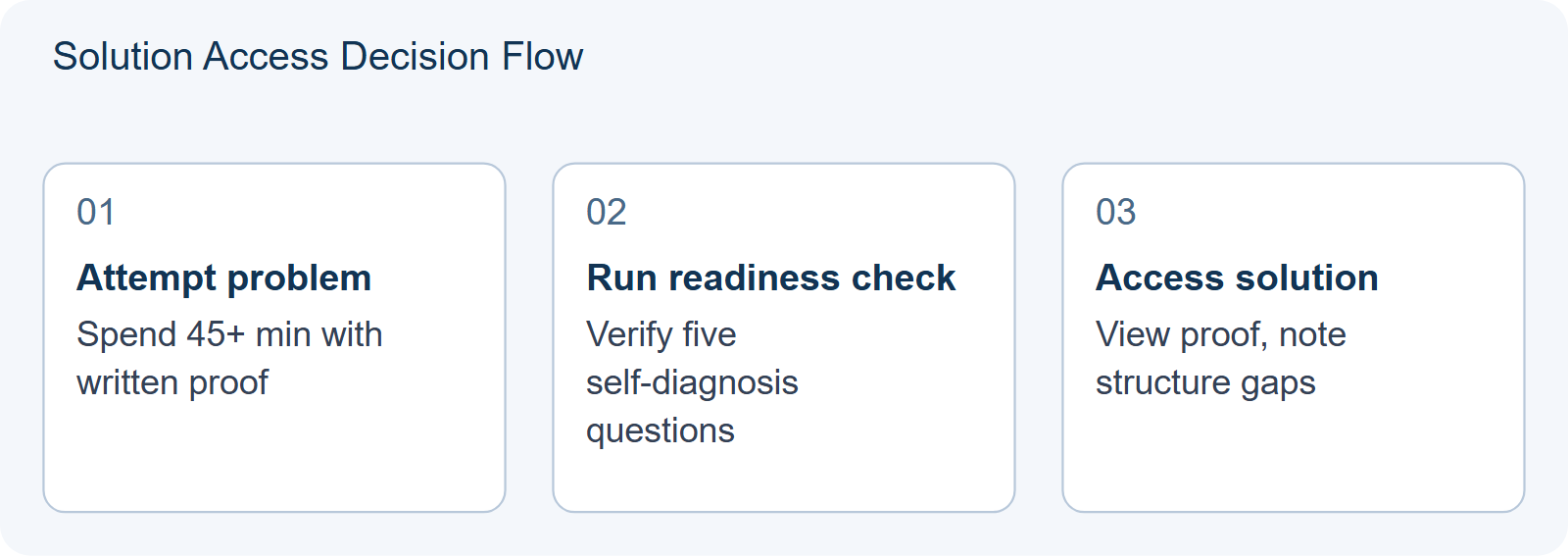
The greatest risk with BMO1 past papers solutions is premature access. Reading a proof before genuine struggle eliminates the problem’s developmental value. Apply this protocol before viewing any solution:
- Have I spent at least 45 minutes on this problem? BMO1 problems reward sustained engagement. Shorter attempts rarely penetrate to the core insight.
- Can I articulate what makes this problem difficult? If you cannot identify the obstacle, you have not yet engaged deeply enough.
- Have I produced at least one complete written attempt? Even failed proofs reveal gaps in your reasoning that solutions alone cannot address.
- Can I verify or refute my own conjectures? Testing small cases and searching for counterexamples builds the mathematical habits BMO1 rewards.
- Am I seeking confirmation or education? Confirmation-seeking (“was I right?”) warrants brief checking; education-seeking requires deeper prior work.
Only when all five conditions are met should you consult external solutions. This discipline preserves the problem’s value as a learning instrument.


Hint Extraction: Recovering Partial Learning When Full Solutions Are Unavailable
When complete solutions are unavailable—as occurs for some years and certain problems—hint extraction becomes essential. Instead of requiring full proofs, extract strategic guidance:
- Identify the problem’s subject area (number theory, geometry, algebra, combinatorics) and relevant theorems
- Seek statements of what does not work, narrowing the search space
- Request verification of whether your partial progress is on a productive path
- Ask for analogous problems whose solutions might illuminate the current obstacle
This approach maintains productive struggle while preventing complete stagnation. It also develops metacognitive skills: the ability to monitor your own problem-solving process and diagnose where it falters.
Building Your Personal Solution Archive
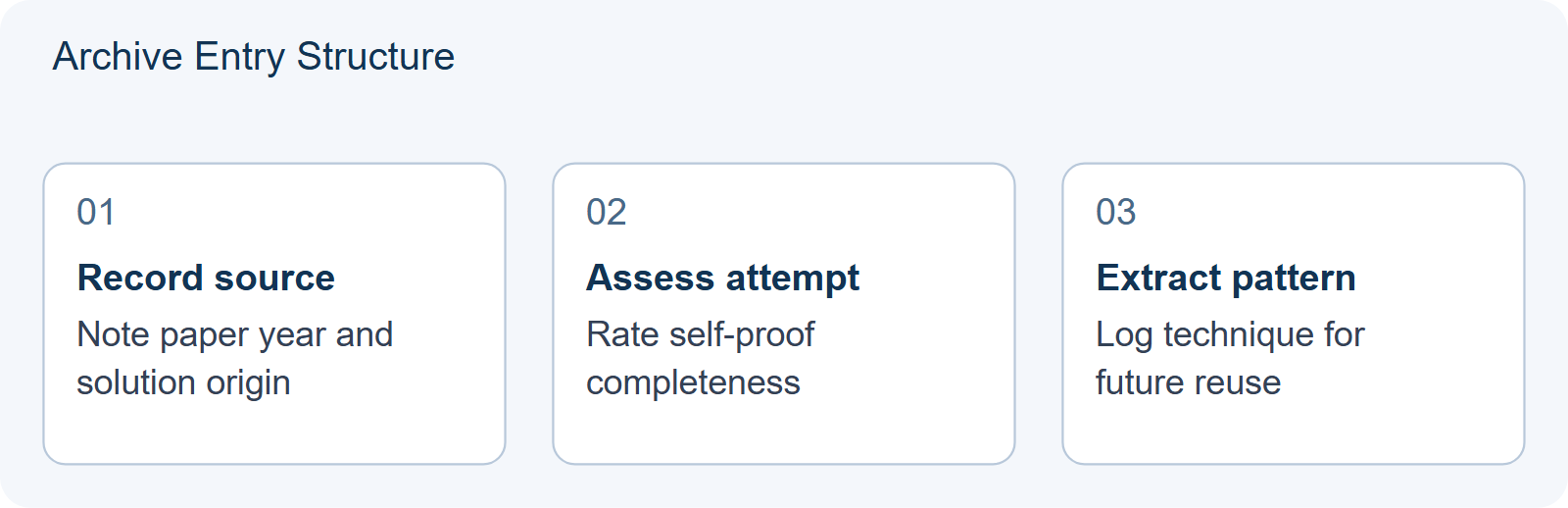
Systematic tracking prevents redundant searching and reveals patterns in your development. Maintain records with this structure:
| Year | Paper Access | Solution Source | Self-Attempt Quality | Key Learning |
|---|---|---|---|---|
| Example: 2025 | Official UKMT | Hanlin video + own notes | Full proof, 2 errors | Induction setup in Q3 |
Over time, this archive reveals which years lack coverage and where to focus future search effort. It also documents your proof-writing evolution, providing concrete evidence of progress when motivation wavers.
Preparing for Consultation: Course-Fit and Resource Requests
If you are considering structured support for BMO1 preparation, prepare efficiently before contacting any programme:
- Inventory your current paper collection: List which years you have attempted, which solutions you possess, and where gaps remain
- Identify your proof-writing bottleneck: Is it finding initial approach, completing rigorous arguments, or presenting solutions clearly?
- Specify your solution-access needs: Whether you require video walkthroughs, live feedback on written attempts, or help with particular gap years
- Clarify timeline constraints: BMO1’s November date limits how many papers you can deeply process; prioritise accordingly
This preparation enables productive conversation about whether specific resources match your situation. For Hanlin’s current BMO offerings, including the BMO preparation programmes and related competition mathematics resources, direct inquiry through official channels will yield the most accurate information.
Related Reading
For the complete inventory of BMO1 and BMO2 papers, see our BMO Past Papers pack overview. For general problem-solving protocols applicable across mathematical competitions, refer to our article on structured practice methodology.
Note: BMO (British Mathematical Olympiad) is organised by UKMT (United Kingdom Mathematics Trust). Hanlin is an independent preparation provider and is not affiliated with UKMT.
Frequently Asked Questions
Does Hanlin provide solutions for all BMO1 years?
No. Hanlin offers video analysis for BMO Round 1 papers from the last three years. Earlier years are not covered in this pack. Students seeking solutions for additional years should consult official UKMT materials, third-party resources, or develop independent proof capabilities.
Why can't I find official UKMT worked solutions for every problem?
UKMT releases problem statements and marking schemes, but detailed pedagogical solutions are not published for all years. This is standard practice for many olympiad competitions. The absence of official solutions encourages independent development of proof-writing skills rather than passive solution consumption.
How do I know if my proof would receive full marks without official marking?
Compare your proof against the logical completeness of published solutions: does it justify every non-obvious step? Does it address all cases? Does it conclude unambiguously? For definitive assessment, seek feedback from experienced competition mentors or structured programmes that offer proof review.