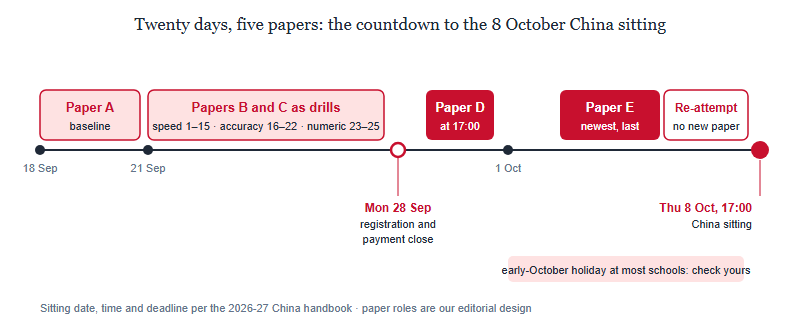
With twenty days left before the China-region SMC sitting on Thursday 8 October 2026, use five past papers at most: an older one now as a baseline, two older ones split into drills, a recent one at 17:00 on a school day, and the newest held back for a final rehearsal. Because this year’s last three questions take a 000–999 answer, convert every all-multiple-choice paper by covering the options on its final three questions.
The paper budget: what twenty days can actually absorb
A Challenge paper costs more than its 90 minutes. The sitting is the cheap half; the review — re-attempting every wrong and blank question before looking at a solution, then naming why each mark went — takes at least as long again. Budget three hours per full paper and the arithmetic of the next three weeks becomes very concrete.
| Honest hours per week until 8 October | Full papers you can sit and review | What to do with the rest of the time |
|---|---|---|
| 3 to 4 | 3 | Use two older papers as drills instead of full sittings |
| 5 to 6 | 4 | One drill paper, split into the three sets described below |
| 7 or more | 5, and no more | Re-attempt old mistakes; a sixth paper usually goes unreviewed |
Which papers you have matters less than how you order them. Per the 2026–27 China handbook summarised in our season decode, the China-region entry fee covers reference past papers along with entry, marking and certificates, though how many reference papers you receive, and when, should be confirmed with the organising channel. The ordering rule is the one our BMO past-paper ladder uses for olympiad papers: older papers are for diagnosis and drills, and the newest paper is the closest proxy for the real thing, so it is spent last.
The triage table: which paper on which day
Find today’s row. If you are starting later than 18 September, drop rows from the top rather than squeezing all five papers into fewer days — the final rehearsal and the review days are the part that must survive.
| When | Paper | How to sit it | What to record | Move on when |
|---|---|---|---|---|
| Fri 18 – Sun 20 Sep | A: an older paper | Full 90 minutes, all 25 questions, options covered on 23–25 | Score, number attempted, clock time at question 15 and at question 22 | You have all four numbers written down. The baseline is a measurement, not a verdict |
| Mon 21 – Sun 27 Sep | B and C: older papers | Not full sittings. Split each into a speed set (1–15), an accuracy set (16–22) and a numeric set (23–25, options covered), using the clock times from paper A as your targets | For each set: correct, wrong, blank, time taken | Your weakest set is obvious. Spend the extra drill time there |
| Mon 28 Sep | — | China-region registration and payment close (RMB 240, per the handbook) | Confirmation that your entry is in | Do not start paper D until this is done |
| Tue 29 – Wed 30 Sep | D: a recent paper | Full 90 minutes starting at 17:00, after a normal school day, plain rough paper only | Score, attempted, both clock times, and how the last 20 minutes felt | Review completed the same evening or the next |
| Sat 3 – Mon 5 Oct | E: the newest paper | Full rehearsal under the paper’s own rules, at 17:00 if you can | The same numbers as paper D, side by side | This is the last new paper before the sitting |
| Tue 6 – Wed 7 Oct | None | Re-attempt every question you lost on papers A to E, untimed | A one-page list of your three commonest ways of losing marks | The list fits on one page |
| Thu 8 Oct | The real paper | China sitting 17:00–18:30, per the handbook | Nothing. Reconstruct the paper that evening, while you remember it | — |
Converting old papers for the three 000–999 questions
UKMT’s competition page describes this year’s paper as 22 multiple-choice questions and three 000–999 digit questions, and says the change to the last three is being trialled this year; the China handbook describes the same split, with answers from 0 to 999. Every paper printed before this change offers lettered options on all 25 questions. A past paper sat as printed therefore rehearses habits that stop working at question 23. The fix is mechanical: cover the options on 23–25 before you start, and practise the replacement habit for each one below.
| Old-paper habit | Why it fails on a 000–999 question | Conversion drill |
|---|---|---|
| Eliminating options you can rule out | There is nothing to eliminate, so partial progress no longer narrows anything | Carry the working through to one number, or stop and leave it blank |
| Substituting each option back into the question | There are no candidates to test | Estimate first, then compute exactly; the estimate becomes your check |
| Choosing the option nearest your estimate | An estimate that is not exactly right counts as a wrong answer | Treat any uncomputed answer as a blank, which our SMC mark table shows costs you nothing |
| Reading the answer’s form from the options | The answer is entered as three digits, from 000 to 999 | If your result is a fraction, a surd, negative or above 999, recheck before writing it |
| Confirming your answer appears among the options | That safety net has gone | Check by a second route or by substituting your number back into the conditions |
Two refinements make the conversion more useful than it first looks. First, you do not have to wait for question 23: any earlier question on an old paper whose answer is a whole number from 0 to 999 converts the same way, and the easier ones are the right place to learn the discipline before you meet it on hard questions. Second, rehearse under the room’s rules. UKMT’s rules for its own sitting allow blank rough paper and forbid squared paper, calculators and measuring instruments; confirm the China-region instructions with the organising channel, and practise as if they are the same.
What the multiple-choice section alone can earn
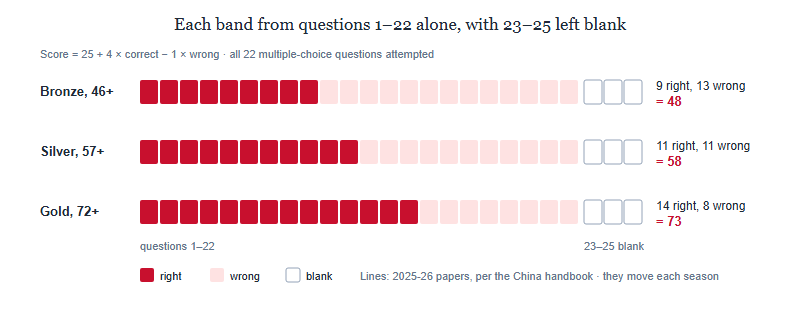
Before you spend holiday evenings on the three hardest questions on the paper, check what the first 22 can do without them. Under the published scheme — start from 25, plus 4 for a correct answer, minus 1 for a wrong one — attempting all 22 multiple-choice questions and leaving 23–25 blank gives a score of 3 plus five times your correct answers. Against the 2025–26 lines quoted in the handbook, that produces the lookup below.
| Band (2025–26 line) | Correct from questions 1–22, all attempted, 23–25 blank | Resulting score | One fewer correct gives |
|---|---|---|---|
| Bronze (46) | 9 | 48 | 43 |
| Silver (57) | 11 | 58 | 53 |
| Gold (72) | 14 | 73 | 68 |
Read the right-hand column before deciding where the next evening goes. Every band sits one correct answer inside the first 22 questions, and a single extra error there costs five marks against the line. For most candidates between bronze and silver on their baseline, an hour on accuracy in questions 16–22 moves the score further than an hour on question 25.


After each paper: the pattern lookup
Write the same four numbers after every sitting — score, number attempted, clock time at question 15, clock time at question 22 — and read them against the patterns below. The right-hand column is our coaching judgement, not organiser guidance.
| What your numbers show | What it usually means | What to do with the remaining days |
|---|---|---|
| Score rising, but more wrong answers each time | You are attempting more and guessing worse | Reapply the one-in-five rule before the next paper |
| Clock past 45 minutes at question 15 | The accessible questions are costing thinking time they should not | Speed sets on questions 1–15 from older papers |
| Question 22 reached with under 15 minutes left, several blanks in 16–22 | The middle of the paper is the bottleneck | Accuracy sets on 16–22, untimed first, then against your own clock |
| Numeric questions blank every time | Your time is running out before the last three questions | Leave them for the last minutes unless your earlier sets are already reliable |
| Score flat across three papers | New papers have stopped teaching you anything | Stop sitting; re-attempt every lost question from the papers you already have |
What the SMC is for this season, and what comes next
In the China region the Challenge is not a gate to Round 1. The handbook allows direct BMO Round 1 registration at any high-school year, with no qualifying Challenge score, which makes 8 October the cheapest honest measurement you will get before a three-and-a-half-hour proof paper on 19 November. That is also why the reconstruction on the evening of the sitting matters: it is the record you will read when deciding how to spend the six weeks after it. If the route rules for students outside the UK are still unclear, our eligibility reality check sets them out, and what the British Mathematical Olympiad is explains what Round 1 asks of you.
From 9 October the papers change shape. Olympiad practice uses full written solutions rather than answers, and our Round 1 and Round 2 past-paper pack is where that work starts. One observation from our own marking, offered as observation rather than data: students who keep a clean record of their practice papers tend to switch to proof practice faster, because they already know which kinds of question they avoid under time. Confirm the format, date and entry details for your sitting on ukmt.org.uk and with the organising channel before relying on anything here.
Questions students ask about SMC past papers
How many SMC past papers should I sit before 8 October?
Five full papers at most in the last twenty days, each reviewed within a day. An unreviewed paper mostly just tells you your score.
How do I practise the 000-999 questions with older papers?
Cover the options on questions 23 to 25 and compute one whole number from 0 to 999. Any other kind of result means recheck.
Can I reach SMC gold without the numeric questions?
On the 2025-26 reference lines quoted in the China handbook, yes, though lines move each season. Fourteen correct from the 22 multiple-choice questions, all attempted, scores 73 against a gold line of 72.
Should I sit the newest past paper first?
No. Keep the newest paper for a final timed rehearsal a few days before the sitting, and use older papers for baseline and drills.
This is an independent editorial guide operated by Hanlin Education for China-based international-school students. We are not affiliated with, endorsed by, or sponsored by UKMT or the BMO Subtrust. The SMC format and UKMT’s room rules are as published on ukmt.org.uk; China-region dates, fees and boundary figures are per the 2026–27 handbook circulated by the organising channel; paper roles, drills and thresholds are our editorial judgement. Formats, dates and boundaries change every season: confirm current details on ukmt.org.uk and with the organising channel that handles your entry. Errors reported to our editorial desk are corrected within 7 working days.