Most of a BMO candidate's training time is spent on problems they do not solve. What happens in the thirty minutes after you give up decides almost everything about whether that time compounds. Reading the full solution immediately feels productive and teaches very little; a graded approach that reveals as little as possible teaches a great deal. The difference is a protocol, not talent.
Why "I understood the solution" is not a skill
Understanding an argument and generating one are different cognitive tasks, and only the second is examined. Per ukmt.org.uk, BMO Round 1 requires full written solutions rather than answers, with complete proofs of any assertions you make, and the marks awarded depend on the clarity of your mathematical presentation. Nothing in that rubric rewards recognition. You are asked to produce.
This matters because recognition is very easy to mistake for competence. When you read a well-written solution, each step follows from the last, and the sensation of everything clicking into place is genuine and pleasant. What it does not tell you is whether you could have found the first step. The step that mattered — the one where the author decided to consider the residues modulo 7, or to look at the largest element, or to fix the diagram and move a single point — is presented as though it were obvious. It was not obvious. It was chosen, and the reasons for choosing it are usually invisible in the write-up.
A useful test: three days after reading a solution you found illuminating, sit down and reproduce it on a blank page with nothing in front of you. Students are routinely unable to do this for problems they were sure they had learned. That is not a memory failure. It is evidence that reading produced familiarity rather than capability.
How long to stay stuck before you read anything
The productive answer is longer than feels comfortable and shorter than stubbornness suggests. Two anchors help fix it.
The first is the exam itself. BMO1 gives 3.5 hours for six problems, which is roughly 35 minutes per problem if you spread yourself evenly — and the paper explicitly warns you not to, since one complete solution gains far more credit than several unfinished attempts. So 35 minutes is not a target; it is the point at which, in the exam, you would decide whether to commit or move on.
The second is that training is not an exam. Outside a timed paper, the useful window is considerably longer, because the skill being built is exactly the tolerance for not knowing. A workable rule for a training problem:
- First 20 minutes: understand and reformulate. Restate the problem in your own words, test small cases, draw the diagram properly with a compass rather than freehand.
- 20 to 60 minutes: genuine attack. Try the obvious approaches and let them fail. This is where most learning happens and most students quit.
- At 60 minutes: stop, write down where you are stuck in one sentence, and leave the problem entirely.
- Return once, the next day, for 20 minutes. A surprising proportion of problems fall here, and they fall for free.
- Only then begin the hint ladder below.
The single sentence describing where you are stuck is the load-bearing part. "I cannot do it" is not a diagnosis. "I can show it for even n but the odd case has no obvious parity argument" is a diagnosis, and it tells you which level of the ladder you actually need.
The hint ladder: read in layers, stop as early as possible
The mistake is treating a solution as a binary — not read, or read. In practice a written solution contains four or five separable amounts of information, and each level you decline to consume is skill you keep.
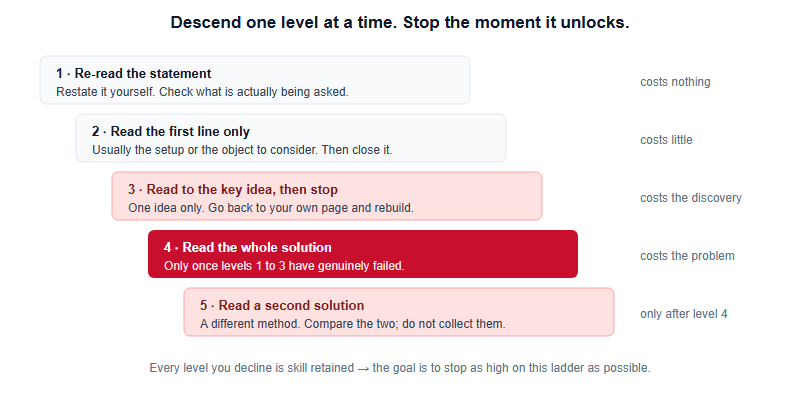
Level 3 is the one worth practising deliberately, because it is genuinely awkward: you have to read a paragraph, recognise that you have just been handed the idea, and close the page before your eyes drift to the next line. Print the solution and cover it with a sheet of paper if you cannot trust yourself on screen. The physical version of this discipline works better than the intention to be disciplined.
There is one common case where you should go straight to level 4 without guilt. If, after an hour of genuine work, you cannot even restate the problem in a form you understand, the obstacle is not that you lack an idea — it is that you lack a piece of vocabulary or a standard result. Reading the whole solution to acquire the missing tool is efficient. What is wasteful is reading the whole solution when you were three minutes from the idea.
The re-solve test, and the spacing that makes it stick
Nothing you read counts until you have written it out from nothing. This is the step almost universally skipped, and it is the step that converts reading into ability.


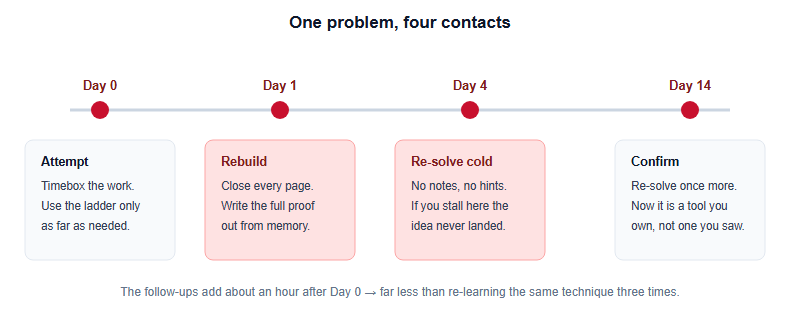
The Day 1 rebuild has a second benefit that is specific to this competition. Because BMO1 asks for complete written proofs and marks the clarity of presentation, writing the argument out properly is not administrative overhead — it is rehearsal of the thing being examined. A student who reads solutions but never writes them is training half the paper.
Be honest at Day 4. If you cannot re-solve it cold, that is information, not failure: it means you consumed the answer at level 4 when you needed a level-3 nudge, or that a prerequisite is missing. Either way the correct response is to log it and move on, not to re-read the solution a third time.
What to write down, and which solutions to read
Most students keep a notebook of solutions. Solutions are the wrong thing to keep, because you can always look a solution up. What you cannot look up is the trigger: the feature of the problem that should have made you reach for that technique.
| Field | What goes in it | Why it is the useful part |
|---|---|---|
| Trigger | The feature of the statement that should have prompted the idea | This is the only part that transfers to a problem you have not seen |
| Technique | The move itself, in one line | Forces compression; if you cannot compress it you did not understand it |
| Where I stopped | The exact step at which your own attempt died | Patterns appear after ten entries and they are usually the same three |
| Level used | Which rung of the ladder you had to descend to | Tracks whether your independence is improving over a term |
| Re-solve dates | Day 1 pass or fail, Day 4 pass or fail | Turns a vague sense of progress into two ticks |
Ten entries is enough to be useful; a hundred is a filing project. If the same "where I stopped" appears repeatedly — and for most candidates it does — you have found the thing to work on next, which is worth more than another twenty problems attempted at random.
On which solutions to read: UKMT publishes past papers and solutions, and those official write-ups should be your default because they are complete and written to be marked. See our guide to the BMO past-paper pack for how to organise a set of them, and check ukmt.org.uk for what is currently available. Community solutions on discussion forums are a legitimate supplement, with two caveats worth stating plainly. They are often extremely terse, compressing a hard idea into a sentence that a beginner reads as magic; and they are occasionally wrong, or right for a reason the author has not stated. Reading a terse forum solution before an official one is the fastest way to conclude that you are bad at this when in fact you were reading shorthand.
There is also a specific trap around elegance. Short solutions get upvoted; long, natural solutions get ignored. But the elegant three-line argument is frequently the polished end product of a messy hour, and studying only polished endings gives you no model of how anyone gets there. Where you can find a solution that shows its own reasoning — why this substitution, why this case split — that is worth two clever ones.
Finally, a note for candidates training without a school squad around them, which describes most students working from outside the UK; the constraints on how international candidates enter are set out in our note on BMO eligibility for international students, and our overview of what the British Mathematical Olympiad is covers the wider pathway. Solo training removes the person who would otherwise have given you a level-2 hint instead of a full solution. The ladder is a substitute for that person. It is not as good as a strong training partner, but it is far better than the default, which is to read the answer at minute thirty and feel productive.
Questions students ask
How long should I stay stuck before reading anything?
About an hour of genuine work, then a 20-minute return the next day. Only after that should you start the hint ladder.
Is it cheating to read solutions during training?
No. Reading is how techniques are acquired. The waste comes from reading all of it when a single line would have unlocked the problem.
How many problems a week is realistic?
Fewer than students expect. Six problems taken through all four contacts beats twenty attempted once and abandoned.
Should I use forum solutions or official ones?
Official UKMT write-ups first, since they are complete and written to be marked. Treat forum posts as terse supplements that are occasionally wrong.
This is an independent editorial guide operated by Hanlin Education for China-based international-school students. It is not affiliated with, endorsed by, or sponsored by UKMT or the BMO Subtrust. Competition dates, formats, fees and eligibility change between seasons — confirm current details on ukmt.org.uk before acting on anything here. Factual errors are corrected within 7 working days of being reported.