For students in China aiming for the British Mathematical Olympiad (BMO), the 2026-27 season offers a streamlined path. Unlike the UK system where BMO1 is typically an invitation-only follow-up to the Senior Mathematical Challenge (SMC), BMO registration China allows high school students to enter BMO Round 1 directly. This article outlines the critical dates, eligibility rules, and strategic preparation needed for the November sitting.
Key Dates and Eligibility for 2026
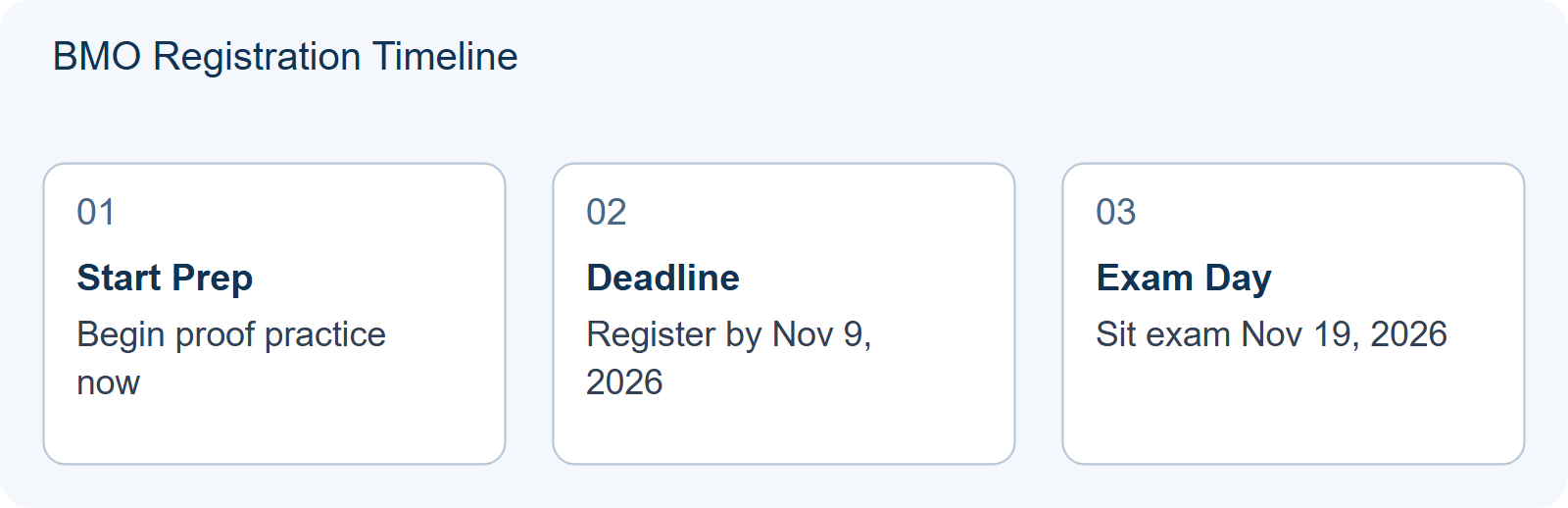
The 2026 BMO Round 1 exam will take place on November 19, 2026, from 17:00 to 20:30 local time. The registration deadline for the China region is November 9, 2026. It is crucial to note that while the UKMT global schedule lists November 18, the China region sits on November 19 due to timezone adjustments for regions more than two hours ahead of GMT.
| Item | Detail |
|---|---|
| Exam Date | November 19, 2026 |
| Registration Deadline | November 9, 2026 |
| Duration | 3.5 Hours |
| Format | 6 Proof Questions |
| Eligibility | Any High School Grade (China) |
Who Can Register?
Direct entry is available to any high school student in China. You do not need to have participated in the SMC beforehand. However, there is a strict exclusion: students holding UK school registrations cannot sit the exam at China centers. This makes BMO1 an accessible target for students who may have missed earlier UKMT rounds or prefer to focus solely on olympiad-style problems.
Understanding the Exam Format
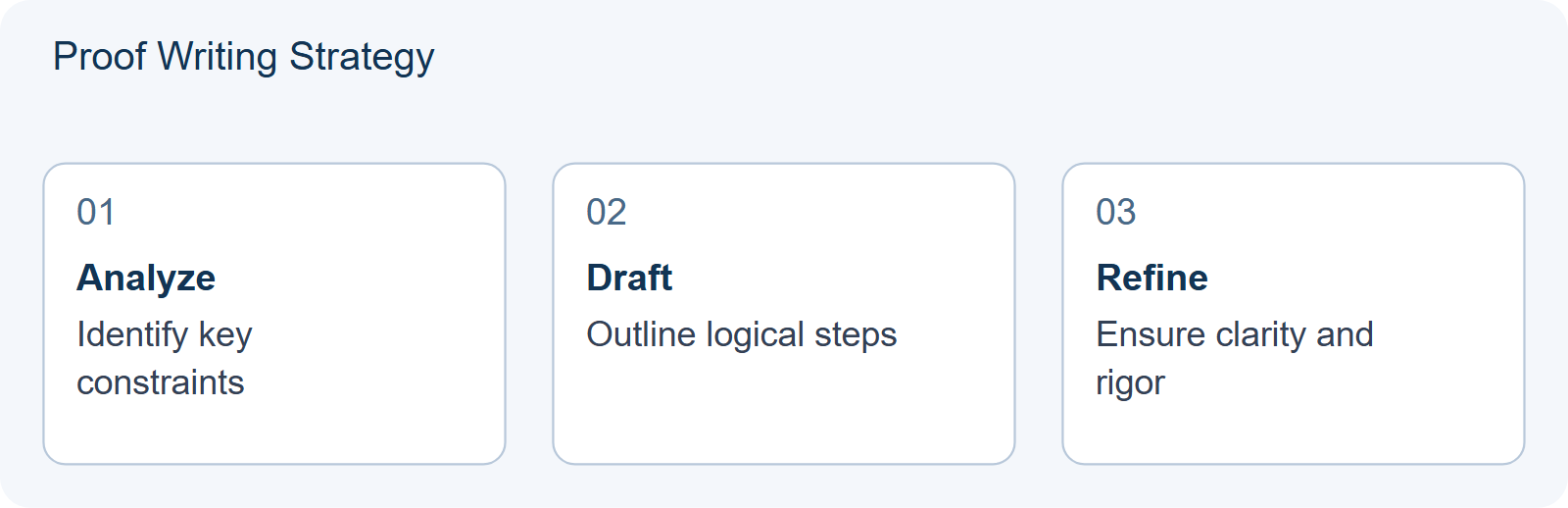
BMO differs significantly from multiple-choice competitions like AMC. The exam consists of six questions to be solved in three and a half hours. Each question is worth 10 points, for a total of 60. The core challenge is not just finding the answer, but providing a complete written proof. Partial credit is awarded for logical steps, even if the final conclusion is incorrect.
Historical data highlights the difficulty. In 2025, the average score was only 12.6 out of 60, with a median of 11. Award thresholds generally start around 18 for Distinction and rise to 48+ for Gold. This low scoring average underscores the importance of mastering proof-writing techniques rather than just computational speed.
Strategic Preparation
Preparation should focus on four main areas: Number Theory, Algebra, Geometry, and Combinatorics. Students transitioning from AMC/AIME backgrounds must adapt their mindset. Instead of guessing or eliminating options, you must construct rigorous arguments. A common pitfall is attempting all six questions superficially. UKMT advice suggests that fully solving one or two questions often yields higher marks than leaving many incomplete attempts.
For those planning their academic year, consider how this fits with other competitions. If you are targeting UK universities, BMO results are highly valued. For North American applications, combining BMO with AMC/AIME provides a balanced profile. Check our guide on The 2026-27 China-Region Olympiad Clash Calendar to see how BMO dates align with other major contests like the Euclid or COMC.
Finding a Test Centre
Registration is conducted through authorized centres in China. Since direct entry is permitted, ensure your chosen centre supports standalone BMO1 registration without requiring prior SMC participation. Early registration is recommended to secure a spot before the November 9 deadline.
To further refine your approach, review What Each BMO Question Stem Requires to understand the difference between “Show That” and “Determine All” prompts. Additionally, managing your study time effectively is critical; see The Autumn Term Hour Budget for a week-by-week planner tailored for students with full course loads.


Illustrative Decision: Allocating the Final 45 Minutes Before Registration
HYPOTHETICAL/ILLUSTRATIVE: This scenario is a constructed example for educational planning purposes only. It does not represent a real student, official rules, or guaranteed outcomes.
Consider “Alex,” a Grade 11 student in Shanghai preparing for BMO Round 1. With the registration deadline of November 9 approaching, Alex has three weeks left before the exam on November 19. The critical decision arises during the final week of preparation: how to allocate limited study hours between two competing priorities. Option A involves drilling complex Number Theory proofs from past papers, aiming to master high-difficulty questions that often appear as Q5 or Q6. Option B focuses on refining the presentation and logical structure of solutions for easier Algebra and Geometry problems (Q1–Q3), ensuring no marks are lost due to ambiguity or incomplete justification.
| Factor | Option A: Drill Hard Proofs | Option B: Polish Easy Solutions |
|---|---|---|
| Primary Goal | Maximize potential score ceiling | Minimize avoidable mark loss |
| Risk | Time sink; may yield zero partial credit if stuck | Boredom; neglecting higher-tier differentiation |
| Best For | Students already scoring >30/60 consistently | Students scoring <20/60 with frequent gaps |
Alex’s recent mock results show an average score of 18 out of 60. In these mocks, Alex successfully solved Q1 and Q2 but received only 2/10 on Q3 because the geometric argument lacked a clear statement of why certain triangles were similar. Conversely, Alex spent 40 minutes attempting Q5 without writing a single coherent line of proof. This data point changes the decision calculus. While mastering hard number theory is intellectually satisfying, it offers diminishing returns for a student currently struggling to secure full marks on accessible questions. The low historical average score mentioned in the article highlights that most candidates fail not because they cannot solve the hardest problem, but because they leave easy points on the table through sloppy reasoning.
Therefore, Alex chooses Option B. The revised plan dedicates 70% of remaining study time to rewriting previous solutions for Q1–Q3, focusing strictly on clarity, defining variables, and justifying every step. Only 30% is allocated to reviewing one new combinatorics concept. This shift prioritizes reliability over ambition. By ensuring that the first three questions are fully justified, Alex aims to secure a baseline of 25–30 marks rather than gambling on a difficult Q5 solution that might yield zero.
This choice reflects a strategic understanding of the marking scheme: partial credit rewards logical progression. A well-structured argument on a simpler problem is more likely to earn full marks than a fragmented attempt at a harder one. For students in China registering directly, this practice helps manage anxiety by focusing on controllable factors—presentation quality—rather than uncontrollable ones—problem difficulty.
Reusable Self-Check: Review your last two mock exams. Did you lose marks on questions you *could* solve? If yes, prioritize proof-writing rigor over learning new advanced topics. If you consistently solve Q1–Q3 perfectly but stall on Q4+, then shift focus to bridging that gap. Align your final prep phase with your specific error pattern, not general prestige of topics.
Frequently Asked Questions
Do I need to take SMC first?
No. In China, students can register directly for BMO Round 1 without participating in the Senior Mathematical Challenge (SMC).
Can UK students take the exam in China?
No. Students with UK school registrations are excluded from sitting the exam at China test centres.
How is BMO scored?
There are 6 questions worth 10 points each. Marks are awarded for the completeness and correctness of the written proof, not just the final answer.