Many China-based international students run a US maths track (AMC, then AIME) and a UK track (SMC, then BMO) at the same time. They are not the same test in a different accent. AMC and AIME reward fast, correct answers, while the British Mathematical Olympiad rewards written proofs. Here is how the two tracks compare — and how to combine them without burning out.
Two philosophies: answer-only versus written proof
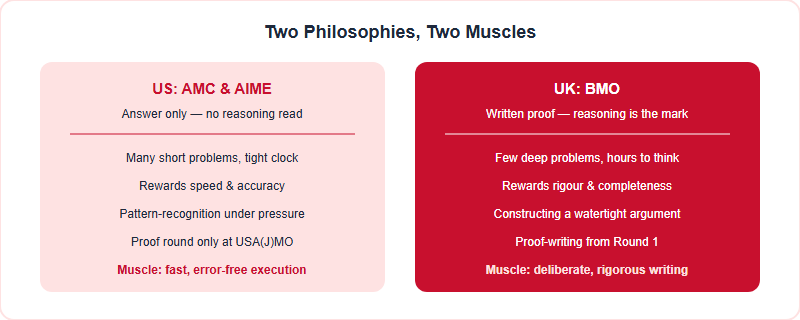
The deepest difference is not the syllabus — the topics overlap heavily — but what counts as a finished piece of work. The US entry rounds are answer-only. On the AMC you choose from options; on the AIME you submit an integer. A marker never reads your reasoning, so speed and reliability under time pressure are everything. The BMO flips this: on Round 1 and Round 2 the marker reads only your reasoning, and a correct answer with no proof scores almost nothing.
This means the two tracks build genuinely different muscles. The US track trains rapid pattern-recognition and error-free execution across many short problems. The UK olympiad rounds train the slow, deliberate craft of constructing and writing a watertight argument. Students who understand this treat them as complementary rather than redundant. If the BMO is new to you, our overview of what the BMO is and how it works sets out the proof-based format in full.
Format at a glance
The table below lines up the main rungs of each ladder. Treat every number as the standard format and confirm current specifics on the official sites — ukmt.org.uk for the UK rounds and maa.org for AMC and AIME — because both organisers adjust details from year to year.
| Test | Track | Standard format | Answer or proof? | Approx. window |
|---|---|---|---|---|
| SMC | UK | 25 multiple-choice, 90 min | Answer only | ~ October |
| BMO Round 1 | UK | 6 problems, 3½ hours | Written proof | ~ November |
| BMO Round 2 | UK | 4 problems, 3½ hours | Written proof | ~ January–February |
| AMC 10 / 12 | US | 25 multiple-choice, 75 min | Answer only | ~ November |
| AIME | US | 15 questions, integer answers, 3 hours | Answer only | ~ February |
| USA(J)MO | US | 6 problems over two days | Written proof | ~ March |
One row deserves a flag: the US does have a proof round — the USA(J)MO — but it sits at the very top of the ladder, reached only after strong AMC and AIME performances. For most international students, the BMO is where they first meet olympiad proof-writing, which is exactly why the two tracks reinforce each other so well.
The calendars collide in November
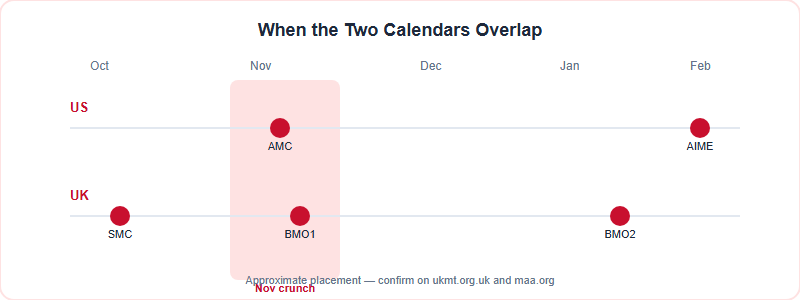
For a dual-track student, the real challenge is logistical, not mathematical. Both ladders put a major event in the autumn: the AMC and the SMC both fall around October–November, and BMO Round 1 lands soon after. That means a student running both tracks can face the AMC, the SMC and BMO1 inside a few weeks, right when the school term is at its most crowded with mocks and applications.
Planning around this collision is the single most valuable thing you can do. Map the confirmed dates for your region early — time zones matter, since UK-run and US-run competitions may be scheduled in their own local time and sat at awkward hours from China. Then decide honestly where your marginal hour of preparation should go in any given week. Trying to peak for everything simultaneously usually means peaking for nothing.
What each track signals to universities
Both tracks are recognised, but they say slightly different things. Strong AMC and AIME results are widely understood in US-facing admissions and are a familiar reference point for competitive STEM programmes. A strong BMO result — particularly reaching Round 2 — is a recognised signal of proof-level mathematical maturity that resonates with UK maths and Oxbridge-style admissions, where the ability to construct a rigorous argument is exactly what tutors probe.


Two honest caveats. First, no competition result is a guarantee of admission anywhere; it is one factor among grades, interviews, references and admissions tests, and should be presented as evidence of genuine interest rather than a trophy. Second, which track carries more weight depends entirely on where you are applying. A student aiming primarily at UK maths courses gets more differentiated value from the proof-based BMO; a US-focused applicant may lean on AMC and AIME. Before you commit to the UK rounds, make sure you satisfy the entry conditions in our guide to BMO eligibility for international students.
How to sequence both without burning out
The good news is that the underlying maths transfers. Number theory, combinatorics, algebra and geometry all appear on both ladders, so foundational study serves both at once. The divergence is in the final layer of preparation — speed drills for the US answer rounds, proof-writing for the UK olympiad rounds — and that layer is what you schedule around the calendar. A workable approach for many students:
- Summer: build shared topic foundations that feed both tracks equally.
- Early autumn: sharpen AMC and SMC speed together — both are answer-only, so the drills overlap.
- Late autumn: pivot hard into proof-writing for BMO1, using genuine problems from the archive.
- Winter: depending on results, push toward BMO2 and, on the US side, AIME.
Whatever sequence you choose, protect your proof-writing time. It is the rarer skill, it is the one BMO rewards, and it is the one that transfers upward to the USA(J)MO if you ever reach that rung. When you move into the proof phase, work from the BMO past papers archive so the difficulty matches the real paper.
Frequently asked questions
Is the BMO harder than the AMC or AIME?
It is different rather than simply harder. The BMO demands full written proofs, while AMC and AIME are answer-only; each is difficult in its own way.
Can I prepare for both tracks at once?
Yes. The topic foundations overlap heavily, so build those together and split only in the final layer — speed for AMC/AIME, proof-writing for BMO.
Does the US have a proof-based olympiad like BMO?
Yes, the USA(J)MO, but it sits above the AMC and AIME. For most students, the BMO is their first olympiad proof paper.
Which track do UK universities prefer?
A strong BMO result signals proof-level maturity valued in UK maths admissions, but it is one factor among many and never a guarantee.
This is an independent editorial guide operated by Hanlin Education for China-based international-school students. It is NOT affiliated with, endorsed by, or sponsored by UKMT or the BMO Subtrust. Competition formats and dates change each year — always confirm current UK details on ukmt.org.uk and US details on maa.org. Any factual error will be corrected within 7 working days.