The British Mathematical Olympiad (BMO) has been run in its present form since 1965, and the UK has fielded a team at the International Mathematical Olympiad (IMO) since 1967. For sixty years, BMO has sat at the senior end of the UK Mathematics Trust (UKMT) competition pathway — the gateway from the Senior Mathematical Challenge (SMC) of October to the IMO team announced in early summer. This guide is the editorial reference international students preparing for BMO from outside the United Kingdom need: the two-round structure, the selection path from SMC, the eligibility rules that govern international participation, and a clear-eyed account of what BMO participation actually signals in 2026.
Quick Facts
| Organising body | United Kingdom Mathematics Trust (UKMT), with the BMO Subtrust running the Olympiad rounds |
| First held in present form | 1965 (per UKMT historical records) |
| UK IMO team participation | Continuous since 1967 |
| BMO Round 1 (BMO1) | 3.5 hours, 6 problems, typically mid-November, taken in students’ own schools |
| BMO Round 2 (BMO2) | 3.5 hours, 4 problems (each worth 10 marks), typically late January or early February |
| Round 2 invitation rule | Top 10% of BMO1 candidates invited to BMO2 |
| BMO1 selection basis | Performance in the UK Senior Mathematical Challenge (SMC, late October) |
| Annual BMO1 candidates | ~1,600 UK candidates each year, plus discretionary and international entries (per UKMT statistics) |
| Eligibility (for IMO team) | British passport or three years of full-time UK secondary education prior to leaving school |
| International entry path | Discretionary entry purchased by participating schools (in China: through ASEEDER and authorized partners) |
| Final IMO team size | 6 students annually |
Where BMO Sits in the UKMT Pathway
BMO is not a standalone event. It is the apex of a four-stage UKMT competition pipeline that begins as early as primary school and culminates in IMO team selection. Understanding this pipeline is the first step in understanding what BMO participation means.
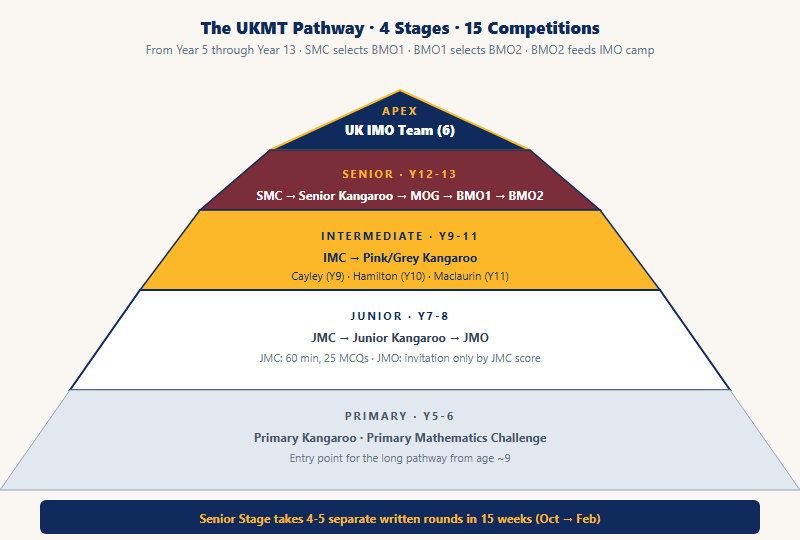
Reading top to bottom: the IMO team of six students is the international destination; BMO Round 2 is the final domestic round; BMO Round 1 is the entry point to that round; the Senior Mathematical Challenge in late October is the trigger that determines BMO1 invitation. Every stage below the senior level — Intermediate, Junior, Primary — is preparatory infrastructure that builds the problem-solving habits the senior rounds demand.
BMO Round 1 (BMO1) · Format and Conditions
BMO1 is the first written olympiad round of the senior pathway. Its conditions are deliberately demanding:
- Duration: 3 hours 30 minutes
- Number of problems: 6
- Where taken: in candidates’ own schools, under invigilation
- When: typically mid-to-late November
- Selection: based on Senior Mathematical Challenge (SMC) performance in October
- Annual UK cohort: approximately 1,600 candidates, with additional discretionary and international entries
- Marking: each problem is marked in detail; partial credit is awarded for substantive progress, not only complete solutions
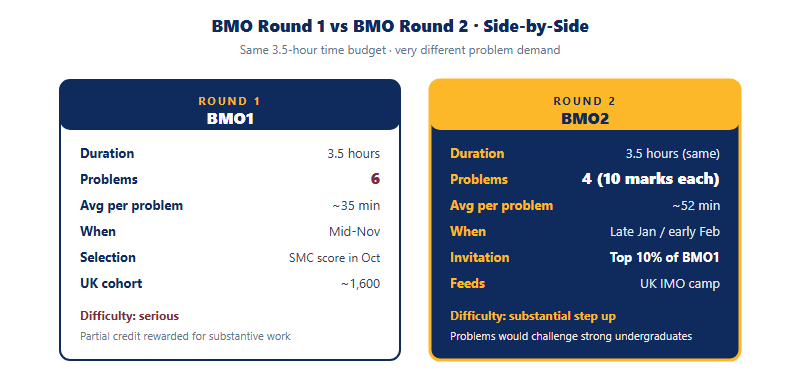
The 6-problem, 3.5-hour format means each problem is given roughly 35 minutes on average. In practice, strong candidates spend more time on the harder later problems and less on the first one or two. The mark distribution rewards completion: a solved-and-justified problem typically scores in the high single digits or full marks, while a problem with strong partial work scores a few marks. Candidates who attempt all six problems without finishing usually score lower than candidates who finish four cleanly.
BMO Round 2 (BMO2) · Format and Conditions
BMO2 is the second round, invitation-only:
- Duration: 3 hours 30 minutes (same as BMO1)
- Number of problems: 4 (each worth 10 marks; maximum total 40)
- Invitation rule: top 10% of BMO1 candidates
- When: typically late January or early February
- Difficulty step: significantly harder than BMO1; problems require longer, more layered arguments
The reduction in problem count from 6 to 4 combined with the same time budget reflects the increased per-problem depth. BMO2 problems are designed so that strong undergraduates would still find them substantial. The selection from BMO2 feeds the UK National Mathematical Olympiad camp, where the UK IMO team is ultimately chosen.
The Selection Funnel · From SMC to IMO Team
BMO is the central narrowing point in a multi-stage funnel. The numbers shift each year, but the structural pattern is consistent:
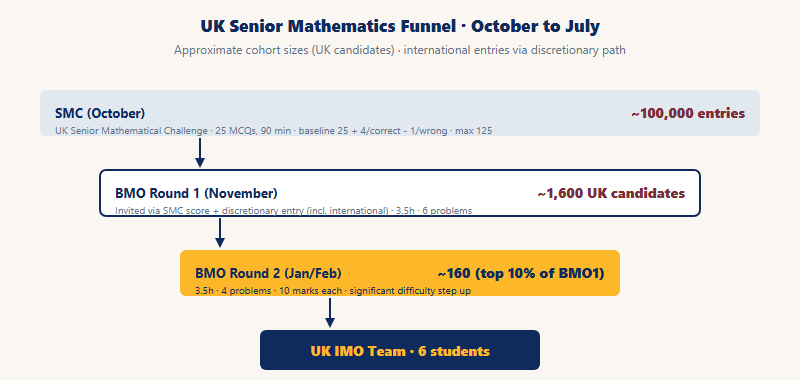
The 1-in-625 implied narrowing from SMC to BMO2 (using the order-of-magnitude figures above) understates the discontinuity. The SMC entry pool is broad and includes many candidates participating for the certificate or the school requirement, not the BMO route. The candidates who actually compete for BMO selection at SMC — that is, who train year-round — are a much smaller fraction of the 100,000 entries. From within that focused cohort, the narrowing from SMC to BMO1 to BMO2 is sharper but less dramatic in absolute terms.
International Student Eligibility · The Rules That Actually Apply
This is the section that most students preparing from outside the UK come to this guide for. The rules are clear once you separate the two questions: (1) can I sit BMO and have my paper marked? versus (2) can I be selected for the UK IMO team?
For UK IMO team eligibility
Per BMOS policy, candidates eligible for IMO team selection must either:
- Hold (or be eligible for) a British passport, or
- Have completed at least three years of full-time UK secondary education before leaving school (including sixth form / college)
All participants in BMO1 and subsequent rounds must additionally be in Year 13 or below, in pre-university education.
For BMO participation as an international candidate
Students who do not meet the IMO team eligibility above can still participate in BMO1 and BMO2 via discretionary entry purchased by the school. In recent years, entries to BMO have been made from schools in Ireland, Kazakhstan, India, China, South Korea, Hong Kong, Singapore, and Thailand, among others. International candidates’ papers are marked against the same UK cut-off, and Distinction-level performance is recognized internationally even though the student cannot represent the UK at IMO.


In China specifically, the discretionary entry path runs through ASEEDER (the authorized partner) and registered school programs. Chinese candidates’ BMO scores receive the same Distinction / Merit recognition as UK candidates’ scores, and these recognitions are routinely cited on UK university applications (particularly to mathematics-track programs at Oxford, Cambridge, Imperial, Warwick, and other selective UK universities). The fact that the IMO team destination is off-limits does not diminish the scoring credibility of a strong BMO performance from a Chinese candidate.
After BMO · What Happens to Top Performers
The structure that follows BMO2 for UK-eligible candidates is the UK National Mathematical Olympiad camp, where shortlisted students train under coaches drawn from UK academic mathematics. From this camp, the final UK IMO team of six is selected. The team competes at IMO each July, typically alongside teams from approximately 100 countries.
For international candidates who do not enter the IMO team pipeline, the value of the BMO record sits in two places:
- UK university applications: Oxford, Cambridge, Imperial, Warwick, and other mathematics-heavy programs read BMO Distinction as a clear positive signal — particularly when paired with strong A-level Mathematics and Further Mathematics results, or the equivalent in another curriculum
- US and other international university applications: top-tier US programs (MIT, Caltech, Princeton, Harvard) increasingly recognize international math olympiad performance; BMO Distinction from a Chinese international school applicant is a distinguishable signal in a Common App reader’s view of the academic profile
Historical Context · Why the 60-Year Record Matters
BMO has run in its present format since 1965. The UK IMO team has competed continuously since 1967. This 60-year continuity matters for one reason: cumulative problem archive. The body of past BMO problems — freely published by UKMT — is one of the deepest competition mathematics archives in any English-speaking country. Students preparing today have access to several hundred past problems with worked solutions, which is itself a competitive advantage over students preparing for newer olympiads with thin archives.
The longevity also means UK undergraduate mathematics admissions have decades of calibration data on BMO results. Admissions tutors at Oxford and Cambridge have seen what BMO Distinction predicts about undergraduate readiness across many cohorts. A BMO record is therefore not a novelty signal — it is a known quantity in UK admissions.
Frequently Asked Questions
What is the British Mathematical Olympiad?
The British Mathematical Olympiad (BMO) is a two-round written competition organised by the BMO Subtrust under the United Kingdom Mathematics Trust (UKMT). BMO Round 1 takes place in November (3.5 hours, 6 problems); BMO Round 2 takes place in late January or early February (3.5 hours, 4 problems, top 10% of Round 1). BMO has been run in its present form since 1965 and is the senior end of the UKMT competition pathway, used to select the UK team for the International Mathematical Olympiad.
How long is each BMO round?
Both BMO Round 1 and BMO Round 2 are 3 hours 30 minutes. BMO1 contains 6 problems (approximately 35 minutes average per problem); BMO2 contains 4 problems each worth 10 marks (approximately 52 minutes average per problem).
Can international students take BMO?
Yes, via discretionary entry purchased by participating schools. Students from Ireland, Kazakhstan, India, China, South Korea, Hong Kong, Singapore, and Thailand routinely participate. International candidates’ papers are marked against the same UK cut-off, and Distinction-level performance is internationally recognized. However, only candidates with a British passport or three years of UK secondary education can be selected for the UK IMO team.
How do I qualify for BMO Round 1?
For UK candidates: by performance in the Senior Mathematical Challenge (SMC), which is taken in late October. The UKMT publishes a cut-off score each year, and candidates above the cut-off are invited to BMO1. For international candidates: through discretionary entry purchased by the school — in China, this is administered through ASEEDER and authorized partners.
How many candidates take BMO each year?
Approximately 1,600 UK candidates take BMO Round 1 each year, plus a smaller number of discretionary and international entries. Approximately 160 candidates (the top 10% from BMO1) are invited to BMO Round 2.
Does BMO help with US college applications?
Yes, for STEM-track applicants. Top-tier US universities (MIT, Caltech, Princeton, Harvard, Stanford) recognize international math olympiad records, and a BMO Distinction from an international applicant is a distinguishable signal. However, for US-focused applicants, the AMC → AIME → USAMO pathway is the more directly recognized track. Students applying to both UK and US universities often pursue both pathways — the AMC + BMO dual-track is increasingly common among ambitious math-focused applicants.
Related Resources
- 📋 Senior stage overview → Senior Stage: SMC, Senior Kangaroo, MOG, BMO
- 📋 BMO deep-dive → BMO Round 1 and Round 2
- 📋 All UKMT competitions → UKMT Competitions Hub
- 📚 Past papers → Resources
- 🏆 Hall of Fame → Past performers
- 📞 Editorial desk → Get in Touch
This guide is published by the independent editorial desk at en.bmo.org.cn. We are not affiliated with the United Kingdom Mathematics Trust or the BMO Subtrust. All facts on this page are cross-referenced against the UKMT site (ukmt.org.uk), the BMO Subtrust site (bmos.ukmt.org.uk), and the relevant published competition records. Our editorial standards are set out in full on the Academic Integrity page; in summary: every page is verified against primary sources, written in plain language for parents and students new to the pipeline, and corrected within seven working days of any reported error.
Next steps
- The BMO Round 1 & 2 guide — how the British Mathematical Olympiad works.
- BMO past papers — the free pack and a proven way to use it.