BMO1 geometry rewards recognition far more than invention. Most olympiad geometry problems are assembled from a small stock of recurring configurations — cyclic quadrilaterals, power of a point, similar triangles, angle bisectors and arc midpoints — and the students who score well are the ones who identify the configuration early, pick the cheapest tool that fits it, and then write the argument in a form a marker can verify line by line.
What the paper actually asks of you
British Mathematical Olympiad Round 1 is described by UKMT as a 3.5-hour challenge consisting of six Olympiad-style questions. Each question carries 10 marks, so the paper is marked out of 60 — confirm the current mark allocation on the paper itself at bmos.ukmt.org.uk before you plan a scoring strategy. BMOS material describes the first problem as intended to be more accessible than the rest. Entry is by invitation based on a qualifying Senior Mathematical Challenge score, or by discretionary entry, and UKMT invites roughly 1,000 high-scoring SMC students. The 2026 paper is listed for Wednesday 18 November 2026; check ukmt.org.uk for the live date before you build a calendar around it.
Three consequences follow, and they shape how geometry should be prepared:
- Time is not the binding constraint you think it is. Three and a half hours across six problems is roughly 35 minutes each, but almost nobody solves six. Two complete, well-written solutions beat five half-arguments, because marking rewards complete reasoning rather than promising starts.
- Geometry is disproportionately "all or nothing". An algebra or combinatorics problem often yields partial progress that a marker can credit. A geometry problem where you never see the key circle tends to produce a page of angle chasing that goes nowhere.
- Recognition is trainable. Because the configuration stock is small, geometry is the area where deliberate pattern drilling pays back fastest. That is the argument for treating it as a separate training strand rather than folding it into general problem practice.
If you are still mapping the pipeline that leads here — SMC in the autumn, Round 1 in November, Round 2 in the new year — start with our overview of what the British Mathematical Olympiad is, then come back to the geometry work.
Six configurations that keep coming back
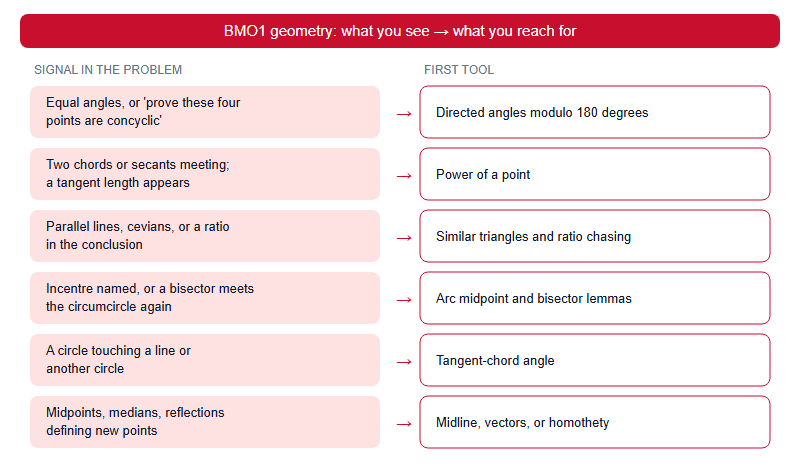
Work through the past papers in our gathered BMO practice pack — worked solutions for many of the years, with coverage still being added — and you will see the same structures recur across years. The table below is our editorial distillation of the configurations worth being able to recognise on sight, the textual or diagrammatic signal that gives each one away, and the tool to reach for first. It is a starting map, not a claim about how any particular future paper will be composed.
| Configuration | Signal in the problem | First tool | Common trap |
|---|---|---|---|
| Cyclic quadrilateral | Four named points; equal angles; a right angle subtended twice; or an explicit "prove concyclic" | Directed angles modulo 180 degrees | Assuming a particular order of points around the circle |
| Power of a point | Two chords or secants meeting; a tangent length; products of segment lengths in the conclusion | PA times PB equals PC times PD | Ignoring whether the point lies inside or outside the circle |
| Similar triangles and ratio chasing | Parallel lines; cevians; a ratio to prove; a midpoint dropped into the statement | Angle-angle similarity, then careful ratio bookkeeping | Writing the vertex correspondence in the wrong order |
| Angle bisector and arc midpoint | Incentre named; a bisector extended to meet the circumcircle | Arc midpoint equidistant from the relevant vertices and the incentre | Quoting a named lemma without stating it precisely |
| Tangents and tangent-chord angle | A circle touching a line or another circle; equal tangent lengths | Tangent-chord angle equals the angle in the alternate segment | Using tangency you never actually justified |
| Midpoints, midlines and parallelograms | Median; midpoint of a side; a point defined as a reflection | Midline theorem, vectors, or a homothety centred at a vertex | Abandoning structure and sliding into unmanageable coordinates |
The toolkit, ranked by return on investment
Students preparing from outside the UK often over-invest in exotic machinery — inversion, projective transformations, complex-number bashes — because those techniques are conspicuous in online discussion. In our editorial view the ranking below is far closer to what a Round 1 paper actually rewards.
- Directed angles modulo 180 degrees. The single highest-value habit. It removes the configuration case analysis that quietly destroys otherwise correct proofs, and it makes concyclicity arguments symmetric. State once at the top of your solution that all angles are directed modulo 180 degrees, and use it consistently.
- Power of a point. Cheap, mechanical, and often the bridge between a length condition and a circle you have not yet drawn. If a problem gives you products of lengths, this should be your first thought.
- Similar triangles with disciplined ratio bookkeeping. Most ratio problems fall to two or three similarity relations chained carefully. The failure mode is bookkeeping, not insight.
- Trigonometric length chasing. The sine rule in several triangles will finish a surprising number of problems where synthetic ideas stall. It is inelegant and it is worth full marks.
- Coordinates or complex numbers as a fallback. Legitimate, occasionally decisive, usually slow. Reserve them for configurations with an obvious origin — a circle centred at the origin, or a right angle at a convenient point — and budget the time honestly.
The practical instruction that follows: spend your first ten minutes on the diagram and the configuration, not on calculation. Draw the diagram twice, at reasonable size, once accurately and once deliberately non-symmetric so that coincidences in your first drawing do not mislead you.
Where the marks are lost: the write-up
Geometry loses more marks in transcription than in thinking. The pattern is consistent: a student sees the key circle, chases angles correctly on scratch paper, and then submits a compressed page that asserts three non-obvious facts without justification. The skeleton below is the structure we recommend for every geometry write-up, including in practice.


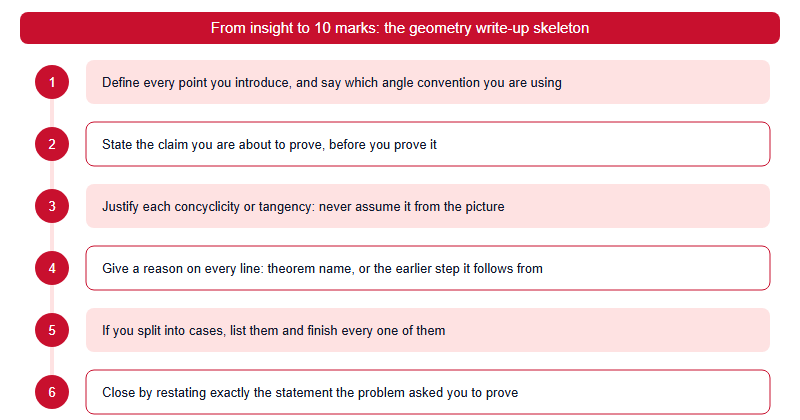
Three habits deserve singling out, because they are the ones most often missing in scripts written by strong calculators:
- "Clearly" and "obviously" earn nothing. If the step is genuinely immediate, giving the one-line reason costs you eight seconds. If it is not immediate, you have just skipped the part of the argument that carried the marks.
- The diagram is a thinking aid, not evidence. A property that is true in your drawing may be false in another valid configuration. This is precisely the failure that directed angles are designed to prevent.
- Named lemmas must be stated in full. If you invoke a result about the arc midpoint and the incentre, write the statement you are using. A marker cannot credit a lemma they cannot identify, and an imprecise statement often turns out to be false as written.
An eight-week geometry rotation
This is the training block we would run in the weeks approaching a November paper, alongside — not instead of — general problem practice. It assumes roughly four to five hours of geometry per week, which is realistic for a Year 12 or Year 13 student carrying A-level, IB or AP coursework.
- Weeks 1–2 — foundations. Circle theorems rebuilt from scratch, then directed angles. Six short problems per week, plus one written up in full as if it were being marked.
- Weeks 3–4 — power of a point and similarity. One timed problem per week under a strict 35-minute limit, then a full write-up the following day when you are no longer under time pressure. Compare the two versions: the gap between them is your write-up deficit.
- Weeks 5–6 — incentre, arc midpoints and mixed configurations. Two geometry problems from older papers each week under time. Keep a running configuration notebook: one page per configuration, with the signal that gave it away.
- Weeks 7–8 — integration. One full 3.5-hour paper every ten days under exam conditions, marked against the worked solutions in the pack, followed by a lost-marks log that classifies every deduction as recognition, execution or write-up.
The lost-marks log is the part students skip and the part that produces the improvement. After four entries you will usually find that one category dominates, and that tells you what the next block should train. Our guide to BMO past papers and how to use them covers how to structure that marking honestly, and if you are still checking whether your school can enter you at all, read our eligibility reality check for international students first — entry logistics need to be settled long before the geometry work matters.
Frequently asked questions
Do I need inversion or projective geometry for BMO1?
Rarely. Circle theorems, similarity and power of a point cover most of what Round 1 problems reward; heavier machinery is optional.
Is a clear diagram enough to justify a step?
No. A diagram guides your thinking, but every angle, length or concyclicity claim still needs a written reason in the proof.
How many marks is each BMO1 problem worth?
Each of the six problems carries 10 marks, 60 in total. Confirm the current allocation on the paper at bmos.ukmt.org.uk.
Should I attempt every problem on the paper?
Usually no. Two complete, fully justified solutions typically score better than five partial attempts left unfinished.
This is an independent editorial guide operated by Hanlin Education for China-based international-school students. We are not affiliated with, endorsed by, or sponsored by UKMT or the BMO Subtrust. Competition formats, dates, eligibility and mark schemes are set by the organisers and can change — confirm current details on ukmt.org.uk. Errors reported to our editorial desk are corrected within 7 working days.