Working through past papers is the single highest-leverage way to prepare for the British Mathematical Olympiad — but for most international students the papers are scattered across years and rounds, and bare question sheets without proper worked solutions teach very little. So we did the legwork: we have collected the BMO1 and BMO2 past papers, added full worked solutions for many of the years, and organised the whole archive by round and year into a single pack — and we give it to you free. (Worked-solution coverage varies by year — our teachers are adding more over time, so message us for the current set and we'll tell you exactly which years are included.) This page shows you what is in it, how the two rounds differ, and the method that turns a stack of papers into real marks.
📥 Get the complete BMO past-paper pack — free
The BMO1 & BMO2 past papers, organised by round and year, with worked solutions for many years (coverage varies — not every year), plus our curated topic notes. Scan the WeChat code on this page and message us — we'll send you the full pack at no cost, and point you to the right starting paper for your level.
What's in the pack
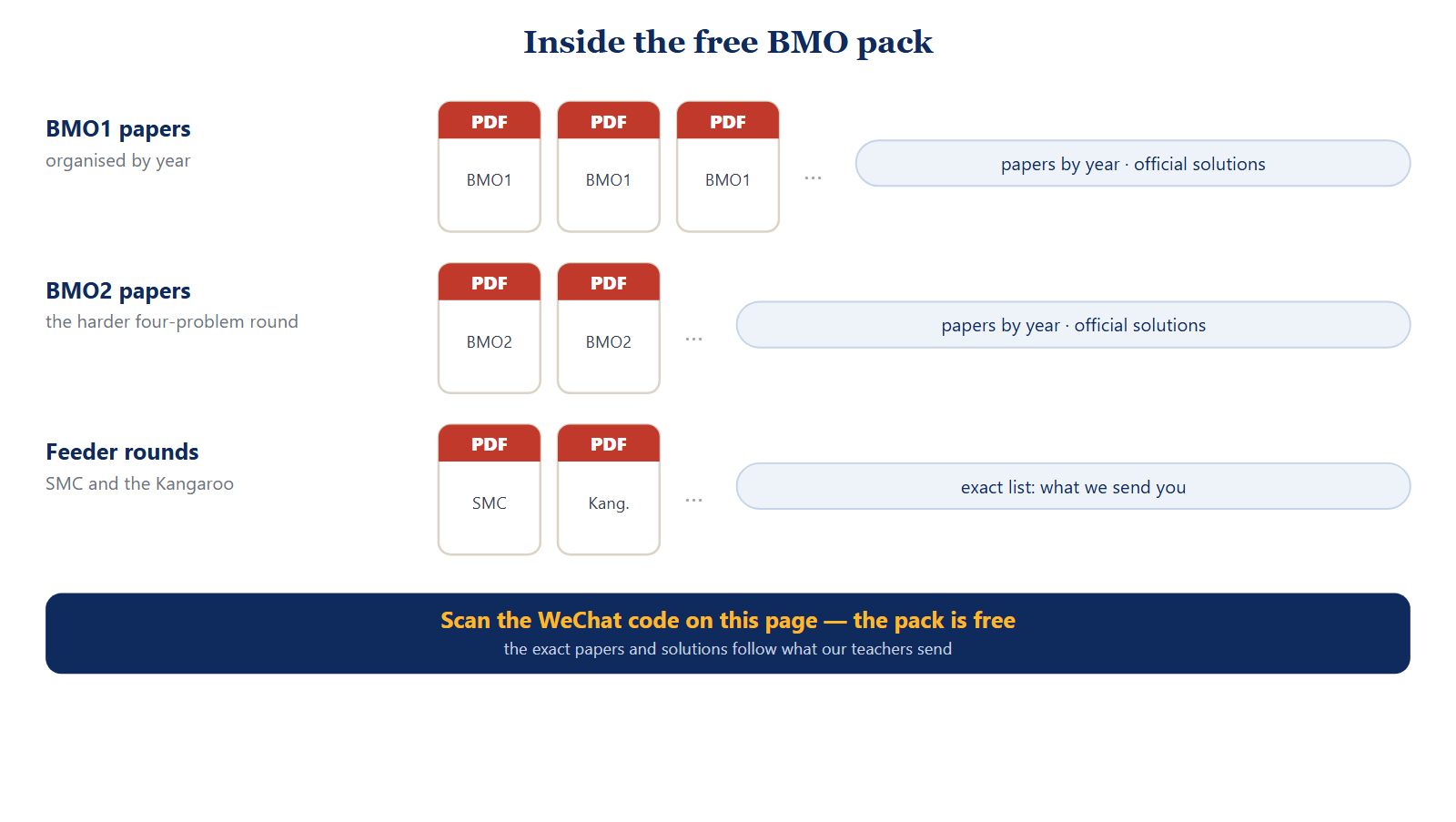
The value of a past-paper archive is not the questions alone — it is having the questions, the worked solutions, and a sensible order to attack them in, all in one place. Our pack brings those together so you spend your time solving, not hunting. Here is what it covers:
| In the pack | What you get |
|---|---|
| BMO Round 1 papers | The BMO1 question papers by year, with full worked solutions for many of the years — the round most international students start with |
| BMO Round 2 papers | BMO2 question papers by year, with worked solutions for the years we have them, for students invited to the harder second round |
| Feeder-round material | Senior Mathematical Challenge (SMC) practice, since the SMC is the gate that qualifies you for a BMO1 invitation |
| Topic notes | Curated notes on the recurring olympiad ideas (invariants, number theory, geometry, combinatorics) the papers keep testing |
If you are still mapping the route that leads to these papers — how the SMC qualifies you for BMO1, and BMO1 for BMO2 — our UKMT senior season timeline sets out the calendar, and how BMO marking works explains the scoring you are training against.
BMO1 vs BMO2 papers: what each one asks
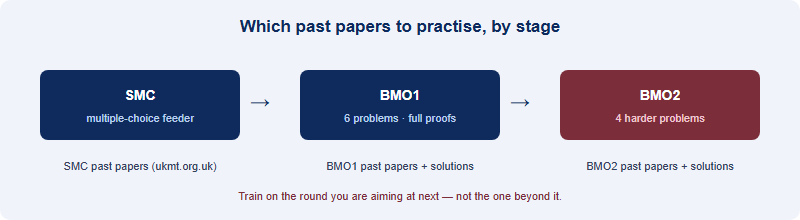
The two rounds are different exams, and their papers should be used differently. BMO1 presents six problems over 3½ hours, rising steeply in difficulty, each requiring a complete written proof rather than a numerical answer. BMO2 is the harder, invitation-only round with four problems over 3½ hours, where the later problems reach genuine olympiad depth. When you open a paper from the pack, you are not training for “a BMO” in the abstract — you are training for one specific round, with its own time budget and difficulty curve.
For an international student deciding what to attempt after the SMC, the sibling decision — BMO1 versus the Senior Kangaroo — is covered in Senior Kangaroo vs BMO1 after the SMC. When you request the pack we'll tell you which round's papers fit where you are now.
How to actually use BMO past papers (the part that matters)
Having the papers is the easy 10%. The 90% that changes your score is how you work through them. The most common mistake international students make is treating olympiad papers like exam past papers — reading the question, glancing at the solution, and ticking it off. That builds recognition, not problem-solving. Use this four-step loop on every problem instead:


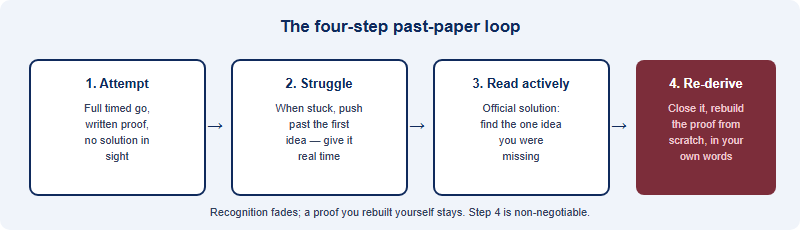
- Attempt under real conditions. Sit a whole paper to time, writing full proofs. Olympiad marks reward complete, rigorous arguments — partial credit follows the mark scheme, so practise writing, not just thinking.
- Struggle before you peek. The learning is in the stuck moment. Give a hard problem 30–45 minutes before opening the solution; the first idea is rarely the winning one.
- Read the solution actively. Don't absorb it line by line — hunt for the single key idea you missed, and name it (an invariant, a clever substitution, a parity argument).
- Re-derive from scratch. Close the solution and rebuild the proof in your own words. If you can't, you haven't learned it yet — you've only recognised it.
Work chronologically backwards from recent years, and keep an error log of the key ideas you keep missing — that log, not the number of papers done, is the real measure of progress. Structured guidance on which ideas to drill, and feedback on your written proofs, is where a coach adds the most over self-study; ask us about it when you collect the pack.
Ready to start? Get the pack free.
Scan the WeChat code on this page and message us for the BMO1 & BMO2 past papers (with worked solutions for many years — we'll tell you exactly which) plus topic notes — free. Tell us your current level and we'll point you to the right starting paper.
Frequently asked questions
How do I get the BMO past papers?
Scan the WeChat code on this page and message us. We'll send you the complete BMO1 & BMO2 archive with worked solutions and topic notes, free of charge.
Do the papers come with solutions?
Many of the years come with full worked solutions written to teach the key ideas, not merely to confirm the answer — but coverage varies by year and not every paper has one. Your advisor will tell you exactly which years are included when you request the pack.
Should I practise BMO1 or BMO2 papers?
Train for the round you are aiming at next. Work BMO1 papers until you are qualifying comfortably; move to BMO2 papers once you are invited to Round 2. When you collect the pack we'll point you to the right starting paper.
How many past papers should I do?
Depth beats volume. One paper worked through the four-step loop, with an error log, is worth more than five papers skimmed against the solutions.
This is an independent editorial guide to the UKMT pathway, operated by Hanlin Education for China-based international-school students. It is not affiliated with, endorsed by, or sponsored by the UK Mathematics Trust (UKMT) or the BMO subtrust; BMO, BMO1 and BMO2 are run by the BMO subtrust. Competition rules, dates and formats can change each year — confirm current details through the official BMO channels. Any factual error will be corrected within 7 working days.