The UK route runs Senior Mathematical Challenge → BMO Round 1 → BMO Round 2 — multiple-choice screening into long proof papers, and it explicitly admits overseas students. The US route runs AMC 10/12 → AIME → USAMO/USAJMO — multiple-choice, then a short-answer paper, then proofs. They test the same maths in different shapes, so most dual-track applicants should treat them as complementary, not either/or.
If you are a student at a Chinese international school weighing UK and US university applications, the two olympiad systems are not rivals you must choose between. They reward overlapping skills on different calendars, and — crucially for international applicants — they have very different access rules. Below we compare format, difficulty, audience and eligibility using current official information from ukmt.org.uk and the MAA, and we lay out how to plan a sensible dual-track year. For the fundamentals of the UK competition itself, start with our explainer on what the BMO is.
The two ladders, side by side
Both countries use a funnel: a wide, accessible entry round screens thousands of students into progressively harder, longer, proof-based rounds. The shape of the funnel is similar; the rungs are different. The UK ladder has one screening test and two olympiad rounds. The US ladder has one screening test, one short-answer “bridge” round (the AIME), and then the olympiad.
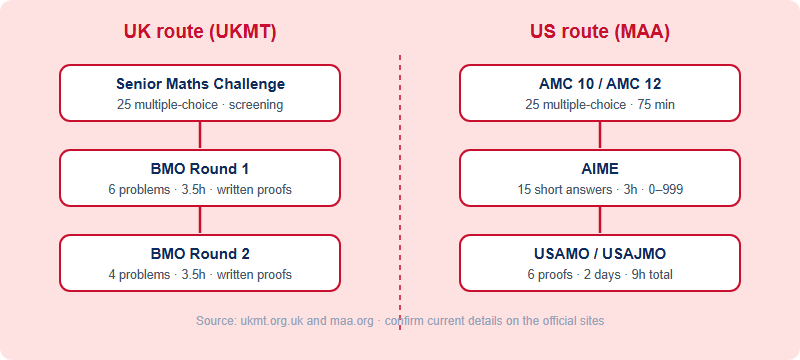
The biggest structural difference is the AIME. The US system inserts a 15-question, short-answer round (every answer an integer from 0 to 999) between the multiple-choice screen and the proof olympiad. The UK system has no such bridge — once you clear the Senior Mathematical Challenge, you go straight into full written proofs at BMO Round 1. That means UK students meet rigorous proof-writing earlier in the funnel, while US students get an extra calculation-heavy stage before proofs begin.
Format and timeline reference table
Here is the round-by-round comparison for the current cycle. All dates and figures below are taken from the official UKMT and MAA calendars; always re-check them before you enter, because dates shift each year.
| Stage | UK (UKMT) | US (MAA) |
|---|---|---|
| Screening round | Senior Mathematical Challenge — 25 multiple-choice questions | AMC 10 / AMC 12 — 25 multiple-choice questions, 75 minutes |
| Screening date(s) | Thu 9 October 2025 | AMC A: 5 Nov 2026 · AMC B: 13 Nov 2026 |
| Bridge round | None — proofs begin immediately | AIME — 15 short-answer questions, 3 hours, answers 0–999 |
| Bridge date(s) | — | AIME: one window, 5–6 Feb 2027 · the AIME I / II split is retired |
| Olympiad round 1 | BMO Round 1 — 6 problems, 3.5 hours, full written solutions (Wed 19 Nov 2025) | USAMO / USAJMO — 6 proof problems over 2 days, 9 hours total |
| Olympiad round 2 | BMO Round 2 — 4 problems, 3.5 hours, full written solutions (Wed 21 Jan 2026) | — (USAMO is the single olympiad stage) |
| Olympiad date | See above | USAMO / USAJMO: 21–22 March 2026 |
| Invitation scale | ~1000 invited to BMO1 from SMC; ~100 invited to BMO2 from BMO1 | AIME: 100+ on AMC 10 / 85+ on AMC 12 (fixed from 2027); USAMO/USAJMO primarily on the AIME score |
A note on the UK invitation figures: UKMT states it invites around 1000 qualifying students from the Senior Mathematical Challenge to BMO Round 1, and around 100 from BMO1 to BMO2. Schools can also enter strong students at their own discretion even without the qualifying score — useful for international centres. For the precise current cut-offs and entry mechanics, confirm on the official site.
Difficulty: where each path gets hard
“Harder” is the wrong question; “harder in what way” is the right one. The US AMC/AIME stages reward fast, accurate problem-solving across many topics under tight time pressure — 25 questions in 75 minutes, then 15 numerical answers in three hours. The skill is pattern recognition, speed and not making errors. The UK BMO rounds, by contrast, reward sustained reasoning: six problems in three and a half hours where a clean, complete written proof matters as much as the final answer. You can score well at BMO with only a few problems if your write-ups are rigorous.
Three concrete contrasts students feel in practice:
- Proof timing. UK students hit full proofs at the first olympiad round (BMO1). US students don’t write proofs until USAMO/USAJMO — the AMC and AIME are answer-only. So the UK route forces proof discipline earlier.
- Partial credit. BMO problems are marked on written working, so partial progress earns marks. AIME answers are right-or-wrong integers (0–999), with no partial credit at that stage.
- Stamina. USAMO/USAJMO is a two-day, nine-hour proof marathon. BMO rounds are single 3.5-hour sittings. Different kinds of endurance.
The encouraging news for dual-track students: the underlying toolkit — number theory, combinatorics, algebra, geometry — overlaps heavily. Time spent on either system strengthens the other. If you want a structured way to build that toolkit from the ground up, our JMO-to-Cayley reading plan sequences the foundational topics that feed into both BMO and AMC-style problems.
Eligibility: the decisive difference for China-based students
This is where the two systems diverge most sharply for international applicants, and where many families make planning errors. The headline: the UK route is openly available to overseas students, while the US route is accessible at the lower rungs but has a hard ceiling at the top for students not enrolled in a US or Canadian school.
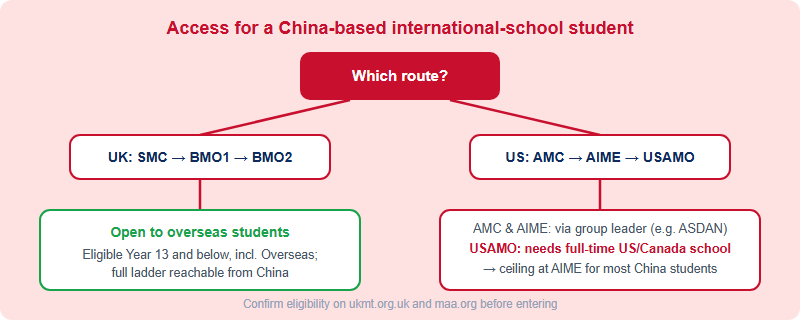
UK route. UKMT lists BMO Round 1 as open to eligible students in Year 13 and below, with “Overseas” explicitly named alongside England, Wales, Scotland and Northern Ireland. In practice this means a Chinese international school can enter students and, with strong results, the whole SMC → BMO1 → BMO2 ladder is reachable. (Selection to the UK IMO team is a separate, citizenship-bound stage — but the BMO rounds themselves are open.) For the detail on entering from outside the UK, see our BMO eligibility reality-check for international students.
US route. The MAA runs the AMC for students outside the USA and Canada through registered International Group Leaders. In China these include partners such as ASDAN for private schools, so AMC 10/12 and, by qualification, the AIME are accessible to international-school students. The ceiling appears at the olympiad: the MAA states that only students attending an accredited school full-time in the United States or Canada are eligible for USAMO and USAJMO. So for most students based in China, the realistic top of the US ladder is the AIME, not USAMO — a critical fact to plan around, and one to confirm directly with the MAA for your situation.


This is the single most important planning insight in this comparison, and it is easy to miss: a strong China-based student can complete the entire UK olympiad sequence, but on the US side will usually max out at AIME. That asymmetry should shape how you weight the two tracks.
How dual-track UK/US applicants should plan the year
Because the calendars barely overlap, you do not have to choose. A typical dual-track year looks like this: the Senior Mathematical Challenge in October, BMO Round 1 in November, the AMC in November, BMO Round 2 in January, the AIME in February, and — for students enrolled in the US/Canada — USAMO/USAJMO in March. The autumn is busy, but the proof-heavy UK rounds and the answer-heavy US rounds reinforce the same skills.
Practical guidance for China-based international-school students:
- Lead with the route you can finish. If you cannot enrol full-time in a US/Canada school, your complete olympiad story runs through the UK ladder. Make BMO your spine and use the AMC/AIME as a complementary, speed-sharpening track.
- Use the AMC/AIME to build calculation fluency. The timed, answer-only format is excellent training for accuracy and speed that pays off in the first half of BMO papers too.
- Use BMO to build proof discipline. Writing complete solutions for BMO1/BMO2 is exactly the rigour that, for eligible students, USAMO later demands — and it reads strongly to admissions for both UK and US universities.
- Confirm every date and rule yourself. Dates, qualifying scores and international entry mechanics change yearly. Treat the figures here as a planning frame and verify on ukmt.org.uk and the MAA before you commit.
The honest summary: these are complementary systems, not competitors. For a China-based applicant, the UK route offers a fully reachable end-to-end olympiad path, while the US route offers excellent training and a strong AMC/AIME credential. Run both where you can; lead with the one you can complete.
Frequently asked questions
Is the BMO harder than the AMC?
They are hard in different ways. BMO needs full written proofs over 3.5 hours; the AMC is 25 timed multiple-choice questions. BMO rewards rigour, the AMC rewards speed and accuracy.
Can a student in China take both the BMO and the AMC?
Yes. The UK route admits overseas students, and the AMC runs through international group leaders in China. The calendars rarely clash, so a dual-track year is workable.
Can China-based students reach the USAMO?
Usually not. The MAA limits USAMO/USAJMO to students attending a US or Canada school full-time, so most China-based students top out at the AIME. Confirm your case with the MAA.
Which path is better for university applications?
Both signal strong mathematics. The UK ladder is fully completable from China; the AMC/AIME is a respected credential. Lead with the route you can finish, and add the other.
Next steps
- BMO past papers, and how to use them — the single highest-value thing to do once you have picked a path
- The BMO rounds explained — what BMO1 and BMO2 actually ask, side by side
- Preparation resources — reading list, problem sets and the proof-writing habits that score
This is an independent editorial guide operated by Hanlin Education for China-based international-school students. It is not affiliated with, endorsed by, or sponsored by UKMT or the BMO Subtrust, nor by the Mathematical Association of America. Dates, formats, qualifying scores and eligibility rules change each cycle — always confirm current details on ukmt.org.uk and bmos.ukmt.org.uk (and on maa.org for US competitions) before entering. We correct confirmed errors within 7 working days.