To prepare for BMO Round 2, shift from speed to depth: it is a 3.5-hour paper of four problems, each marked out of 10 for a full written proof, sat on Wednesday 21 January 2026 (confirm the current date on ukmt.org.uk). Unlike Round 1, partial answers earn little — examiners reward complete, rigorous arguments. Train the four workhorse techniques (induction, invariants, pigeonhole, contradiction) and practise writing one airtight solution end to end.
What actually changes between BMO Round 1 and Round 2
Round 1 and Round 2 share the same 3.5-hour clock, but they reward almost opposite habits. BMO Round 1 is six problems; the official UKMT instruction is blunt — “One complete solution will gain far more credit than partial attempts at all six problems.” Round 2 takes that logic to its conclusion: only four problems in the same time, each worth 10 marks, for 40 total. According to UKMT, around 100 students who perform well in BMO1 are invited to BMO2, and the paper is sat in candidates’ own schools.
The practical effect is a change of pace. In Round 1 you can hunt across six questions for the two or three you can crack. In Round 2 you have roughly 50 minutes per problem if you split time evenly — but strong candidates rarely do. They invest the first hour finding the idea on one or two problems, then spend the rest writing those up flawlessly. A half-finished fourth problem is worth far less than two complete proofs. If you are still deciding whether you are eligible to sit it from outside the UK, our companion guide on BMO eligibility for international students covers the Year 13-and-below rule and the school-entry route.
| Dimension | BMO Round 1 | BMO Round 2 |
|---|---|---|
| Problems | 6 | 4 |
| Time | 3.5 hours | 3.5 hours |
| Marks per problem | 10 | 10 |
| Total marks | 60 | 40 |
| Where sat | In your school | In your school |
| Who sits it | Open + qualifiers from SMC | ~100 invited from BMO1 (+ school entry) |
| What scores | Complete solutions > many partials | Full rigorous proofs; partials earn little |
| What follows | Invitation to BMO2 | ~24 IMO-eligible go to Cambridge training (Easter) |
One more shift matters for ambition. UKMT states that around 24 high-scoring students who are eligible to represent the UK at the International Mathematical Olympiad are invited to a training session in Cambridge around the Easter holidays. For an international student, that selection pathway may not apply, but the certificates and the mathematical credential do — and BMO2 remains a genuine signal of olympiad-level proof ability for university applications. For the broader picture of what the competition is and where it sits, see What Is the British Mathematical Olympiad.
How BMO Round 2 is marked — and why it changes your strategy
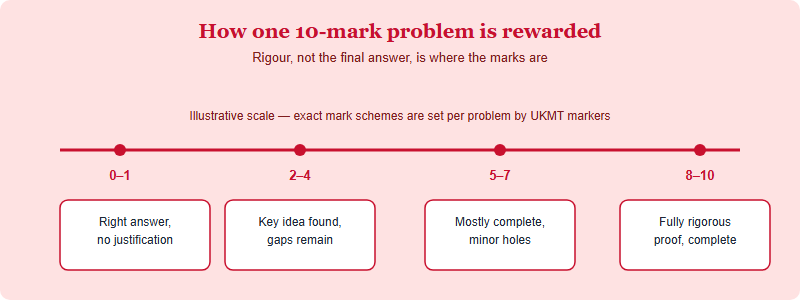
The single most important fact to internalise: olympiad marking is not multiple choice and not “answer-only.” The official BMO1 rubric requires “full written solutions — not just answers — with complete proofs of any assertions you may make,” and Round 2 is marked the same way by a panel of around twenty markers. Each problem is scored on a 0–10 scale where the jump from a clever observation to a watertight proof is where most marks live.
Markers think in terms of how much of a complete argument you have. A correct final number with hand-waving in the middle can score surprisingly low; a fully justified proof that you reached methodically scores high. This is why the 2026 award thresholds reward depth: a Certificate of Distinction went to the top 25% of qualified entrants (18+ out of 40 in 2026) and a Certificate of Merit to the next 45% (9+ out of 40), per UKMT — note that two solid, fully-proved problems can already reach Distinction territory. Thresholds vary each year, so confirm on the official site.
The four proof techniques that carry BMO Round 2
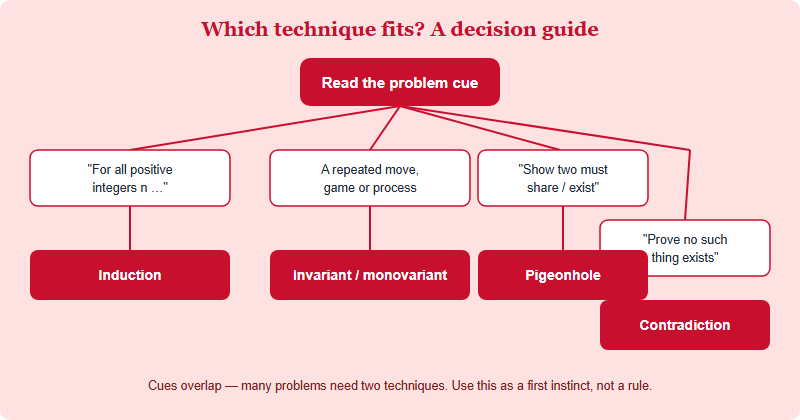
Olympiad problems look unfamiliar by design, but a small toolkit unlocks most of them. These four techniques recur across number theory, combinatorics, geometry and algebra — and recognising which one fits is half the battle.
1. Mathematical induction. When a statement depends on a positive integer n, induction lets you build a proof from a base case and an inductive step. Beyond the basic form, learn strong induction (assume the claim for all values up to k) and downward/structural induction on the size of a configuration. Induction is the natural reflex for “prove this holds for all n” — but you must state the hypothesis precisely and verify the base case honestly; a sloppy base case is a common mark-loser.
2. Invariants and monovariants. In process and game problems (“you repeatedly do X — what is reachable?”), find a quantity that never changes (an invariant) or only moves one way (a monovariant). Parity (odd/even) is the simplest invariant; colourings and sums modulo a number are close behind. If a target state has a different invariant value from the start, it is impossible — and that impossibility is the proof.
3. The pigeonhole principle. If you place more objects than boxes, some box holds at least two. Trivial to state, deadly in application: the art is choosing the right “pigeons” and “holes.” Pigeonhole underwrites many existence arguments in combinatorics and number theory (“two of these must share a remainder mod m”). Its generalised form — n items in k boxes forces a box with at least ⌈n/k⌉ — is worth memorising.


4. Proof by contradiction (and contrapositive). Assume the opposite of what you want, then derive an impossibility. This is the standard route for “prove no such configuration exists” or “prove a number is irrational.” A close relative, the extremal principle, assumes a smallest or largest object and shows it cannot exist or must have a special property — a technique that powers many of the hardest BMO2 problems.
A realistic preparation plan
You cannot cram olympiad maturity, but you can build it deliberately over a few months between BMO1 (typically autumn) and BMO2 in January. The goal is not to memorise problems — it is to recognise structures and to write proofs a stranger could mark. Here is a workable cadence for an international student preparing largely independently.
| Phase | Focus | What to do each week |
|---|---|---|
| Weeks 1–3 Foundations | One technique at a time | Study induction, then invariants, then pigeonhole, then contradiction. For each, work 8–10 short problems until the pattern feels automatic. |
| Weeks 4–6 Topic depth | Number theory + combinatorics | These dominate BMO2. Drill modular arithmetic, divisibility, counting and extremal arguments. Write every solution in full prose. |
| Weeks 7–9 Past papers | Real BMO2 problems | Use official past papers from bmos.ukmt.org.uk. Attempt one problem under timed conditions, then study the official solution. |
| Weeks 10–12 Full simulation | Exam rhythm + write-up | Sit a complete 3.5-hour, four-problem mock. Mark it against the official scheme. Rewrite your two best solutions to a publishable standard. |
Three habits matter more than volume. First, write proofs in full sentences, not symbol-soup — if a marker has to guess your logic, you lose marks you earned in your head. Second, read official solutions critically: ask “what was the key idea, and what cue should have triggered it?” so your pattern library grows. Third, time your write-ups, not just your thinking — many strong solvers find the idea but run out of clock before the proof is on paper. If you are coming up from the junior rounds, the structured ladder in our JMO-to-Cayley reading plan shows how to sequence skills before you ever reach BMO2.
Finally, calibrate your target honestly. With 40 marks on offer and a 2026 Distinction threshold of 18, you do not need to solve all four problems — two complete, rigorous proofs is a serious result. Aim to convert the problems you can do into full marks rather than scattering partial attempts across all four. Quality of write-up, not coverage, is the BMO2 game.
Frequently asked questions
How many questions are on BMO Round 2 and how long is it?
BMO Round 2 is a 3.5-hour paper with four problems, each marked out of 10 (40 total). Confirm current details on ukmt.org.uk.
Do I need to solve all four problems to do well?
No. Marking rewards full proofs, and the 2026 Distinction threshold was 18 of 40 — two complete, rigorous solutions can already reach it.
Which proof techniques matter most for BMO2?
Induction, invariants/monovariants, the pigeonhole principle, and proof by contradiction (with the extremal principle) cover most BMO2 problems.
Can international students sit BMO Round 2?
Overseas students in Year 13 or below may be eligible via the school-entry route; UK team selection has extra rules. Verify on ukmt.org.uk.
This is an independent editorial guide operated by Hanlin Education for China-based international-school students. It is not affiliated with, endorsed by, or sponsored by the UK Mathematics Trust (UKMT) or the BMO Subtrust. Competition dates, formats, marks, thresholds and eligibility change year to year — always confirm current details on ukmt.org.uk and bmos.ukmt.org.uk. Spotted an error? We correct confirmed mistakes within 7 working days.
Next steps
- The BMO Round 1 & 2 guide — how the British Mathematical Olympiad works.
- BMO past papers — the free pack and a proven way to use it.