BMO Round 1 carries 60 marks — six problems worth 10 marks each — and is graded on an olympiad full-marks scheme, not a school-style “marks for effort” rubric. UKMT states plainly that “many olympiad mark schemes are such that a score of 5 out of 10 cannot be awarded,” and that “one complete solution will gain more credit than several unfinished attempts” (per ukmt.org.uk). Understanding why is the difference between a near-miss and a Merit.
The headline numbers: 6 questions, 10 marks each, 60 total
BMO Round 1 is a 3.5-hour written paper of six problems. Each problem is marked out of 10, for a maximum of 60. There is no multiple choice and no answer sheet: you submit complete written arguments, and “candidates are expected to give full written solutions, including complete proofs of any assertions they make” (per ukmt.org.uk). If you are new to the contest itself, start with our What Is the British Mathematical Olympiad overview, then come back for the scoring mechanics.
That structure already tells you something strategic. Sixty marks across six questions in 210 minutes is roughly 35 minutes per problem if you spread evenly — but you should not spread evenly. Because of how the scheme rewards completeness, the marginal value of finishing one more problem usually beats the marginal value of adding a third partial idea to a problem you cannot close.
| Parameter | BMO Round 1 | BMO Round 2 |
|---|---|---|
| Number of problems | 6 | 4 |
| Marks per problem | 10 | 10 (confirm on the official site) |
| Total marks | 60 | 40 |
| Time allowed | 3.5 hours | 3.5 hours |
| What is submitted | Full written proofs | Full written proofs |
| Typical qualifying pool | ~1000 from the SMC | ~100 from BMO1 |
Why the scheme is “all-or-nothing” by design
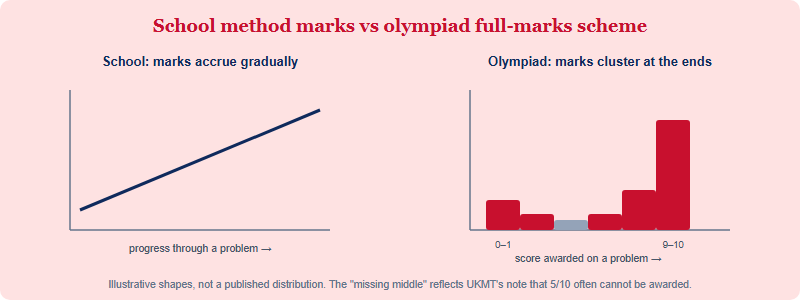
School maths rewards method marks: show a sensible approach, drop an arithmetic slip, still bank most of the marks. Olympiad marking inverts this. UKMT describes the logic directly: “the logical structure of the mark scheme aims to reflect the logical structure of the problem while rewarding correct arguments more generously than correct calculations” (per ukmt.org.uk). A proof is a chain. If a load-bearing link is missing or merely asserted, the chain does not hold — and an unjustified leap, however plausible, is not a proof.
This is why “a score of 5 out of 10 cannot be awarded” on many problems: the marks cluster at the ends. A genuinely complete, rigorous solution earns high marks; a promising start that stops before the key step earns low marks. The middle is thin because there is rarely a “half-correct proof” — either the argument closes or it has a gap.
What this means for how you write under exam pressure
If completeness is rewarded and partial credit is scarce, your writing strategy should follow. These are editorial coaching habits drawn from how the scheme behaves — not official UKMT rules — and they map directly onto the points above.
- Finish one before you flirt with three. A single fully proved problem outscores three half-proved ones. Pick the problems you can actually close and close them.
- Justify every assertion. “Clearly,” “obviously,” and “it follows that” are where marks leak. If a step needs a reason, write the reason — correct arguments are rewarded more than correct numbers.
- State your claim, then prove it. Markers follow “the logical structure of the problem.” Make your structure visible: name what you are about to show, then show it.
- Do not abandon a near-complete proof to chase a new question. The last 10% of a proof often carries the marks that the first 90% set up.
- Write for a reader, not for yourself. A solution you can follow in your head but have not written down scores what is on the page, which may be very little.
The deeper point for international students is that this rewards a skill many strong calculators have never trained: writing a watertight argument in continuous prose. A student who routinely tops school exams on speed and accuracy can still score low on BMO1 the first time, simply because the paper is testing proof, not computation. That gap is trainable — and it is exactly where focused preparation pays off.
From raw score to certificate: Distinction and Merit
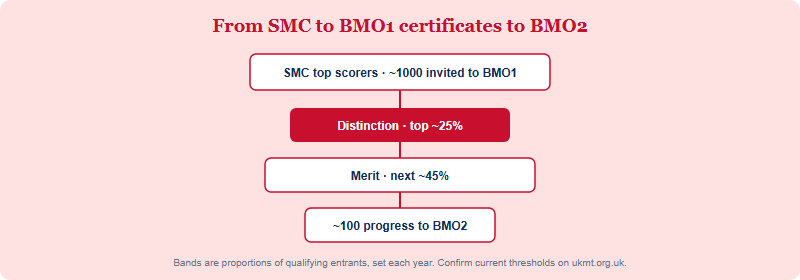
BMO1 awards certificates above threshold, and the thresholds are relative to the qualifying field each year, not a fixed mark. UKMT describes the top 25% of qualifying entrants receiving a Certificate of Distinction and the next 45% a Certificate of Merit (confirm the current year’s wording on the official site). Because the cohort is already self-selected — roughly the top thousand from the SMC — clearing these thresholds is a meaningful signal, not a participation mark.
For students planning a year around these gates, the scoring model should shape preparation from the start — you are training proof-writing for marks, not exam tricks. Our companion pieces on eligibility for international students and the earlier-stage JMO-to-Cayley plan show where to build that proof habit before the senior rounds arrive.


A concrete picture: why “correct arguments beat correct calculations”
Consider two students attempting the same BMO1 problem — described in general terms here, not from any specific paper, to illustrate how the scheme behaves. Student A spots the key idea, sets up the right structure, but runs out of time and leaves one case unproven and an inequality merely “clearly true.” Student B finds a slightly clumsier route but closes every case and justifies every line. Under a school rubric, A might edge ahead on insight. Under the olympiad scheme, B almost certainly scores higher, because the marks follow the completeness of the argument, not the elegance of the idea.
This is the practical meaning of UKMT’s statement that the scheme rewards “correct arguments more generously than correct calculations.” A correct numerical answer with a hand-waved justification is worth far less than a fully reasoned argument. The contest is not asking what is true; it is asking you to demonstrate why it must be true, with no gaps a sceptical reader could drive through.
| What you wrote | How the olympiad scheme tends to treat it |
|---|---|
| Complete, rigorous proof of the full result | High marks — the chain holds end to end |
| Right idea, but one case or step left unjustified | Low-to-mid marks — a single gap breaks the chain |
| Correct final answer, little or no justification | Few marks — the answer is not the point; the proof is |
| Several partial attempts across different problems | Less than one finished proof — completeness is rewarded |
| “Clearly / obviously / it follows that” over a real step | Marks leak — assertions are not proofs |
The takeaway for an international student training for BMO1 is that the highest-leverage skill is not learning more advanced topics — it is learning to write the topics you already know without gaps. Two students with the same mathematical knowledge can score 40 marks apart purely on rigour and presentation. This is also why mock papers should be marked the olympiad way, not the school way: if a teacher hands back “good attempt, 6/10” on a proof with a hole in it, the feedback is training the wrong instinct.
How to read your own result and plan the next step
Because thresholds are relative to each year’s field, a raw BMO1 score only means something in context. A score that earns a Merit one year might sit just below the line another, depending on the cohort and the paper’s difficulty. Read your result as a position in the field, not an absolute mark — and use it to plan. A first-time entrant who scores on two or three problems has shown the proof instinct is there and usually has the most to gain from targeted rigour work. A student clearing the Distinction band is realistically in BMO2 territory, where four harder problems and the same 3.5 hours await. Our guides on eligibility for international students and the foundational JMO-to-Cayley plan show how to build, season by season, toward those higher bands.
Frequently asked questions
How many marks is each BMO1 question worth?
Each of the six BMO Round 1 problems is worth 10 marks, giving a maximum of 60. The paper runs 3.5 hours and requires full written proofs (per ukmt.org.uk).
Why can't I get 5 out of 10 on a question?
UKMT notes that many olympiad schemes cannot award 5/10: a proof either closes or has a gap, so marks cluster low for partial attempts and high for complete ones. Confirm specifics on the official site.
Is one finished problem better than several started ones?
Yes. UKMT states one complete solution gains more credit than several unfinished attempts, because correct arguments are rewarded more generously than partial calculations.
What score earns a Distinction?
Thresholds are relative each year: roughly the top 25% of qualifying entrants receive a Distinction and the next 45% a Merit. Always confirm the current year’s figures on ukmt.org.uk.
This is an independent editorial guide operated by Hanlin Education for China-based international-school students. It is NOT affiliated with, endorsed by, or sponsored by UKMT or the BMO Subtrust. Marking schemes, mark totals and certificate thresholds change year to year — confirm current details on ukmt.org.uk before relying on them. Any error will be corrected within 7 working days of notification.