The UKMT senior pathway runs in three stages: the Senior Mathematical Challenge (SMC) in October, British Mathematical Olympiad Round 1 (BMO1) in November, and BMO Round 2 (BMO2) in January. Each round qualifies you for the next: around 1,000 SMC scorers are invited to BMO1, and roughly the top 100 from BMO1 reach BMO2. Students based outside the UK can sit the papers at a registered exam centre, but UK IMO team selection has separate residency rules.
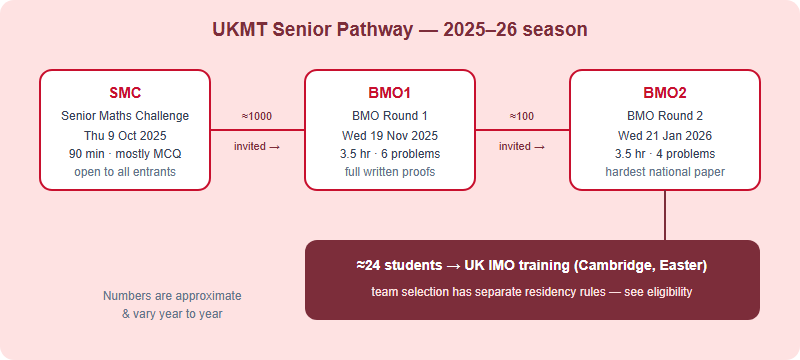
The three-stage senior route, in one picture
If you are preparing from a Chinese international school, the single most useful thing to understand first is that the UKMT senior competitions are a funnel, not a menu. You do not pick “the BMO” and enter it directly the way you might register for a one-off contest. You enter the SMC, and your score on that paper decides whether an invitation to BMO1 follows. The same logic chains again from BMO1 to BMO2. Each stage is harder, shorter on questions, and longer on written proof.
The diagram below is the map every senior competitor should carry in their head. It shows the format shift at each stage — from fast multiple-choice reasoning at SMC to full Olympiad write-ups at BMO1 and BMO2 — and the rough numbers who progress. For a plain-language primer on what the olympiad itself is, see our companion piece, What Is the British Mathematical Olympiad.
Stage 1 — Senior Mathematical Challenge (October)
The SMC is the gateway. For the 2025–26 season it was held on Thursday 9 October 2025, a 90-minute paper open to students in Year 13 and below (England, Wales and Overseas), S6 or below in Scotland, and Year 14 or below in Northern Ireland. Historically the SMC was 25 multiple-choice questions; for 2026 UKMT is trialling a revised structure of 22 multiple-choice questions plus three “000–999” integer-answer questions. Because format details like this can change, confirm the exact paper structure on the official SMC page before you sit it.
The SMC rewards speed and clean reasoning, not lengthy proof. There is no requirement to “show your working” for marks — what counts is the answer. That makes it a very different exercise from what comes next, and it is precisely why many strong international students underestimate the jump to BMO1. Treat the SMC as a timed reasoning sprint: read fast, eliminate aggressively, and protect easy marks before chasing the back-end questions.
Crucially, your SMC score is what generates a BMO1 invitation. UKMT sets a qualifying threshold each year; the exact boundary moves, so do not memorise a number you read in a forum — confirm the current cut-off on the official site. As a first-party observation from coaching China-based cohorts: the students who clear the BMO1 threshold comfortably are almost always the ones who treated the SMC as a serious target in its own right, not a warm-up they could coast through.
Stage 2 — BMO Round 1 (November)
BMO1 is where the competition becomes a true olympiad. For 2025–26 it fell on Wednesday 19 November 2025: a 3.5-hour paper with six problems, each requiring a full written solution. UKMT invites around 1,000 qualifying students from the SMC. Students who did not sit the SMC, or who narrowly missed the automatic threshold, can still be entered at their school’s discretion — so a capable student is not permanently locked out by one off day on the multiple-choice paper.
The skill shift here is enormous. On the SMC, a correct final number is everything. On BMO1, a correct number with no valid argument earns very little — marks come from a rigorous, communicated proof. This is the single biggest reason a student can be “good at maths” and still find BMO1 brutal: writing mathematics is a separate craft from solving it. If you are building that skill from a junior base, our JMO-to-Cayley reading plan shows how the proof habit develops year by year long before the senior rounds.
For international students, two practical points matter most. First, you must sit the paper at a registered UKMT exam centre — many international schools already run UKMT challenges, so ask your maths department whether your school is registered before assuming you need to find an external centre. Second, the top scorers in BMO1 are the pool from which BMO2 is drawn, so BMO1 is both a destination and a qualifier.
Stage 3 — BMO Round 2 (January) and what lies beyond
BMO2 is the UK’s hardest national mathematics paper. For 2025–26 it was scheduled for Wednesday 21 January 2026: a 3.5-hour Olympiad with four problems, again demanding complete written solutions. Where BMO1 has six problems, BMO2 has four — fewer questions, far deeper. UKMT invites around 100 qualifying students from BMO1 to sit it.
Beyond BMO2, the pathway becomes selection rather than open competition. A much smaller group — UKMT describes it as around 24 high-scoring students who are eligible to represent the UK at the International Mathematical Olympiad — is invited to a training session held in Cambridge around the Easter holidays. This is the point where eligibility rules genuinely bite for overseas students, which we unpack in the next section.
How China-based international students access the pathway
Here is the distinction that causes the most confusion, stated plainly: sitting the papers and being selected for the UK IMO team are two different things. According to the BMOS eligibility policy, BMO1 and BMO2 are open-entry competitions for students in full-time secondary education, taken at a registered UKMT exam centre. That means an international-school student in China can, in principle, enter and sit them.


UK IMO team selection is narrower. The standard route requires that a student either holds British citizenship, or will have completed at least three full years of full-time secondary education in the UK by the time they leave school. There are documented provisions for British students resident overseas and for refugees, stateless or asylum-seeking students — but these come with conditions, including not taking part in the IMO selection activities of more than one country in the same academic year. The honest summary: the competition experience and the awards are widely accessible; the UK team place is gated by residency or nationality. We cover this in depth in BMO eligibility for international students.
| Round | 2025–26 date | Time | Questions | Answer style | Who is invited |
|---|---|---|---|---|---|
| SMC | Thu 9 Oct 2025 | 90 min | 22 MCQ + 3 integer-answer* | Answer only | Open entry (Year 13 & below) |
| BMO1 | Wed 19 Nov 2025 | 3.5 hr | 6 problems | Full written proof | ≈1,000 from SMC + discretionary |
| BMO2 | Wed 21 Jan 2026 | 3.5 hr | 4 problems | Full written proof | ≈100 from BMO1 |
| IMO training | Easter (Cambridge) | — | — | — | ≈24, UK-eligible only |
*2026 trial format for the SMC, replacing the previous all-multiple-choice structure for the final questions. Confirm the current format and all dates on ukmt.org.uk before entering.
A realistic preparation timeline (work backwards from October)
Because the rounds are fixed in the calendar, the smartest move is to plan backwards from the SMC date. The decision tree below shows how a China-based student should sequence the year — and, importantly, where the path branches if BMO1 does not come this cycle. Missing the BMO1 threshold one year is a data point, not a verdict; the senior route repeats annually, and the proof skills you build transfer directly to the next attempt.
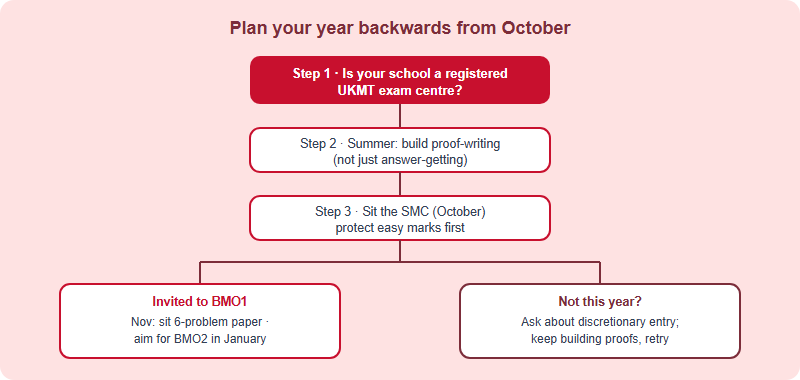
One more first-party note from working with Chinese international-school cohorts: the students who progress are rarely the ones who started latest-but-hardest in October. They are the ones who spent the summer learning to write a proof — to state assumptions, justify each step, and finish an argument — so that when BMO1’s six problems arrive, the format is familiar even when the problems are hard.
Frequently asked questions
Can a student in China enter BMO1 directly without the SMC?
BMO1 invitations are mainly from SMC scores, but schools can make discretionary entries. Ask your maths department, and confirm current entry routes on ukmt.org.uk.
What is the difference between BMO1 and BMO2?
BMO1 is six problems in 3.5 hours; BMO2 is four problems in 3.5 hours and is harder. Around 100 of the top BMO1 scorers are invited to BMO2.
Can international students be picked for the UK IMO team?
You can sit the papers, but UK team selection needs British citizenship or three full years of UK secondary schooling. Confirm details on bmos.ukmt.org.uk.
When are the 2025–26 rounds held?
SMC on 9 October 2025, BMO1 on 19 November 2025, and BMO2 on 21 January 2026. Dates change yearly — always verify on the official UKMT calendar.
Next steps
- The BMO rounds explained — what you are working toward once the entry route is settled
- BMO past papers, and how to use them — start here as soon as your centre place is confirmed
- Preparation resources — the reading and problem sets that suit a self-directed run-up
This is an independent editorial guide operated by Hanlin Education for China-based international-school students. It is not affiliated with, endorsed by, or sponsored by UKMT or the BMO Subtrust. Dates, formats, thresholds and eligibility rules change year to year — always confirm current details on ukmt.org.uk and bmos.ukmt.org.uk. We correct confirmed errors within 7 working days.