The Senior Mathematical Challenge is marked out of 125. You begin the paper holding 25 marks, gain 4 for a correct answer and lose 1 for a wrong one. That single scheme means that if you answer all 25 questions, your score is exactly five times the number you get right. This page turns that arithmetic into two lookup tables — score to band, and answer or leave blank — for the China-region sitting on Thursday 8 October 2026.
Three dates, one fee, and what the SMC is actually for
The China region runs its own calendar, and this year the gap between the two calendars is one day at the front and a whole structural difference behind it. The UK sits the Challenge on Wednesday 7 October 2026 per ukmt.org.uk. The China-region paper is the following day, and entry closes on a Monday ten days before that.
| Fixture | Date | Sitting window | Entry closes | Fee | Source |
|---|---|---|---|---|---|
| SMC, UK sitting | Wednesday 7 October 2026 | — | Through your school | — | ukmt.org.uk |
| SMC, China region | Thursday 8 October 2026 | 17:00–18:30 | Monday 28 September 2026 | RMB 240 | 2026–27 China-region handbook |
| BMO Round 1, China region | Thursday 19 November 2026 | 17:00–20:30 | Confirm with the organising channel | RMB 880 | 2026–27 China-region handbook |
| BMO Round 2, China region | Thursday 21 January 2027 | Confirm at registration | Monday 11 January 2027 | RMB 880 | 2026–27 China-region handbook |
Now the fact that changes how you should read your own mark. In the UK, the Challenge is a gate: your score is what invites you to Round 1. In the China region, the handbook states that students may register for BMO Round 1 directly, at any high-school year, with no qualifying Challenge score required. Round 1 entry is a separate RMB 880 payment on 19 November whether or not you sat 8 October.
So for a China-based candidate the Challenge is not a gate. It is a measuring instrument — the cheapest, most standardised way to find out where you sit against a UK field that numbered about 130,000 for the 2025-26 papers per the handbook before you commit RMB 880 and three and a half hours to a proof paper. That is a good reason to enter, and a very good reason to score it honestly afterwards rather than rounding your result upward. If you are still unsure which parts of the pathway are open to you from a school outside the UK, our eligibility reality check for international students sets out the boundaries.
The band table, and what each line costs in correct answers
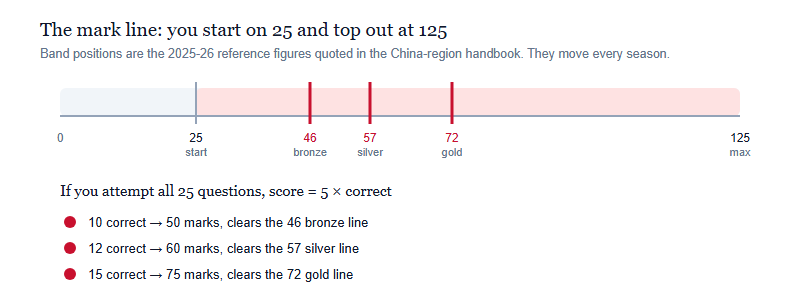
The paper is 25 questions in 90 minutes: 22 multiple choice and three questions answered with a number from 000 to 999, which UKMT has described as a change affecting the last three questions. Confirm the current arrangement on ukmt.org.uk. Marking is 25 to start, plus 4 for correct, minus 1 for wrong. Twenty-five questions at plus 4 is 100, and 25 plus 100 is the 125 maximum that the published boundaries are quoted against.
| Band (2025–26 reference) | Mark, out of 125 | Correct answers needed if you attempt all 25 | What the mark tells a China-based candidate |
|---|---|---|---|
| Gold | 72 or more | 15 | Your speed and accuracy are not the constraint. Round 1 preparation should be about writing proofs, not about faster arithmetic. |
| Silver | 57 or more | 12 | Strong technique, patchy under time. Expect Round 1 to punish incomplete write-ups more than missing ideas. |
| Bronze | 46 or more | 10 | The material is reachable; the clock is the enemy. Time-boxed practice will move this number fastest. |
| Below the bronze line | Under 46 | 9 or fewer | Not a verdict on Round 1, which rewards depth over speed — but treat the Challenge result as a reason to work on fundamentals in parallel. |
Notice how narrow the bronze margin is. Nine correct answers with every question attempted gives 45, one mark under the 2025–26 bronze line. Ten gives 50. The difference between those two outcomes is usually not a tenth question you could solve; it is five questions you could not solve and answered anyway.
The one line of arithmetic that runs the whole paper
Write c for the number you get right and a for the number you attempt. Wrong answers are a minus c, so your score is 25 plus 4c minus (a minus c), which simplifies to:
Score = 25 + 5 × (correct) − (attempted)
Everything else follows from that line. Attempt all 25 and the two 25s cancel, leaving five times your correct count. Leave five blank and you keep five marks you would otherwise have handed back — provided those five really were questions you would have got wrong.
| Correct answers | A. All 25 attempted | B. 20 attempted, 5 left blank | C. Only the ones you are sure of |
|---|---|---|---|
| 8 | 40 | 45 | 57 |
| 9 | 45 | 50 | 61 |
| 10 | 50 | 55 | 65 |
| 11 | 55 | 60 | 69 |
| 12 | 60 | 65 | 73 |
| 13 | 65 | 70 | 77 |
| 14 | 70 | 75 | 81 |
| 15 | 75 | 80 | 85 |
| 16 | 80 | 85 | 89 |
Worked example, because this is where the marks hide. Fourteen correct with all 25 answered gives 70, which is under the 2025–26 gold line of 72. The same fourteen correct with three hopeless questions left blank gives 25 plus 70 minus 22, which is 73. Identical mathematics, identical understanding, different band — decided entirely by what you did in the last four minutes.
Answer or leave it: the one-in-five rule
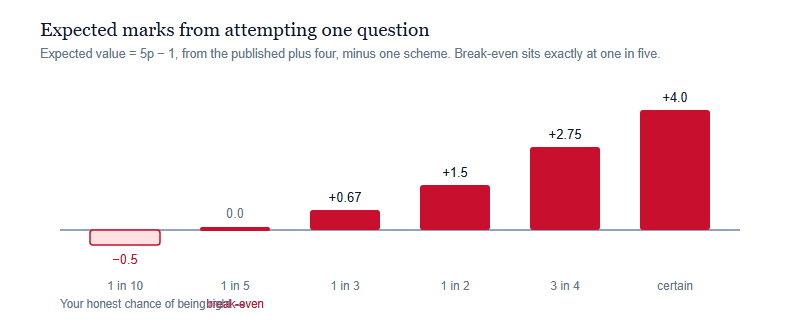
Because a correct answer is worth 4 and a wrong one costs 1, the expected value of attempting a question where you have probability p of being right is 5p minus 1. That expression is zero when p equals one fifth. So the rule is short enough to hold in your head under time pressure:


Answer if your honest chance of being right is better than one in five. Otherwise leave it blank.
| Situation in the room | Chance you are right | Expected marks | Verdict |
|---|---|---|---|
| You solved it and checked it | Near certain | +4 | Answer, and do not revisit it |
| Two candidates left and one feels wrong | About 3 in 4 | +2.75 | Answer |
| Down to two, genuinely undecided | 1 in 2 | +1.5 | Answer |
| You have ruled something out but little more | 1 in 3 | +0.67 | Answer |
| No progress, nothing eliminated | At or below 1 in 5 | 0 or less | Leave blank |
| A numeric 000–999 question you have not computed | Effectively nil | About −1 | Leave blank |
One first-party observation, offered as an observation and not as a UKMT statistic: in the practice scripts our own coaching desk marks, the commonest self-inflicted loss on a Challenge paper is a block of end-of-paper answers filled in during the last four minutes, on questions the candidate had not read properly. Ninety minutes across 25 questions is about three and a half minutes each, and the honest version of the final four minutes is usually to check two answers you already have rather than to invent five you do not.
Reading your 8 October mark into a 19 November decision
Because Round 1 entry does not depend on this score, the only job the number has is to tell you what to do with the six weeks between the two papers. Round 1 is a different animal: six questions, 60 marks, full written proofs, and marks awarded for argument rather than for the final number. If that structure is unfamiliar, start with our guide to what the British Mathematical Olympiad actually is.
| Your Challenge mark | What it does and does not tell you | The next six weeks |
|---|---|---|
| Gold range | Speed and accuracy are fine. It says nothing about whether you can write a complete proof. | Full timed write-ups of past Round 1 questions, marked strictly. |
| Silver range | You have the toolkit and lose marks to the clock. Round 1 gives you far more time per question. | Work depth: one full question a day, written out properly. |
| Bronze range | Fundamentals are present. Round 1 will feel like a different subject, not a harder version of the same one. | Two topics only, chosen and stuck to, with written solutions. |
| Below bronze | Round 1 remains open to you, and a low Challenge mark has never prevented anyone from writing a good proof. | Fundamentals plus one olympiad topic. Enter for the experience, not for the certificate. |
If 28 September goes past you
The deadline is a Monday, and it is the tightest fixed point on the whole China-region calendar right now. If it passes without an entry, here is what is still true:
- Round 1 on 19 November is unaffected. Per the handbook, direct registration is open at any high-school year with no qualifying score, so missing the Challenge does not close the olympiad.
- You can still get the number, just not the certificate. Sit a past Challenge paper on the evening of 8 October, 90 minutes, no notes, and score it with the formula above. The band comparison is honest as long as you keep the conditions honest.
- Past-paper conditions are the whole point. Timed, unaided and marked without mercy. Our Round 1 and Round 2 past-paper pack covers the olympiad papers themselves once you move on from the Challenge.
- Do not assume the deadline flexes. Registration and payment close together; if you think you have a case, ask the organising channel rather than planning around a hoped-for extension.
Everything above is arithmetic plus two published boundary sets, which is deliberately a small claim. The bands move each season, the numeric-question arrangement is one UKMT has described as a trial, and the entry route you use may differ from the one your classmate uses. Confirm the current position on ukmt.org.uk and with the channel that will actually take your payment.
Questions students ask before the Challenge
Do I need an SMC score to enter BMO1 from China?
No. The China-region handbook allows direct BMO1 registration at any high-school year, with no qualifying score.
When does China-region SMC registration close?
Payment and registration close on Monday 28 September 2026 for the 8 October sitting. Confirm with the organising channel.
Is it worth guessing on the Senior Mathematical Challenge?
Under plus four and minus one, guessing pays only when your honest chance of being right is better than one in five.
Are the 46, 57 and 72 boundaries fixed every year?
No. Those are 2025-26 reference figures quoted in the handbook. Boundaries move each season, so check the current ones.
This is an independent editorial guide operated by Hanlin Education for China-based international-school students. We are not affiliated with, endorsed by, or sponsored by UKMT or the BMO Subtrust. Dates, fees, entry routes and boundary marks change every season: confirm current details on ukmt.org.uk and with the organising channel that handles your entry. Errors reported to our editorial desk are corrected within 7 working days.