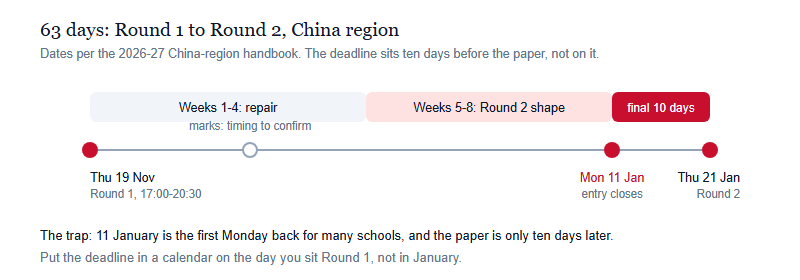
Sitting BMO Round 1 on Thursday 19 November 2026 quietly commits you to a second decision nine weeks later: China-region Round 2 entry closes on Monday 11 January 2027, for a paper on Thursday 21 January. That is 63 days containing a results wait, a winter break and one hard deadline. This page lays the window out as three tables: the fixed points, what to do at each Round 1 outcome, and the weeks in between.
The four fixed points in the window
Two of these dates are certain because the handbook circulated by the organising channel fixes them. One is a payment deadline that falls in the first week back from the winter break. The fourth — when marks come back — is the one you cannot plan against, so the planner below is built so that it does not need to.
| Fixed point | Date | Weekday | What it costs | What happens if you miss it |
|---|---|---|---|---|
| BMO Round 1, China region | 19 November 2026 | Thursday, 17:00–20:30 | RMB 880 | No Round 1 mark exists, and the qualifying route into Round 2 runs through Round 1 |
| Round 1 marks released | Confirm with the organising channel | — | — | Not something you control; plan the window so your work does not wait on it |
| Round 2 entry closes | 11 January 2027 | Monday | RMB 880 | The paper is ten days later. Treat the deadline as fixed unless the organising channel tells you otherwise |
| BMO Round 2, China region | 21 January 2027 | Thursday, window confirmed at registration | Already paid | — |
The 7-point line, read correctly
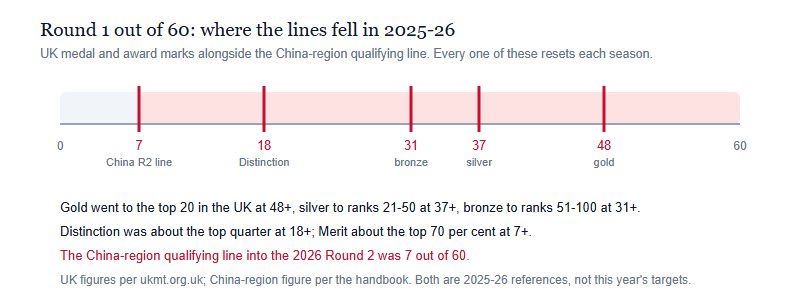
The single most misread number on this pathway is the qualifying line. The handbook gives the China-region qualifying line into the 2026 Round 2 as 7 points out of 60. Beside it sit the UK figures for the same 2025–26 papers: gold medals to the top 20 in the UK at 48 or more, silver at ranks 21 to 50 from 37, bronze at ranks 51 to 100 from 31, Distinction at about the top quarter from 18, and Merit at about the top 70 per cent from 7.
Three things follow, and all three change how you should use November.
- Seven out of sixty is less than one complete solution. On a six-question paper with 60 marks available, that is a very different target from a medal, and it is reachable by a candidate who gets a single problem substantially right and nothing else.
- It rewards writing, not attempting. Marks on this paper attach to argument. A page of exploratory algebra with no stated conclusion tends to score less than a short, complete proof of something modest. If that is unfamiliar territory, our introduction to what the British Mathematical Olympiad is explains why the paper behaves this way.
- It moves. Seven was the line for one round in one region. Do not plan a season around it; use it as evidence that the Round 2 door is nearer than the UK medal table makes it look.
The outcome grid: what to do about 11 January
You will be making the Round 2 decision under uncertainty, because the deadline may well arrive before you can be certain of everything. Find your row.
| Where you stand in early January | What the handbook supports | Action before Monday 11 January |
|---|---|---|
| You did not sit Round 1 | The handbook describes qualification into Round 2 through Round 1; we cannot confirm any other route | Ask the organising channel directly rather than assuming. Plan your season around next November either way |
| You sat it; your own reconstruction is well below the reference line | Qualification is decided by the official mark, not by your reconstruction | Wait for the result if it is due; do not pay on hope, and do not write yourself off on a memory of the paper |
| You sat it; your reconstruction is at or above the reference line | The line moves each season, so a near-miss reconstruction is genuinely uncertain | Diarise the deadline now and hold the RMB 880. Round 2 is a separate payment |
| Results are not out and the deadline is approaching | Nothing in the handbook suggests the deadline moves for late results | Ask the organising channel one specific question: how are entries handled when marks are not yet released. Get the answer in writing |
| You are a Year 11 or Year 12 candidate treating this as season one | Round 1 entry is open at any high-school year in the China region | The value of this window is the habit, not the entry. Keep the training and enter Round 2 only if you qualify |
The nine weeks, week by week
This planner assumes you do not know your mark for most of the window, which is the realistic case. It is built around the shape of Round 2 rather than around any particular result, so nothing in it is wasted if you turn out not to qualify.
| Week | Dates | Focus | What you should have at the end of it |
|---|---|---|---|
| 1 | 20–29 Nov | Reconstruct the paper you just sat, from memory, before it fades | Your own written account of what you attempted and where you stopped |
| 2 | 30 Nov – 6 Dec | Mark that reconstruction honestly against published solutions when they are available (check ukmt.org.uk) | A list, in your handwriting, of the marks you lost to write-up rather than to ideas |
| 3 | 7–13 Dec | Repair the single topic that cost most. One problem a day, written out in full | Five complete write-ups, not five sketches |
| 4 | 14–20 Dec | Change shape: fewer, longer problems. Round 2 is four problems, not six | Two problems worked over 90 minutes each without abandoning either |
| 5 | 21–27 Dec | Holiday block. Long problems, no clock, proper reading of solutions | One hard problem understood completely, including why your first idea failed |
| 6 | 28 Dec – 3 Jan | First full timed rehearsal on an old Round 2 paper, marked strictly | A rehearsal mark and a written list of your recurring write-up faults |
| 7 | 4–10 Jan | Decision week. Confirm your entry and pay. The deadline is the Monday immediately after this week | Entry confirmed, or the decision consciously made not to enter |
| 8 | 11–17 Jan | Second rehearsal at the time of day your sitting uses, once the window is confirmed at registration; fix only the faults on your list | Two full written solutions produced under time in one session |
| 9 | 18–21 Jan | Taper. Reread your own solutions, not new problems. Paper on Thursday | A calm Thursday |
A note from marking our own students’ window work, offered as observation rather than as data: the weeks that get skipped are almost always 1 and 2. Reconstructing a paper you have just sat feels pointless because you already know how it went. It is the highest-value hour in the window precisely because it is the only moment you still remember which idea you abandoned and why. Papers for that work are in our Round 1 and Round 2 past-paper pack.
What Round 2 is, in numbers
The shift from Round 1 to Round 2 is not a difficulty increase applied evenly. It is a change of format that rewards a different working habit.
| Round 1 | Round 2 | |
|---|---|---|
| Problems | Six questions | Four problems |
| Total marks | 60 | 40 |
| 2025–26 Distinction line | 18, about the top quarter | 18 |
| 2025–26 Merit line | 7, about the top 70 per cent | 9 |
| China-region date | Thursday 19 November 2026, 17:00–20:30 | Thursday 21 January 2027, window confirmed at registration |
| China-region fee | RMB 880 | RMB 880 |
Read the two Distinction lines together: 18 out of 60 on Round 1 and 18 out of 40 on Round 2. The proportion of the paper you need rises sharply, and with four problems there is nowhere to hide a weak topic. That is the real argument for spending weeks 4 to 6 on longer single problems rather than on breadth.


The ceiling, and what the January paper is for
Be clear about where this ladder ends before you spend nine weeks on it. Per the handbook, students enrolled at UK schools may not sit the China-region papers, and non-UK nationals cannot be selected for the UK team at the International Mathematical Olympiad. For a China-based candidate the pathway runs to Round 2 and then to the BMO Asia Camp, scheduled for August 2027 and supported by Trinity College Cambridge, with details still to be confirmed. The eligibility boundaries are set out more fully in our eligibility reality check for international students.
That ceiling is worth knowing and is not a reason to skip the paper. A Round 2 mark is one of the few things in a maths file that an admissions reader can check independently: it is externally set, externally marked and dated. Read alongside your transcript, your predicted grades, an admissions test result and what your teacher writes about you, a Round 2 mark corroborates the rest of the picture rather than standing alone — several independent signals pointing the same way are what make a file credible. No competition result decides an application by itself, and nobody should tell you otherwise.
So the honest framing of the window is this: nine weeks of longer, better-written mathematics, one fixed payment deadline on 11 January, and a paper on 21 January that gives you something durable to show for the work. Confirm the current dates, fees and lines on ukmt.org.uk and with the organising channel before you plan around any figure here.
Questions students ask about the window
When does BMO2 registration close in the China region?
Registration closes on Monday 11 January 2027 for the paper on Thursday 21 January. Fee RMB 880 per the handbook.
What score qualified for Round 2 from the China region?
The handbook gives 7 out of 60 as the qualifying line into the 2026 Round 2. Lines move every season.
How is BMO2 marked?
Four problems, 40 marks in total, with the 2025-26 reference lines at 18 for Distinction and 9 for Merit.
Can a China-based student go beyond Round 2?
The China ladder ends at Round 2 and the BMO Asia Camp. Non-UK nationals cannot be selected for the UK IMO team.
This is an independent editorial guide operated by Hanlin Education for China-based international-school students. We are not affiliated with, endorsed by, or sponsored by UKMT or the BMO Subtrust. Dates, fees, entry routes and boundary marks change every season: confirm current details on ukmt.org.uk and with the organising channel that handles your entry. Errors reported to our editorial desk are corrected within 7 working days.