Almost every hour a China-based student spends on olympiad training is aimed at the British Mathematical Olympiad — but the paper that decides whether you sit it is the Senior Mathematical Challenge, a 90-minute paper in early October. UKMT's 2026-27 calendar places it on Wednesday 7 October 2026 One route note: candidates entering through the China region sit separately — the organising channel’s 2026-27 handbook lists Thursday 8 October 2026, 17:00–18:30, with registration closing 28 September. Confirm which sitting your entry route uses; neither date corrects the other.. Nine weeks of targeted work on that paper is worth more than nine weeks of olympiad problems you never get to use.
Why the Challenge decides more than it looks like it does
The Senior Mathematical Challenge looks like the friendly end of the UKMT ladder: multiple choice, no proofs, no marking scheme to fear. Structurally it is the opposite — it is the single filter with the largest effect on your season.
UKMT states that the top-scoring approximately 1,000 eligible students qualify to sit British Mathematical Olympiad Round 1, with UKMT describing several thousand further UK-based students as qualifying for the Andrew Jobbings Senior Kangaroo, which it lists as open to UK schools only. The BMO subtrust separately describes automatic Round 1 entry as following from a certain Challenge score that varies from year to year, with teachers invited to use their judgement in entering other students. Confirm both on ukmt.org.uk and bmos.ukmt.org.uk.
Read those two statements together and the consequence for an overseas candidate is sharp. The consolation route below the Round 1 cut is flagged as UK-only, and discretionary entry depends on a teacher at your centre choosing to enter you. So your Challenge score is doing two jobs at once: clearing an automatic threshold, and giving your head of maths something concrete to justify a discretionary entry. Both jobs reward the same thing — a higher score in October.
| Date (UKMT 2026-27 calendar) | Competition | What it decides |
|---|---|---|
| Tuesday 22 September 2026 | Mathematical Olympiad for Girls | A separate olympiad route, sat before the Challenge |
| Wednesday 7 October 2026 | Senior Mathematical Challenge | Certificates, and qualification for the follow-on rounds |
| Wednesday 18 November 2026 | BMO Round 1 | Round 2 invitations and Round 1 awards |
| Wednesday 18 November 2026 | Andrew Jobbings Senior Kangaroo | The alternative follow-on, listed as UK schools only |
| Wednesday 20 January 2027 | BMO Round 2 | Progression towards national squad selection |
Note the six-week gap between 7 October and 18 November. That window is your entire Round 1 preparation period, and it only opens if the October paper goes well. If you are still orienting yourself in this pathway, our overview of what the British Mathematical Olympiad is explains how the rounds connect.
What changed for 2026: 22 multiple choice and three 000-999 questions
UKMT's Senior Mathematical Challenge page describes the paper as a 90-minute first-round challenge with 22 multiple choice questions and three 000-999 digit questions — a change from the long-standing all-multiple-choice format, in which the final three questions now require a three-digit numeric answer rather than a selection from options.
One editorial caution worth more than any revision tip: UKMT's pages are not all updated in step. At the time of writing, the senior competitions hub page still describes a 90-minute, 25 multiple choice question first-round challenge, while the dedicated Senior Mathematical Challenge page describes the 22-plus-three split. Where two official pages disagree, the dedicated competition page is the one to trust — and you should confirm the format for your own sitting on ukmt.org.uk in the fortnight before the paper rather than relying on any guide, including this one.
On eligibility, UKMT lists the Challenge as open to Year 13 and below for England, Wales and Overseas, with S6 or below in Scotland and Year 14 or below in Northern Ireland. The word "Overseas" doing explicit work there matters for our readers; the practical constraint is not your year group but whether your school is set up as an entering centre, which our eligibility guide for international students covers in detail.
The mark scheme, and what it actually says about guessing
UKMT publishes the Challenge scoring as follows: candidates begin with 25 marks; a correct answer scores 4; an incorrect answer loses 1; an unanswered question scores 0; the maximum is 125. Confirm on ukmt.org.uk, and in particular confirm how the deduction applies to the three 000-999 questions, since that format is new.
Most students hear "incorrect answers lose a mark" and conclude that guessing is punished. Run the arithmetic on the multiple-choice section — taking five options per question, which you should confirm against a past paper — and the conclusion reverses. If you eliminate k wrong options and then choose at random among the remaining 5 − k, your expected gain is k ÷ (5 − k) marks.
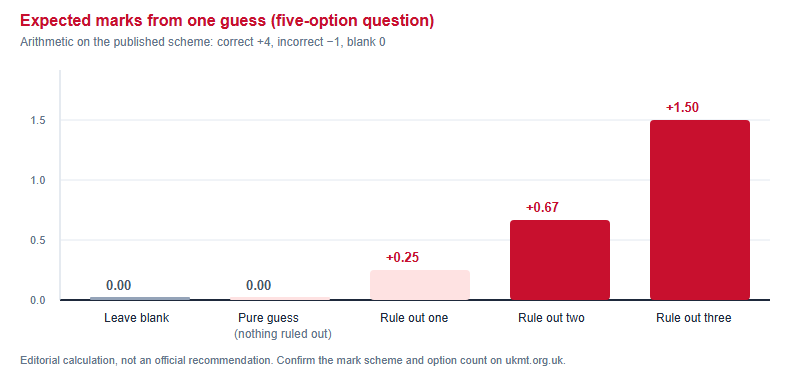
Three consequences follow, and they are the highest-value thing on this page:


- A blank multiple-choice answer is never better than a guess. A pure guess is expectation-neutral; any elimination makes guessing strictly positive. Leaving a multiple-choice question blank because you are "not sure" costs you expected marks whenever you have ruled anything out.
- Elimination is itself a scoring skill. Ruling out two options on a question you cannot solve is worth about two-thirds of a mark — and unlike solving it, it takes twenty seconds. Estimation, checking a special case, and testing units or parity are elimination tools, not just solving tools.
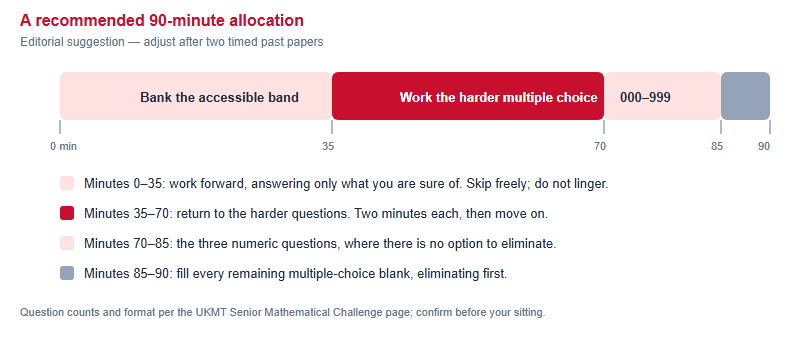
- The 000-999 questions do not work this way. There are no options to eliminate, so the guessing arithmetic above does not transfer. Confirm whether the deduction applies to them at all before deciding how to treat them under time pressure.
Pacing 90 minutes without leaving marks on the table
Twenty-five questions in 90 minutes averages 3 minutes 36 seconds each, which is the wrong way to think about it. Challenge papers are broadly ordered with the more accessible questions first, so a flat allocation spends the same time on a question you can do in forty seconds as on one you cannot do at all. The allocation below is our editorial recommendation; check the ordering against a past paper before you commit to it.
Reading the thresholds without over-reading them
UKMT publishes both certificate thresholds and follow-on qualification scores each year, and both move with the difficulty of the paper. The 2025 figures published by UKMT were Gold at 72 and above, Silver at 57 and above, Bronze at 46 and above, with Round 1 qualification at 104 and above and Senior Kangaroo at 72 and above, marked UK only. Treat those as calibration, not as targets for 2026 — confirm the current year's figures on ukmt.org.uk when they are released.
The award structure itself is stable: UKMT awards the top-scoring 66% of participants Bronze, Silver and Gold certificates in the ratio 3:2:1, with badges for students who are Best in Year or Best in School, and a Certificate of Participation for everyone else. Two things follow. First, certificates are ranked against the field, so a hard paper does not cost you a certificate. Second, the Round 1 cut is an absolute count of roughly the top thousand, so it is genuinely competitive in a way the certificate bands are not.
A nine-week plan from August to 7 October
| Weeks | Focus | Session shape | Success check |
|---|---|---|---|
| 1–2 | Speed on the accessible band | Sets of 15 early-paper questions, 25 minutes | All 15 attempted, accuracy above 90% |
| 3–4 | Elimination drills | 10 hard questions, 30 seconds each, ruling out options only | At least two options ruled out on most questions |
| 5–6 | Full timed papers | Two complete 90-minute papers under exam conditions | Fewer than three blanks at the end of the multiple-choice section |
| 7 | Numeric-answer practice | Short problems demanding an exact three-digit value | Comfort working without answer options to check against |
| 8 | Error taxonomy | Re-mark every past paper; classify each lost mark | A written list of your three most common error types |
| 9 | Taper and logistics | One paper early in the week, then light revision | Format, timing and entry all confirmed with your school |
Week 8 is the week that separates a plateau from a jump. Almost every student who stalls at a Challenge score is losing marks to a repeatable cause — misreading the question, arithmetic slips under time pressure, or abandoning questions that were two lines from an answer — and none of those are fixed by more problems. They are fixed by naming the pattern and building one specific counter-habit for each.
Then plan for what comes next. If your October score clears the bar, you have six weeks to 18 November, and Round 1 rewards an entirely different skill set: written proof rather than selected answers. Start that transition the week after the Challenge, not the week before Round 1. We keep a gathered pack of BMO past papers with a marking routine, with worked solutions for many of the years, which is the fastest way to feel the difference between the two papers.
Frequently asked questions
When is the Senior Mathematical Challenge in 2026?
UKMT's 2026-27 calendar lists it as Wednesday 7 October 2026, with BMO Round 1 on 18 November 2026 (China-region sittings per the organising channel run a day later — SMC on 8 October, BMO Round 1 on 19 November, registration by 28 September; confirm your route). Confirm on ukmt.org.uk.
Should I guess on the multiple-choice questions?
Under the published scheme a five-option guess is expectation-neutral, and better than a blank once you rule out any option. Confirm the scheme first.
How many students qualify for BMO Round 1?
UKMT invites around 1,000 qualifying students from the Challenge, and describes several thousand further UK-based students as qualifying for the Senior Kangaroo, which it lists as UK schools only.
Can overseas students enter the Challenge?
UKMT lists eligibility as Year 13 and below for England, Wales and Overseas. Entry runs through your school as a centre — confirm arrangements with them.
This is an independent editorial guide operated by Hanlin Education for China-based international-school students. We are not affiliated with, endorsed by, or sponsored by UKMT or the BMO Subtrust. Competition formats, dates, eligibility and mark schemes are set by the organisers and can change — confirm current details on ukmt.org.uk. Errors reported to our editorial desk are corrected within 7 working days.