Algebra is the quietest area on a BMO paper and the one most candidates prepare last. That is a mistake with a cheap fix: inequalities, functional equations and polynomial problems are driven by a very short list of recognisable signals, and most of the marks lost on them are lost in the final third of a solution rather than at the start.
Why algebra gets skipped, and why that is expensive
UKMT describes British Mathematical Olympiad Round 1 as a 3½-hour paper with six problems, "the first being intended to be more accessible than the rest", with Round 2 narrowing to four problems over the same time. Confirm the current format for your sitting on bmos.ukmt.org.uk. If you are new to how the two rounds sit inside the wider pathway, our overview of what the British Mathematical Olympiad is gives the map.
Geometry and number theory both have an obvious vocabulary, so students know when they are revising them. Algebra has no such badge. It hides inside problems that look like something else — a counting problem that reduces to a bound, a number theory problem that turns on a factorisation of a polynomial — and there is no published syllabus to revise against. The BMO subtrust does not publish a list of assumed knowledge on its competition pages, so the content boundary has to be inferred from the papers themselves.
The practical consequence for a China-based candidate is a gap that A-level, IB and AP courses do not close. School algebra rewards manipulation: rearrange, solve, state the answer. Olympiad algebra rewards two things school courses barely test — proving a statement holds for all values, and proving nothing else works. Those are the two halves where marks disappear.
Inequalities: three tools and the habit that saves the marks
Most accessible olympiad inequalities fall to one of three tools. The skill is not knowing them — every strong candidate can state AM–GM — but matching them to the shape of the expression fast enough to leave time for the write-up.
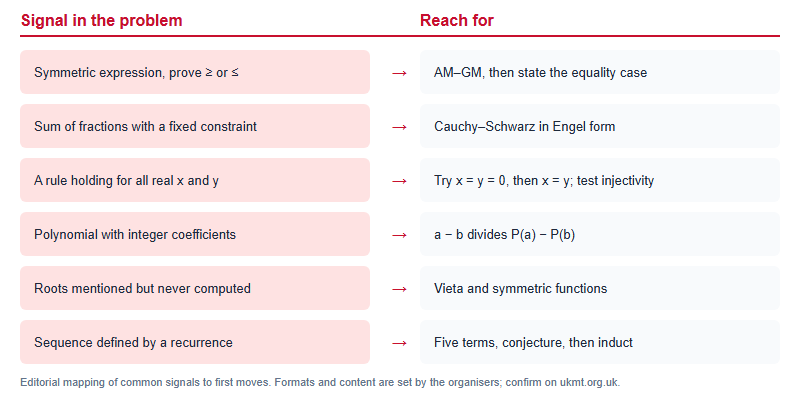
- AM–GM. The default when the expression is symmetric, when products and sums appear on opposite sides, or when you need to convert a product into a sum. Apply it to well-chosen groups of terms rather than to everything at once; the art is the grouping, not the inequality.
- Cauchy–Schwarz, especially in Engel form. The default when you see a sum of fractions whose numerators are squares, or when a constraint fixes a sum. It converts a sum of fractions into a single fraction and is often a one-line finish where AM–GM needs three.
- Rearrangement and sum-of-squares. The default when the expression is not symmetric but is ordered, or when the difference between the two sides can be written as a sum of squares. Writing a difference as a sum of squares is the most honest proof there is: it is visibly non-negative and needs no named theorem.
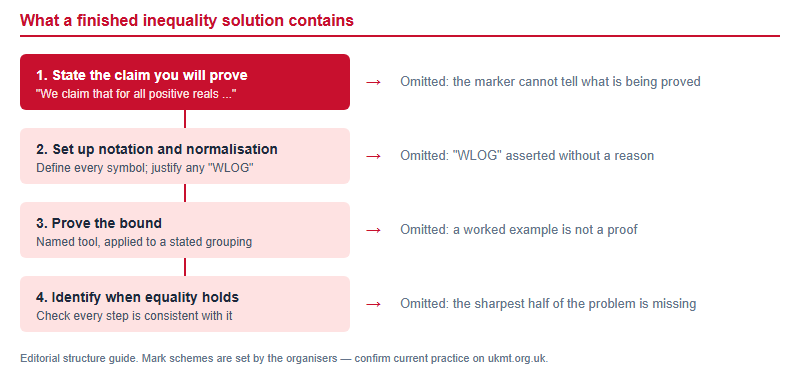
Two techniques make all three easier. Normalisation — using a homogeneous condition to set a sum or product equal to 1 — removes a variable and often collapses the problem. Substitution for constrained variables (replacing a constraint by a parametrisation) turns a constrained inequality into a free one.
The habit that saves the marks is the equality case. An inequality problem is not finished when the bound is proved; it is finished when you have said precisely when equality holds and checked that your chain of steps is consistent with it. If your solution uses AM–GM twice with different equality conditions that cannot both be satisfied, your bound is not sharp and a marker will notice.
Functional equations: substitute, deduce, then prove nothing else works
Functional equations frighten candidates because there is no obvious first line. In fact the first line is almost always the same: substitute convenient values and see what falls out. A workable order of attack:
- Substitute zeros and equalities. Set x = 0, then y = 0, then x = y, then y = −x. Each substitution turns the functional equation into an ordinary equation about a few unknown values such as f(0).
- Look for structural properties. Is f injective? Surjective? Does the equation force f(0) to a specific value? Injectivity in particular is often the key that unlocks the rest, because it lets you cancel f from both sides of an equation.
- Guess the family of solutions. Most competition answers are linear, constant, or the identity, sometimes with a sign or an additive constant. Guessing early is legitimate and helps direct the deduction.
- Prove the guess is forced, then verify it. This is the step candidates skip, and it is worth real marks. A solution that identifies the right function but never shows other functions are impossible is incomplete; so is one that never substitutes the answer back to confirm it satisfies the original equation.
Write functional equation solutions as a numbered sequence of deductions. Label each new equation you derive — (1), (2), (3) — and refer back to those labels. This is not decoration: a marker following a chain of substitutions needs to see which earlier line each step depends on, and the labelling costs you thirty seconds.
Polynomials, sequences and the identities worth knowing cold
Polynomial problems reward a small set of structural facts far more than algebraic stamina.


| Tool | What it says, informally | Typical use on a paper |
|---|---|---|
| Factor theorem | P(a) = 0 exactly when (x − a) divides P | Converting a root condition into a factorisation |
| Vieta's relations | Sums and products of roots are read off the coefficients | Problems about roots you are not meant to find |
| Degree argument | Two polynomials agreeing at more points than their degree are identical | Proving a polynomial identity, or that no such polynomial exists |
| Integer-coefficient divisibility | a − b always divides P(a) − P(b) | Number theory problems dressed as polynomial problems |
| Rational root reasoning | Rational roots are constrained by leading and constant coefficients | Showing a specified root cannot be rational |
| Telescoping | Consecutive terms cancel in pairs | Closed forms for sums and products defined term by term |
Sequences and recurrences deserve a specific warning. Computing five terms, spotting a pattern and asserting it is not a proof — it is the setup for one. The proof is an induction, and the induction step has to use the recurrence explicitly. Candidates routinely lose most of the marks on an otherwise correct recurrence problem because the write-up stops at "so the pattern continues".
Three identities are worth having genuinely memorised rather than re-derived under time pressure: the factorisation of a difference of two cubes, the expansion of the square of a sum of three terms, and the standard closed forms for the sum of the first n integers and of their squares. Each one shows up as a step inside a longer argument, and re-deriving them costs minutes you do not have on a six-problem paper.
A six-week algebra block you can run before Round 1
Algebra rewards short, frequent, narrow sessions far more than long undirected problem sets. The block below assumes roughly four to five hours a week and is designed to sit alongside school work rather than replace a general problem-solving routine.
| Week | Focus | Volume | What you write down |
|---|---|---|---|
| 1 | AM–GM and grouping | 15 short problems | Only the grouping and the equality case, not full solutions |
| 2 | Cauchy–Schwarz and normalisation | 12 problems | The line where the constraint is used |
| 3 | Sum-of-squares finishes | 8 problems, full write-ups | Complete scripts, marked against your own checklist |
| 4 | Functional equations | 8 problems | Numbered deduction chains, plus the verification step |
| 5 | Polynomials and Vieta | 10 problems | Which structural fact you used, in one sentence |
| 6 | Timed integration | 2 past-paper problems at 35 minutes each | An untimed rewrite the next day, compared with the original |
The week 6 comparison is the part that actually moves a score. The gap between what you wrote under time pressure and what you write calmly the next morning is a precise diagnosis of what your exam-day habits cost you, and it is usually structure rather than mathematics. Sourcing is straightforward: we keep a gathered pack of BMO past papers with worked solutions for many of the years, and our guide to BMO past papers and how to use them sets out a marking routine that keeps you honest about the difference between seeing an idea and writing a proof.
One planning note before you build a term around any of this. Entry to Round 1 runs through your school, and the automatic route is tied to performance in the Senior Mathematical Challenge together with the organisers' eligibility conditions, with teachers able to enter further students at their discretion. Confirm the current arrangements on bmos.ukmt.org.uk, and check with your school early — our eligibility guide for international students covers the centre requirements that decide whether a China-based candidate can sit the paper at all.
Frequently asked questions
How much algebra is on a BMO paper?
It varies by year and no syllabus is published. Treat algebra as one of four areas you should be able to attempt, not as an optional extra.
Do I need to memorise named inequalities?
AM–GM and Cauchy–Schwarz, yes. Beyond those, a sum-of-squares argument you can justify beats a named theorem you cannot state precisely.
Is guessing the answer to a functional equation allowed?
Yes, provided you then prove no other function works and verify your candidate satisfies the original equation. Guessing alone is incomplete.
How long is BMO Round 1?
UKMT describes it as a 3½-hour paper with six problems, the first intended to be more accessible. Confirm the format on ukmt.org.uk.
This is an independent editorial guide operated by Hanlin Education for China-based international-school students. We are not affiliated with, endorsed by, or sponsored by UKMT or the BMO Subtrust. Competition formats, dates, eligibility and mark schemes are set by the organisers and can change — confirm current details on ukmt.org.uk. Errors reported to our editorial desk are corrected within 7 working days.