If you are aiming at the British Mathematical Olympiad this cycle, the work starts now. The UKMT senior season runs from the Senior Mathematical Challenge in roughly October to BMO Round 1 in roughly November, so a focused summer-to-autumn plan gives international students the runway to move from answer-only maths to full written proofs. Here is that 14-week roadmap, week by week.
Why the summer window quietly decides your BMO cycle
The BMO is not a test you cram for in the fortnight before the paper. It rewards a very particular skill — constructing and writing a complete, rigorous argument — and that skill takes weeks of deliberate practice to build. Students based at international schools in China face an extra squeeze: the autumn term brings mock exams, coursework deadlines and university applications all at once. By the time the Senior Mathematical Challenge lands in October, there is very little spare capacity left.
That is why the July–August window matters so much. It is the one stretch of the year when a motivated student can put in unhurried, deep practice without competing against school deadlines. In our editorial experience coaching China-based students through the UK pathway, the ones who treat the summer as foundation-building — rather than starting cold in September — are the ones who still have energy left for proof technique when BMO Round 1 arrives. If you are new to the competition itself, start with our overview of what the BMO is and how it works, then come back to this plan.
The season map: SMC in October, BMO1 in November, BMO2 in January–February
Before you plan backwards, you need the shape of the season. The senior UKMT pathway is a ladder: a strong Senior Mathematical Challenge score opens the door to BMO Round 1, and a strong BMO1 opens the door to Round 2 and the selection camps beyond it. Exact dates, entry routes and fees change every year, so treat the windows below as approximate and confirm the live calendar on ukmt.org.uk.
| Stage | Approx. window | Standard format | What it decides |
|---|---|---|---|
| Senior Mathematical Challenge (SMC) | ~ October | 25 multiple-choice questions, 90 minutes, answer-only | Gateway score toward BMO1 or the Senior Kangaroo |
| BMO Round 1 | ~ November | 6 problems, 3½ hours, full written proofs | Invitation toward BMO Round 2 |
| BMO Round 2 | ~ January–February | 4 problems, 3½ hours, full written proofs | Training camps and international-team selection |
Notice the escalation. The SMC is answer-only, so it feels familiar to anyone who has sat AMC-style tests. BMO1 and BMO2 are a different animal entirely: the marker never sees a multiple-choice bubble, only your written reasoning. Almost the entire job of the summer is to close that gap before it becomes a November emergency.
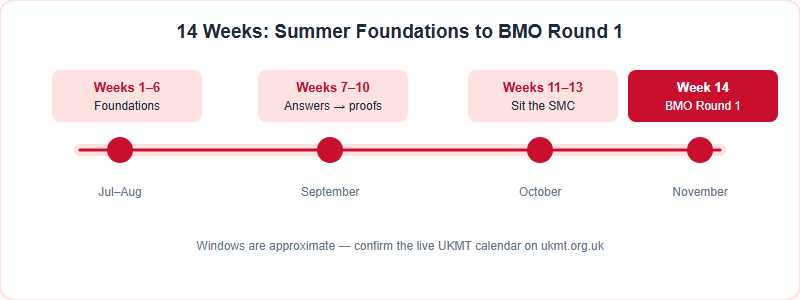
Weeks 1–6 (July–August): build the foundations
The first six weeks are about coverage and comfort, not speed. BMO problems draw on four core areas, and you want a working fluency in each before you touch a full past paper. Spend roughly a fortnight on each of the first three, and keep the fourth ticking over throughout:
- Number theory: divisibility, modular arithmetic, the Euclidean algorithm, prime factorisation, and simple Diophantine equations. This is the most self-contained area and the best place to start.
- Algebra and inequalities: factorisation tricks, the AM–GM inequality, polynomial roots, functional relationships, and clean algebraic manipulation.
- Combinatorics: counting arguments, the pigeonhole principle, invariants, and basic graph ideas — the area that most rewards clear writing.
- Geometry: angle chasing, similar triangles, circle theorems, and the power of a point. Keep this in your weekly rotation from the start; it takes the longest to feel natural.
Work from a structured problem book rather than random internet problems, and write full solutions to at least a few problems each week even now — not because the answers are hard, but because you are training your hand to explain. The habit you build in July is the habit the marker rewards in November.
Weeks 7–10 (September): shift from answers to proofs
This is the pivot, and it is where most students underinvest. Up to now you may have been finding answers; from here you are building arguments. Take problems you can already solve and force yourself to write them up as if a stranger will mark them cold — because one will. A good self-test: hand your written solution to a classmate who has not seen the problem. If they cannot follow every line without you narrating it, the write-up is not finished.
In these four weeks, introduce timed conditions gradually. Start with a single problem in 35 minutes, then two problems in 70. Learn the standard proof structures — proof by contradiction, induction, construction plus verification, and casework — and practise signposting them so a marker instantly sees your logic. Pull real material from the BMO past papers archive and study the official solutions not for the answer but for how rigour is written down. The gap between “I know why this is true” and “I have proved this is true on paper” is the entire competition.


Weeks 11–14 (October–November): sit the SMC, then sharpen for BMO1
Now the season goes live. The Senior Mathematical Challenge arrives first, and because it is answer-only, your prep for it is speed and accuracy: drill past SMC papers under the clock, get comfortable eliminating options, and avoid the classic mistake of over-thinking early questions. A strong SMC score is what earns most students an invitation toward BMO Round 1 — though schools can also enter candidates directly, so confirm the current qualification route and any entry fees on ukmt.org.uk. Before you enter, check that you actually meet the entry conditions in our note on BMO eligibility for international students.
Between the SMC and BMO1 you have only a couple of weeks, so this is not the time to learn new topics — it is the time to sit full timed BMO1-style papers, mark them honestly against the official solutions, and fix the two or three recurring weaknesses that show up. Most students find their marks bleed away in the same places every time: an unjustified “clearly”, a missing case, or a construction they never verify. Hunt those down. Walking into the real paper, your goal is not to solve all six problems — almost no one does — but to write two or three complete, watertight solutions.
The repeatable study week that ties it together
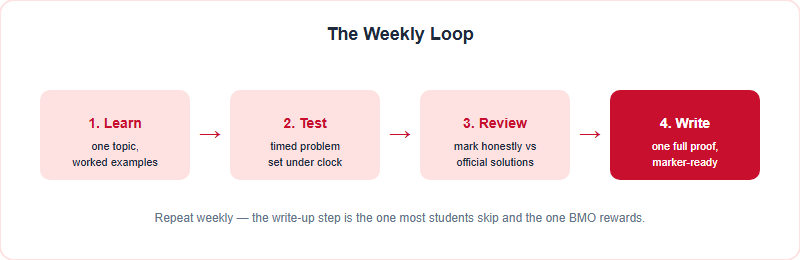
Whatever phase you are in, a single weekly loop keeps the work honest. It balances learning new ideas, testing under pressure, and — crucially — writing at least one solution to a standard a marker would accept.
Frequently asked questions
When do I need to start preparing for BMO Round 1?
Ideally in the summer. A 12–14 week runway from July lets you build topic foundations and, more importantly, learn to write full proofs before the November paper.
Do I have to sit the SMC before BMO1?
A strong SMC score is the usual route to a BMO1 invitation, but schools can also enter candidates directly. Confirm the current qualification route and fees on ukmt.org.uk.
How many BMO1 problems should I aim to solve?
Very few students solve all six. A realistic strong target is two or three complete, rigorous written solutions rather than six partial attempts.
Can international students in China take part?
Yes, subject to the current entry conditions. Check the details in our guide to BMO eligibility for international students and confirm specifics on ukmt.org.uk.
This is an independent editorial guide operated by Hanlin Education for China-based international-school students. It is NOT affiliated with, endorsed by, or sponsored by UKMT or the BMO Subtrust. Competition dates, formats and entry rules change each year — always confirm current details on ukmt.org.uk. Any factual error will be corrected within 7 working days.