BMO training transfers powerfully to Oxbridge admissions tests — but unevenly. Olympiad habits of rigorous proof and long-problem stamina map almost directly onto STEP, help substantially with the extended questions on the MAT, and matter least for the fast multiple-choice format of the TMUA. The catch is the calendar: BMO1 and the autumn admissions tests land within weeks of each other. This guide maps the skill transfer honestly and lays out a dual-track plan for the 2026–27 season.
Two different games that share a core
Students and parents often treat “competition maths” and “admissions-test maths” as one category. They are cousins, not twins. The BMO — the UK’s senior olympiad, run by UKMT and described in full in our foundation guide — asks for original arguments about problems deliberately placed outside any syllabus, written as complete proofs, over a long sitting. Admissions tests exist for a different purpose: they help a specific university rank thousands of applicants on mathematical readiness for a specific degree, which means they anchor closer to school syllabi, reward speed and accuracy as well as insight, and are marked on a tighter rubric.
Three tests matter most for mathematically ambitious applicants from China-based international schools. The MAT (Mathematics Admissions Test) is used by Oxford for mathematics and related degrees, and by some other courses and universities; it mixes shorter answers with longer structured questions. The TMUA is a multiple-choice test of mathematical thinking used by a group of universities for maths-adjacent courses, including economics at some institutions. STEP (Sixth Term Examination Paper) is the deep end: long, proof-flavoured written problems, typically sat in the summer exam season, and commonly attached to Cambridge mathematics offers, with some other universities also accepting or encouraging it. Which test each university requires, how papers are structured, and how results are used all change from cycle to cycle — treat every specific here as “confirm on the official university and test pages before you plan”.
What each assessment actually asks of you
| Assessment | Format character | Timing in the cycle | What it rewards most |
|---|---|---|---|
| BMO Round 1 | Six full-proof problems (confirm current format on ukmt.org.uk) | Typically ~November | Original problem-finding; complete written arguments |
| BMO Round 2 | Four harder full-proof problems | Typically ~January–February | Depth, technique and stamina at near-IMO level |
| MAT | Multiple choice plus longer structured questions | Autumn of the application year (confirm with Oxford / the test administrator) | Fast accurate technique plus multi-step reasoning inside a syllabus |
| TMUA | Multiple-choice papers on mathematical thinking and logic | Test windows set by the administrator (confirm officially) | Speed, precision, and reasoning about arguments and definitions |
| STEP | Long written solutions to substantial problems | Summer exam season, usually after offers (confirm on the official STEP pages) | Sustained rigorous solutions closest in spirit to olympiad work |
Read the right-hand column and the transfer picture already forms: the further down the table you go toward long-form written mathematics, the more your BMO hours pay direct dividends.
The transfer map: what olympiad training buys you
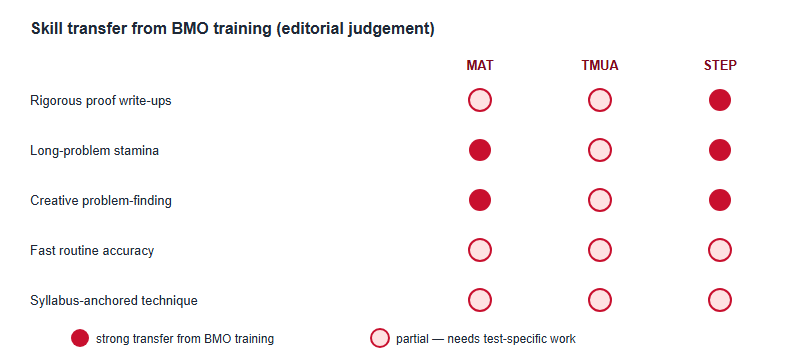
The strongest single transfer is BMO → STEP. STEP questions are long, multi-part and unforgiving about justification — precisely the muscles a BMO campaign builds. Students who have trained for full-proof papers consistently report that STEP feels like a familiar genre, just anchored to syllabus content. The MAT transfer is real but narrower: olympiad experience shines on the later, more inventive parts of the longer questions, while the front of the paper is won by speed and clean technique. TMUA benefits least — its multiple-choice logic items reward precision about definitions and arguments, which proof training does sharpen, but the pace is nothing like an olympiad sitting.
Where olympiad habits actively hurt
Honest coaching requires naming the negative transfer too. Three habits to unlearn on test day:
- Over-elegance. Olympiad culture prizes the beautiful argument. Admissions tests pay identical marks for an ugly correct computation done quickly. Hunting for the slick route on a routine MAT or TMUA item is a time leak.
- Slow starts. BMO tempo — read slowly, think long, commit late — is fatal on a paper where every minute carries marks. You need a separate, faster gear, built through timed test-specific practice.
- Proving what may be assumed. On syllabus-anchored tests you may use standard results freely; olympiad-trained students sometimes burn minutes re-deriving machinery the examiner never asked them to justify. Learn each test’s conventions from its own past papers and official guidance.
The fix is not to abandon olympiad training — it is to schedule short, sharp blocks of test-native practice close to each test date, so the right gear is engaged on the right day.
The 2026–27 dual-track calendar
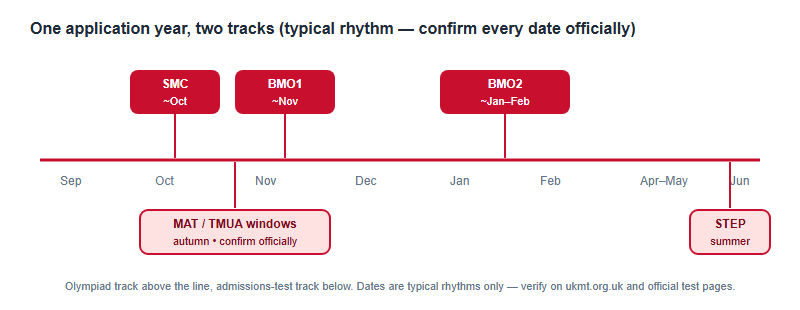
Practical sequencing for that autumn pinch, based on how we have seen dual-track students manage it well:


- Summer before Year 13 (now, if you are reading this in July): front-load admissions-test preparation. MAT and TMUA reward familiarity that can be banked early; the summer is also when a BMO past-paper base is built without calendar pressure. Our BMO past paper pack explains how to sequence those papers by difficulty.
- September–October: admissions tests take priority — they are gateways with hard consequences for your application. Treat the SMC as a low-stakes sharpener that costs little extra preparation.
- Late October–November: after your test date passes, swing fully back to olympiad mode for BMO1. The decompression works in your favour: BMO1’s slower, deeper tempo is a genuine relief after weeks of speed drilling.
- January–June: BMO2 (for those who qualify or enter at that level) lands before most interview decisions resolve, and STEP preparation then inherits everything your olympiad season built. For offer-holders with STEP conditions, the spring is a direct BMO-to-STEP handover.
Year 12 students have a cleaner version of this: sit the SMC and BMO1 with no admissions test in the way, learning the proof-paper craft a full year before it must coexist with the MAT autumn. That one-year head start is the single biggest scheduling advantage available, and it is one reason we encourage capable Year 12 students to enter early — eligibility and entry routes for China-based students are covered in our international eligibility guide.
Does the BMO itself help the application?
Briefly — since admissions signalling is covered in depth elsewhere on this site — a genuine olympiad record supports an Oxbridge mathematics application in two indirect but real ways: it gives your personal statement concrete, discussable mathematical experience, and interview problems often resemble olympiad questions in miniature, so olympiad-trained applicants are practising the interview genre without knowing it. What it is not is a substitute for the required tests: no BMO score waives a MAT sitting or a STEP condition, and no admissions outcome is guaranteed by any competition result. Plan the two tracks as complements with the tests as the non-negotiable spine.
FAQ
Does BMO preparation help with the MAT?
Yes, especially on the longer structured questions where multi-step reasoning wins. But the MAT also rewards speed and syllabus fluency, so add timed MAT-specific practice — olympiad work alone is not enough.
Is STEP or BMO harder?
They are hard differently. BMO problems demand more original insight; STEP demands sustained technical control over syllabus material at length. Strong BMO students usually adapt to STEP quickly.
Should I skip BMO1 in Year 13 because of the MAT?
Usually no — the dates typically fall weeks apart, and SMC/BMO1 need little extra preparation if your test prep is on track. Check the current year’s dates on ukmt.org.uk before deciding.
Do universities require olympiad results?
No. MAT, TMUA and STEP requirements are set by each university; olympiad participation is voluntary enrichment that strengthens the narrative but is never a formal requirement.
This is an independent editorial guide operated by Hanlin Education for China-based international-school students. It is not affiliated with, endorsed by, or sponsored by UKMT or the BMO Subtrust, nor by any university or admissions-test administrator. Test requirements, formats and dates change every cycle; always confirm current details on ukmt.org.uk and the official university and test pages. Factual errors flagged to our editorial desk are corrected within 7 working days.