On BMO Round 1, exam-day strategy means three disciplines: read and triage all six questions before committing to any of them, divide the long sitting into deliberate time blocks instead of drifting, and write up every solved problem immediately and completely — because on a full-proof paper, a solution that lives only in your head scores nothing. This guide turns those three disciplines into a concrete plan you can rehearse before the November paper.
Why tactics matter on a six-question proof paper
BMO Round 1 is not a sprint quiz. It is a small number of hard questions — six in the recent format, marked out of 60, with each question carrying equal weight (confirm the current format for your sitting on ukmt.org.uk). That structure changes the maths of the exam itself. On a 25-question multiple-choice paper like the SMC, a wrong turn costs you one question out of many. On BMO1, a wrong turn can silently consume a quarter of your sitting.
The second structural fact is how marking works. BMO solutions are assessed as complete arguments: a finished, watertight proof earns full or near-full marks, while a pile of promising fragments typically earns very little. We cover the marking philosophy in depth elsewhere on this site; the tactical consequence is simple and unforgiving — two problems fully solved and cleanly written beat five problems half-attempted, essentially every time. Everything in this article follows from that. If you are still deciding whether BMO1 belongs in your season at all, start with What Is the British Mathematical Olympiad? and the eligibility guide for international students.
One honest caveat before the tactics: strategy is a multiplier on ability, not a substitute for it. A brilliant plan will not conjure a proof you cannot find. What it will do — and this is worth real marks — is stop you from losing problems you were capable of solving.
Block your time in percentages, not vibes
UKMT publishes the timing for each sitting, so rather than hard-coding minutes, build your plan in percentages of whatever the stated duration is and convert on the day. Here is the block structure we recommend to China-based students sitting their first serious proof paper:
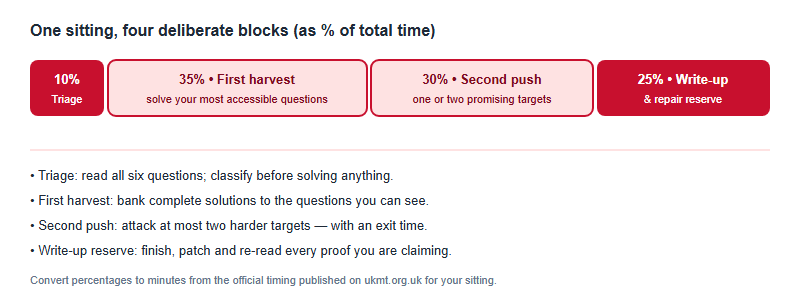
The block most students resist is the final one. Reserving roughly a quarter of the paper for writing up and repairing feels like “wasting” solving time. It is the opposite. Marks are awarded for what is on the page, and turning a correct idea into a complete argument — with the small lemmas actually proved and the edge cases actually checked — reliably takes longer than the idea did. Candidates who solve until the final minutes routinely hand in two “solved” problems written so hastily that neither survives marking intact.
Triage: sort all six before you solve any
Spend the opening block reading every question slowly, and sort them into three honest categories. Do not start writing mathematics yet — the goal is a map of the paper.
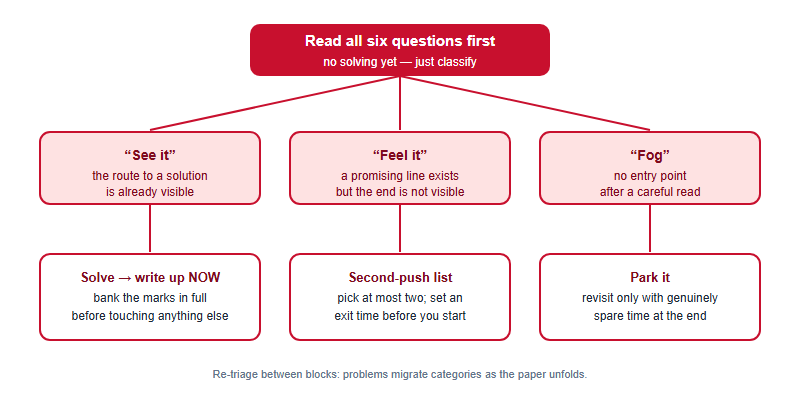
Two refinements make triage work in practice. First, triage is provisional — a “fog” question can turn into a “see it” question after two hours of the paper warming your brain up, so glance back at parked problems when you finish a block. Second, question position is information but not law: on many past papers the earlier questions have been the more approachable ones, so a “fog” reaction to Q1 usually means you misread something, while a “see it” reaction to Q6 deserves a moment of scepticism — check you are not solving an easier problem than the one asked.
The failure modes that cost real marks
| Failure mode | What it looks like | The tactical fix |
|---|---|---|
| Sunk-cost tunnel | Ninety minutes on one stubborn question “because I’ve invested so much already” | Set an exit time before starting any second-push problem; when it arrives, leave — the invested time is gone either way |
| Head-solution, blank page | “I solved three” — but one was never written down properly and scores almost nothing | Write up immediately after solving, while the argument is fresh; never batch all write-ups for the end |
| Cosmetic completeness | A proof that asserts the key lemma (“it is easy to see that…”) without proving it | Re-read each write-up asking: would a sceptical marker accept every step? Patch during the reserve block |
| Last-minute new attempt | Starting a fresh problem with 10% of time left | Final block is for finishing and repairing, not opening; a patched proof is worth more than a new fragment |
| Case amnesia | A correct argument that quietly assumes n is even, or a triangle is acute | Keep a margin checklist: negatives, zero, equality cases, degenerate configurations |
Notice that none of these failures involve not being clever enough. They are all self-inflicted, and they are all preventable by structure. In our experience coaching China-based candidates, first-time BMO1 sitters lose more marks to the second and third rows of that table than to any gap in technique: students trained on answer-only formats — the SMC, the AMC series, school exams — systematically underestimate how much of a proof paper’s work happens after the insight.


Write-up discipline: converting “solved” into “scored”
A BMO write-up has one audience: a marker who did not watch you think. Concretely, that means each solution should state what it is proving, define any notation you introduce, prove or precisely cite every non-obvious claim, and close the loop explicitly — if the question asks for all solutions, your final line should say what the solutions are and why there are no others. Structure helps: a short opening sentence (“We show that no such configuration exists; suppose otherwise…”) tells the marker where you are going and earns you a sympathetic read.
Practical habits worth drilling: leave space between solutions so patches fit; if you attempt a question twice, cross out the abandoned attempt cleanly so the marker knows which argument you are claiming; and when time forces you to submit something incomplete, write an honest final line stating exactly what remains unproved — clarity about a gap reads far better than prose that pretends the gap is not there.
Rehearse the plan, not just the mathematics
Strategy only becomes real under clock pressure. In the weeks before the paper, run at least two or three full-length timed simulations with genuine past papers, executing the four-block structure exactly: triage aloud, harvest, push with exit times, and a protected write-up reserve. Mark your own scripts a day later, pretending to be the sceptical marker — that exercise teaches more about write-up quality than any amount of solving. The complete set of BMO1 and BMO2 papers, with guidance on how to sequence them, is in our BMO past paper pack.
A final calibration note: your target shapes your tactics. If a realistic goal this season is two clean solutions, the second-push block should be short and the harvest and write-up blocks generous. If you are chasing a qualification-level score, you will need a bolder second push — but the write-up reserve stays untouchable. Whatever the ambition, the principle is the same: the paper rewards finished mathematics, so build a plan whose every block pushes work toward finished.
FAQ
Should I attempt all six BMO1 questions?
Almost never. Complete solutions score; scattered attempts do not. Most candidates maximise their mark by fully finishing two to four questions and writing them up properly, not by touching all six.
In what order should I attack the questions?
In the order your triage produces, not the printed order. Bank every “see it” question first, then choose at most two promising targets for a deeper push with a pre-set exit time.
How much time should write-ups get?
Reserve roughly a quarter of the sitting for writing up and repairing proofs. A correct idea scrawled in the final minutes routinely loses marks a calm write-up would have kept.
What if I solve a problem in my head but run out of time to write it?
It scores little or nothing — markers assess what is on the page. That is exactly why you write up each solution immediately after solving it rather than saving all write-ups for the end.
This is an independent editorial guide operated by Hanlin Education for China-based international-school students. It is not affiliated with, endorsed by, or sponsored by UKMT or the BMO Subtrust. Competition details change; always confirm current dates, timings, formats and entry arrangements on ukmt.org.uk. Factual errors flagged to our editorial desk are corrected within 7 working days.