The British Mathematical Olympiad and China’s domestic olympiad ladder — the national high-school contest known as Gaolian, feeding into the Chinese Mathematical Olympiad (CMO) — are both proof-based routes to serious mathematics, but they differ sharply in access, exam style and what the awards signal. For a student at a Chinese international school, the BMO is usually the more reachable ladder, while the domestic track is deeper but structurally harder to enter from outside the mainland school system. This guide compares the two honestly, so you can decide where your hours go.
Two systems, two philosophies
Britain’s senior olympiad sequence, run by the UK Mathematics Trust (UKMT), starts wide and narrows: the Senior Mathematical Challenge (SMC, typically around October) is a fast challenge-style paper — mostly multiple choice, with short numeric-answer questions in the current format (confirm on ukmt.org.uk) — open to whole cohorts, BMO Round 1 (typically around November) is the first full-proof stage, and BMO Round 2 (typically January–February) is a harder, smaller-field proof paper feeding into IMO selection. Exact dates and entry rules for each season are published on ukmt.org.uk. If you have not yet mapped that ladder, start with our foundation guide, What Is the British Mathematical Olympiad?
China’s ladder is organised through the mainland school system. The National High School Mathematics Joint Competition — universally called 高联 or “Gaolian” — is typically sat in the autumn term through registered mainland schools, with a first paper and a harder proof-based follow-on paper. Strong provincial performers earn provincial first/second/third prizes, and the top band in each province is invited to the CMO, a multi-day, full-proof competition in an IMO-like format. From CMO medallists, the national training team and eventually the Chinese IMO squad are selected. Precise formats, dates and provincial quotas are set by the Chinese Mathematical Society and provincial organisers, and they vary — confirm current arrangements with the official organiser before planning around them.
The philosophical difference matters more than the org charts. The UK system is designed as an open enrichment pyramid: a very large national cohort sits the SMC each year (see ukmt.org.uk for current participation), and the olympiad rounds exist to stretch the curious as much as to select a team. The Chinese system is, by design, a selection machine of extraordinary depth: training cultures in strong provinces treat Gaolian as a multi-year project, and the standard at CMO level is among the highest of any national olympiad in the world.
How the two ladders are structured
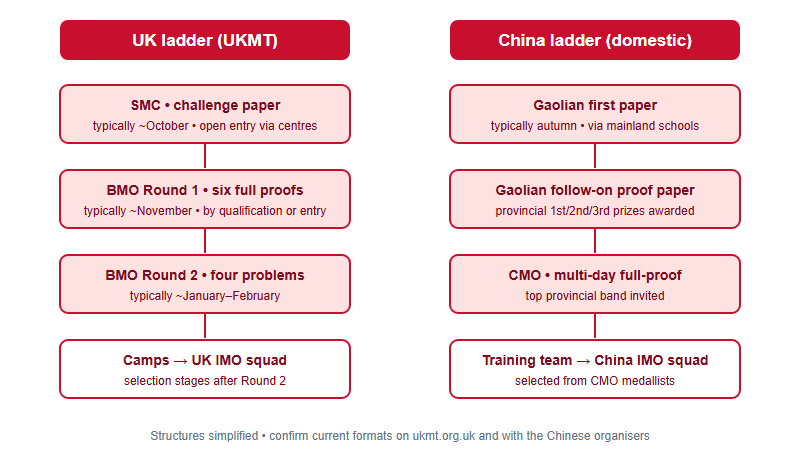
Notice the structural rhyme: both ladders move from a broad screening stage to full-proof olympiads to team selection. The divergence is at the entry door. The UK ladder is entered through any registered UKMT centre — including British international schools in China — while the Chinese ladder is entered through mainland schools registered with provincial olympiad structures.
Access from an international school: the practical divide
This is where the comparison stops being academic. If you study at an international school in China on an A-Level, IB or AP curriculum, you can generally sit the SMC and BMO through a registered centre — many British international schools already are one, and others can register. The full picture, including who counts as eligible and how centres work, is in our eligibility reality check for international students.
Gaolian access runs the other way. Registration is typically handled by mainland schools inside the provincial competition system. International schools teaching overseas curricula are often not registered with that system, and in practice many international-school students find there is simply no entry channel through their school. Policies differ by province and change over time, so if the domestic track matters to you, confirm directly with your school and the provincial organiser rather than assuming either answer. But as an editorial observation from working with China-based cohorts: for most international-school students, the BMO is the ladder with a door that opens, and the domestic ladder is the one they read about.
There is also a purpose mismatch. The domestic track’s most concrete payoff — recognition inside mainland university admissions channels such as strong-foundation programmes — is designed for students taking the gaokao route. If your destination is UK or US universities, that payoff largely does not apply to you, while a strong BMO performance travels directly into a UCAS or Common App narrative.
Exam style: what each system rewards
| Dimension | BMO (Round 1 & 2) | Gaolian → CMO |
|---|---|---|
| Format | Full written proofs; six questions in Round 1, four in Round 2 (confirm current format on ukmt.org.uk) | First paper mixes shorter answers with written work; follow-on paper and CMO are full-proof (formats set by organisers — confirm) |
| Field depth | National UK field plus international centres; broad ability range in Round 1 | Enormous national field; provincial cut-offs in strong provinces are brutally high |
| Typical training culture | Self-study, school clubs, mentoring; a motivated individual can compete from a standing start in 1–2 seasons | Multi-year, often school-embedded training programmes; heavy weekly hours are the norm at competitive levels |
| Style of problems | Classical olympiad topics; Round 1 rewards clean elementary arguments | Same topic families, but at CMO level the technical depth and difficulty ceiling are markedly higher |
| Recognition for overseas applications | Directly legible to UK admissions; understandable to US readers as a national olympiad | CMO-level awards are internationally respected; provincial prizes are less legible outside China |
| Recognition inside mainland system | Limited formal role | Central: provincial and national awards feed domestic admissions channels |
One nuance worth stating plainly: problem-for-problem, the top of the Chinese system is harder. A student who reaches CMO has cleared a bar that, in raw difficulty, sits above BMO Round 1 and in the neighbourhood of — often beyond — BMO Round 2. That is not a criticism of the BMO; it reflects field size and training depth. The flip side is that the BMO gives a far larger share of participants a meaningful, provable result: a score out of 60, a certificate band, a qualification to a next round. In the Chinese system, the overwhelming majority of entrants exit at the provincial stage with nothing an overseas admissions reader can easily interpret.


Which track fits which student
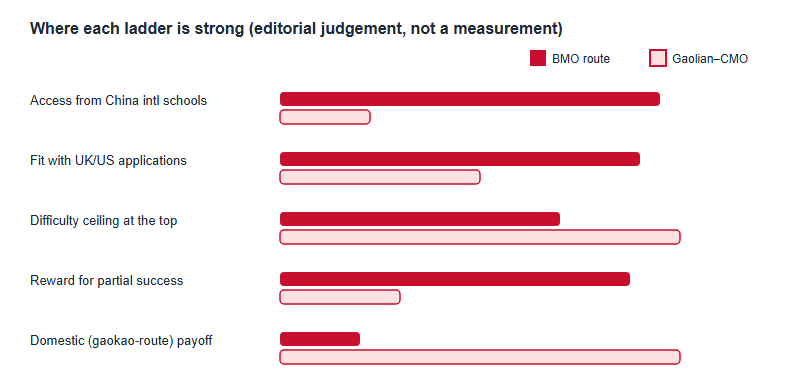
Reading the bars honestly: choose the BMO track if you are on an international curriculum aiming overseas — it is accessible, its awards are legible to your target universities, and even a partial run (an SMC certificate, a respectable BMO1 score) is a real, reportable outcome. The domestic track earns its place if you are in a dual-track or mainland-curriculum situation with genuine access through a registered school, or if you simply want to train against the hardest problem sets in the world regardless of credentials.
And that last point deserves its own paragraph: as training material, the two systems are complements, not rivals. Chinese olympiad books and past Gaolian/CMO problems are superb preparation fuel for BMO2-level ambitions, and plenty of China-based students use domestic materials to train while using the UKMT ladder to compete. If that is your plan, build your base with the BMO past paper pack first, then layer in domestic problems where you want extra depth.
Running both tracks: a realistic assessment
Can one student do both? Structurally, the calendars do not clash badly: Gaolian typically sits in early autumn, the SMC around October, BMO1 around November, CMO in the winter window near BMO2 season — though every one of those dates must be confirmed with the respective organiser for your year. The real constraint is access (few international-school students can enter Gaolian at all) and hours. Domestic-level competitiveness in a strong province is a part-time job; bolting it onto an IB diploma and an overseas application season is how burnout happens.
Our editorial advice for the typical reader of this site: commit to the UKMT ladder as your competition spine, borrow from the Chinese training tradition where it makes you stronger, and only pursue Gaolian entry if a concrete registration channel actually exists at your school. A focused BMO campaign that produces a real score beats a theoretical dual-track plan that produces exhaustion.
FAQ
Can an international-school student in China sit Gaolian?
Sometimes, but only through a school registered with the provincial competition system, which many international schools are not. There is no general individual-entry route; confirm with your school and provincial organiser.
Is the BMO easier than the Chinese olympiad track?
At the top, yes — CMO problems sit at or beyond BMO2 difficulty. But BMO1 is a serious full-proof paper, and for overseas applications a strong BMO run is more accessible and more legible than an early exit from Gaolian.
Do UK universities recognise Gaolian or CMO awards?
Admissions readers respect genuine olympiad achievement from any country, and CMO-level results carry weight. Provincial prizes are harder for overseas readers to calibrate than a BMO score band.
Should I use Chinese olympiad books to prepare for the BMO?
Yes, selectively. Chinese training materials are excellent for depth in geometry, algebra and number theory — pair them with BMO past papers so your practice matches the exam you will actually sit.
This is an independent editorial guide operated by Hanlin Education for China-based international-school students. It is not affiliated with, endorsed by, or sponsored by UKMT or the BMO Subtrust. Competition details change; always confirm current dates, formats and entry arrangements on ukmt.org.uk (and with the relevant Chinese organisers for domestic competitions). Factual errors flagged to our editorial desk are corrected within 7 working days.