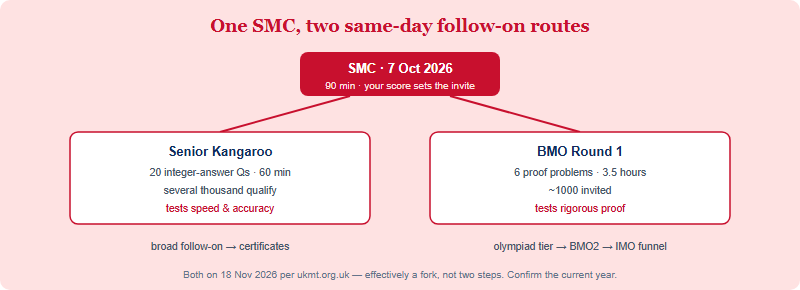
After the Senior Mathematical Challenge, UKMT runs two different follow-on rounds — the Andrew Jobbings Senior Kangaroo and British Mathematical Olympiad Round 1 — and both fall on the same date, Wednesday 18 November 2026. The Kangaroo is a 60-minute, 20-question integer-answer paper for several thousand qualifiers; BMO1 is a 3.5-hour, six-problem proof olympiad for around a thousand. They reward different skills, so the right target depends on the student.
Same parent, two very different children
Both rounds are entered “by invitation based on a qualifying Senior Mathematical Challenge score, or by discretionary entry” (per ukmt.org.uk). That shared starting point is where the similarity ends. The Senior Kangaroo is positioned as the broad follow-on: “several thousand UK-based students qualify,” and it asks for numerical answers, not written proofs. BMO1 is the selective olympiad tier feeding the UK’s international-team pipeline. If you want the full picture of the round you are choosing between, our What Is the British Mathematical Olympiad explainer covers BMO1 in depth.
Because they sit on the same day, this is not a “do both” situation in any practical sense — it is a fork. The decision is usually made for you by your SMC score and the invitation you receive, but understanding the two routes lets you train toward the one that fits and read your result correctly.
| Feature | Senior Kangaroo | BMO Round 1 |
|---|---|---|
| Format | 20 integer-answer questions (000–999) | 6 problems, full written proofs |
| Time | 60 minutes | 3.5 hours |
| What you submit | Numerical answers on a sheet | Complete written arguments |
| Date (published) | Wed 18 Nov 2026 | Wed 18 Nov 2026 |
| Qualifying pool | Several thousand from the SMC | ~1000 from the SMC |
| Skill tested | Fast, accurate problem-solving | Rigorous proof-writing |
| Eligibility | Year 13 and below | Year 13 and below |
The skill split: speed versus rigour
The clearest way to choose is to ask which skill the student already has and which they want to build. The Senior Kangaroo rewards the same fast, accurate problem-solving the SMC trains, compressed harder: 20 questions in 60 minutes, with answers as integers from 000 to 999. UKMT frames it as a paper about “solving interesting problems, not lucky guessing” — integer answers remove the multiple-choice lottery while keeping the pace high.
BMO1 changes the game entirely. Six problems in 3.5 hours means roughly 35 minutes each, and you are not finding a number — you are constructing a proof that “includes complete proofs of any assertions” (per ukmt.org.uk). It rewards depth, structure and the ability to write a watertight argument under time pressure. A student who is fast but has never written a formal proof will feel the floor shift.
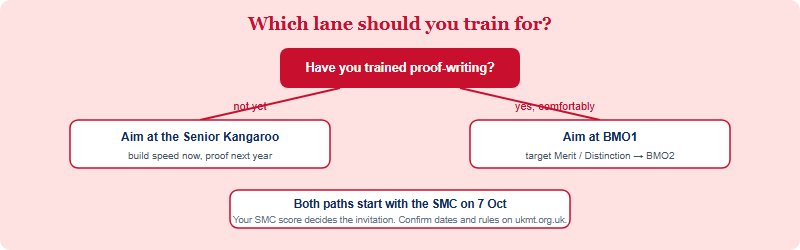
- Choose the Kangaroo lane to train if the student is quick and accurate but new to proof, or wants a strong, achievable senior result while building toward olympiad work next year.
- Choose the BMO1 lane to train if the student already enjoys proof, has done intermediate olympiad work (Cayley/Hamilton/Maclaurin), and is aiming at the selective end of the pathway.
- Either way, the SMC comes first. Your score on 7 October determines which invitation arrives, so the autumn plan is: SMC speed now, then pivot fast to whichever follow-on you are pointed at.
Signal value: what each says on an application
For students using maths competitions as an admissions signal, the two rounds carry different weight — honestly assessed, not inflated. A strong Senior Kangaroo result shows you are among several thousand of the country’s sharper problem-solvers: a real, creditable distinction, especially for younger students. A BMO1 Certificate of Merit or Distinction sits higher on the ladder precisely because the field is smaller (~1000) and the paper demands proof, which is closer to what selective university mathematics actually involves.
No competition result guarantees an admissions outcome, and an honest file says so. But the general principle holds: a result is a stronger signal when the field is more selective and the task is closer to undergraduate-level mathematics. That is why BMO1 — and beyond it, BMO2 — reads strongly. For overseas applicants weighing whether they can even enter, our eligibility reality check for international students is the place to start before you build the rest of the plan.
A realistic two-year view for younger students
For a Year 11 or Year 12 student, the smartest reading is not “Kangaroo or BMO1 this year” but “where do I want to be in two years.” The Senior Kangaroo can be an excellent stepping stone: a strong result while you build the proof habit, then a move to the BMO1 lane the following season. Students who arrive at BMO1 having already done intermediate olympiad proof work — the Cayley/Hamilton/Maclaurin route — tend to handle the format shock far better. We map that earlier runway in the JMO-to-Cayley plan, which is where most successful BMO students quietly started.
Whichever lane you train for, the logistics are identical and time-sensitive: entries run through schools and centres, auto-qualifiers to follow-ons are free, and discretionary entry costs £40 per candidate (per ukmt.org.uk). Settle the registration question early, sit the SMC, then commit hard to the route your score opens.


What each paper feels like in the room
The format gap is not just a line in a table — it changes the entire experience of the contest, and students who train for the wrong one feel it within minutes. The Senior Kangaroo is a sprint: 20 questions in 60 minutes is three minutes a question, so the pressure is on quick recognition and clean execution. You read, you spot the route, you compute, you record an integer from 000 to 999, you move on. There is no credit for working you do not finish, and no partial marks for an approach — only the answer counts, which is why accuracy under speed is the whole game.
BMO1 is the opposite tempo. Six problems in 3.5 hours rewards patience: you might spend twenty minutes exploring a problem before the idea appears, then forty minutes writing it up rigorously. The room is silent for hours, not one. A student used to the Kangaroo’s pace can panic when a BMO1 problem does not yield in three minutes — but on BMO1 that is normal, and the skill is staying with a problem long enough to crack it, then proving the crack holds. Recognising which tempo suits a student’s temperament is as useful as comparing their topic knowledge.
| In the room | Senior Kangaroo | BMO Round 1 |
|---|---|---|
| Pace | ~3 minutes per question | ~35 minutes per problem |
| Mode | Recognise, compute, record | Explore, prove, write up |
| Partial credit | None — only the integer answer counts | Yes, but completeness is rewarded over partial attempts |
| Stamina demand | One intense hour | Sustained focus over 3.5 hours |
| Failure mode | Careless slips under time pressure | Gaps in proofs; abandoning near-complete solutions |
Pivoting from SMC prep to your chosen lane
There are only about six weeks between the SMC on 7 October and the follow-on rounds on 18 November, so the pivot from general SMC preparation to lane-specific training has to be deliberate. The good news is that SMC work transfers cleanly to the Kangaroo and partially to BMO1 — but the last mile is different for each. These are editorial coaching suggestions based on the format differences, not official UKMT guidance.
- Pivoting to the Kangaroo: keep doing timed multi-question sets, but push the difficulty up and tighten the clock. Drill the integer-answer format so the 000–999 recording is automatic, and practise deciding fast when to skip a question and come back.
- Pivoting to BMO1: stop optimising for speed and start writing full solutions to single hard problems, marked the olympiad way. Build stamina with at least one timed multi-hour sitting before the real paper, so 3.5 hours of silent focus is not a shock on the day.
- For both: use past papers as your spine. UKMT publishes past materials and solutions; working real problems under real timing is the single most reliable preparation, far more than reading about technique.
If you are weighing the broader UKMT-from-overseas question — how the pathway fits together and how a student outside the UK plugs into it — the route choice here is one decision inside that larger plan. A student who knows their lane, has trained the right tempo, and has sorted registration early walks into 18 November ready to do the only thing that matters: solve the problems in front of them.
Frequently asked questions
Can I sit both the Senior Kangaroo and BMO1?
UKMT lists both on the same date, Wednesday 18 November 2026, so in practice a student takes one. Your SMC score determines which follow-on you are invited to. Confirm on the official site.
Which is harder, the Kangaroo or BMO1?
They test different skills. The Kangaroo is fast integer-answer problem-solving in 60 minutes; BMO1 is deep proof-writing over 3.5 hours. BMO1 sits at the more selective olympiad tier.
Is the Senior Kangaroo worth doing if I want BMO later?
Yes — it is a strong senior result and a good stepping stone while you build proof skills, then move to the BMO1 lane the next season. Plan it as a two-year runway.
Do international students qualify for these rounds?
Eligibility is by school year (Year 13 and below) and entry runs through schools or centres. Whether overseas candidates can enter, and how, must be confirmed on ukmt.org.uk.
This is an independent editorial guide operated by Hanlin Education for China-based international-school students. It is NOT affiliated with, endorsed by, or sponsored by UKMT or the BMO Subtrust. Competition formats, dates, fees and eligibility change year to year — confirm current details on ukmt.org.uk before relying on them. Any error will be corrected within 7 working days of notification.