For many international students preparing for the British Mathematical Olympiad (BMO), functional equations present a specific psychological hurdle. You might stare at an equation like and immediately guess that works. You plug it in, verify it, and feel a surge of confidence. But when you look at the mark scheme or discuss it with peers, you realise your answer was incomplete. The question asked to determine all functions, and you only found one family. In BMO algebra, finding a candidate solution is merely the first step; proving uniqueness is where the marks are awarded.
This article addresses a narrower procedural question than our broader BMO Algebra Decoded: Inequalities, Functional Equations and Polynomials (2026-27) guide: how do you systematically test substitutions to ensure no other functions exist? We will walk through a series of substitution checks, including domain verification, fixed inputs, and candidate testing, that helps you move from intuition to rigorous proof. This method is particularly useful for students who find themselves stuck after identifying an obvious linear solution but unable to close the argument.
The Gap Between Guessing and Proving
A determine all functions problem requires two distinct logical components: existence and uniqueness. Existence means showing that the function you proposed actually satisfies the equation. Uniqueness means showing that no other function can satisfy it. Most students fail because they spend most of their time on existence and too little on uniqueness, or worse, they assume uniqueness without proof.
Olympiad marking often rewards partial progress, but a uniqueness gap remains a gap. A complete solution demands that every possible case is accounted for. If you miss a pathological solution or fail to rule out non-linear behaviour, your proof is invalid. The substitution audit is designed to prevent this by forcing you to interrogate the equation before you commit to a single form.
The key mental shift is to treat the equation as a machine that generates information. Each substitution is a test input. Some substitutions reveal values such as or . Others reveal symmetries, monotonicity-like relations, or constraints on ranges. When students skip this audit, they often write a proof that works only for the candidate they already guessed. When they run the audit, the proof structure often appears naturally from the extracted facts.
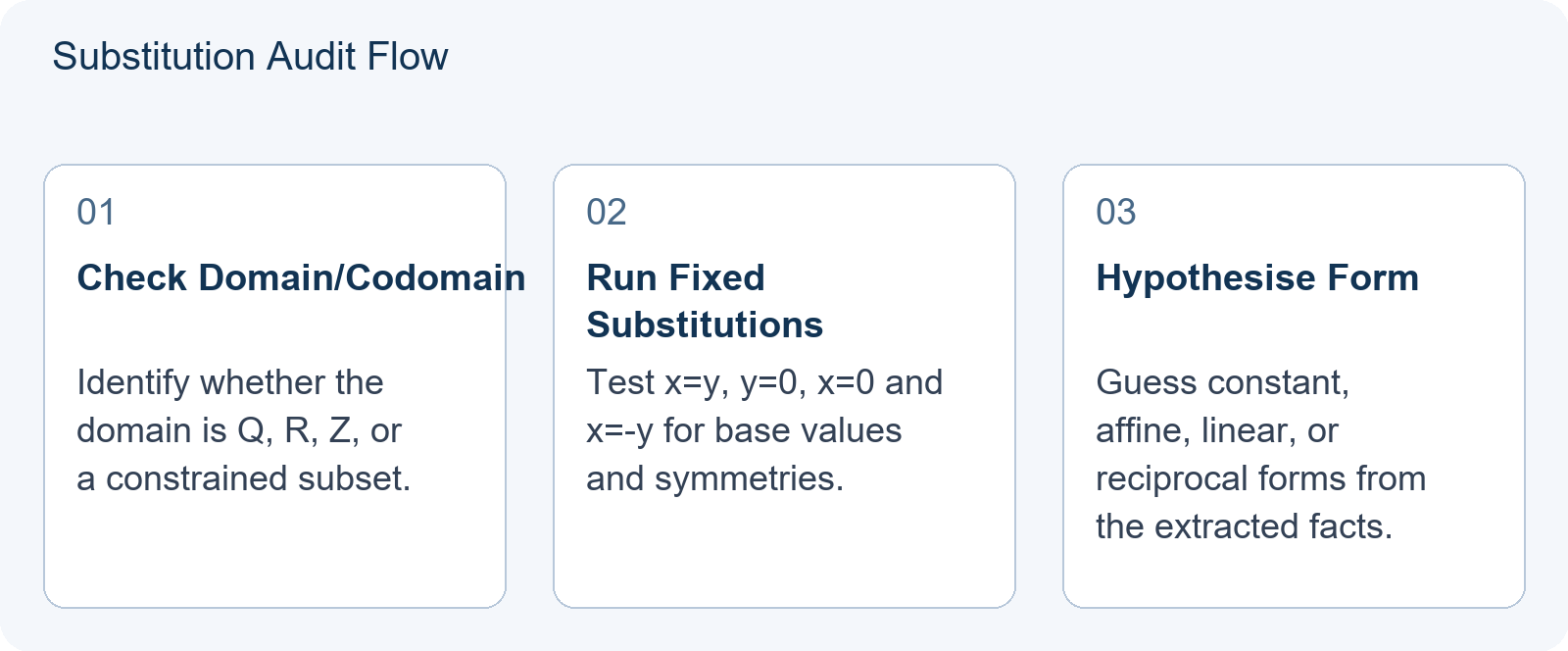
Step 0: Record Domain, Codomain and Regularity
Before plugging in any numbers, write down exactly what the problem states. Is the function defined over integers, rationals, reals, positive reals, or some other set? Does the problem state that is continuous, monotonic, bounded, injective, surjective, or something else? These constraints drastically change which substitutions are valid and which uniqueness arguments are available.
For example, Cauchy’s functional equation has wild, discontinuous solutions over the reals if no regularity condition is imposed. However, if the domain is restricted to the rationals, the only solutions are linear. If continuity is assumed, the solutions are linear over the reals. Misreading these boundaries leads to incorrect assumptions about uniqueness. Always circle the domain and codomain in your notes before starting.
Regularity conditions are not decoration. They are proof tools. If the problem says is increasing, then you may compare values and rule out strange oscillations. If the problem says the codomain is the positive integers, then you may use divisibility or bounds. If no regularity is stated, you should be suspicious of any proof that silently assumes it.
The Substitution Audit: Fixed Inputs
Once the setup is clear, run through standard substitutions. These are not random guesses; they are strategic probes designed to extract information about specific values of the function.
- : This often reveals symmetry or doubling properties. For instance, in , setting gives , which shows that is nonnegative when is real-valued.
- : This isolates or relates to . It is crucial for determining constant terms.
- : This is similar to the previous substitution, but sometimes yields different information if the equation is not symmetric in and .
- : This is useful for odd and even properties. If , first set to get ; then setting gives , so the function is odd. Setting in the same equation gives a different relation and is not the cleanest route to oddness.
- One-variable dependence: Try to isolate in terms of to see if the function behaves predictably under composition.
Do not skip these steps. Even if they seem trivial, they provide the foundational values, such as or , that anchor your subsequent induction or algebraic manipulation. A substitution that produces a tautology is also useful, because it tells you that the equation is symmetric in a way that may require a different strategy.
Testing Simple Candidates
After gathering initial data, hypothesise simple forms. Common candidates include:
- Constant functions: . Test whether the constant satisfies the equation for all allowed .
- Affine functions: . Check whether the slope and intercept are consistent with your earlier substitutions.
- Linear functions: . This is often the result of additive equations.
- Reciprocal or power functions: or . These are relevant for multiplicative equations.
If a candidate fails, discard it immediately. If it passes, you have established existence. Now you must prove uniqueness. A candidate that passes is not proof that it is the only candidate; it is only a witness that the problem has at least one solution.
Labelled Teaching Illustration: Cauchy-Type Equation Over the Rationals
Note: This is a hypothetical teaching example, not an official BMO problem.
Consider the problem: Determine all functions such that for all .
1. Substitution audit. Set : , so . Set : , so . Thus is odd and sends to .
2. Candidate testing. Try . The left-hand side is . The right-hand side is . They match for every , so is a solution family.
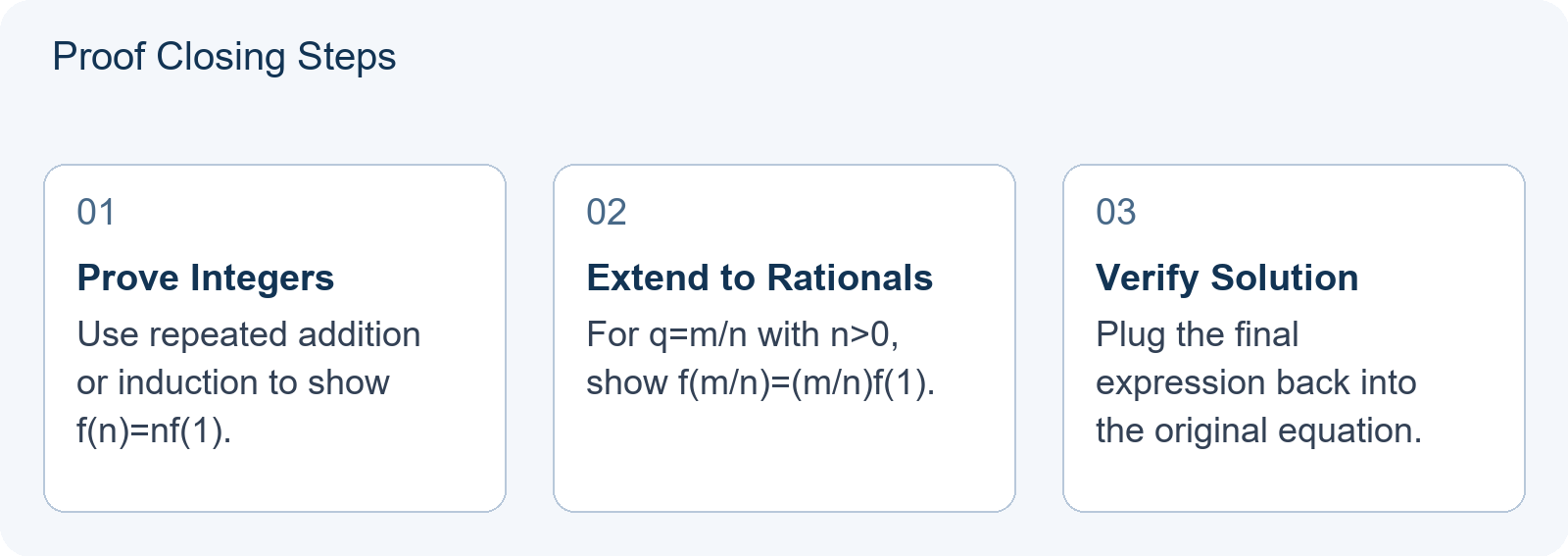
3. Proof closing: uniqueness. We need to show for all .


First, for every positive integer , repeated addition gives . Since is odd, . Also . Therefore for every integer .
Now let with and a positive integer. Then
,
where the sum has terms. Since , we get , so . Let . Then for all .
Verification: . Done.
This illustration shows how the audit leads directly to the structure of the proof. Without establishing and integer scaling first, the rational extension would be difficult to justify rigorously.
Diagnostic: When Substitutions Give Tautologies
Sometimes standard substitutions yield or , providing no new information. This usually indicates that the equation is too symmetric, or that you need to introduce a new variable relationship. Try substituting for some constant , or consider fixing one variable to a specific value derived from earlier steps, such as setting after learning .
Another strategy is to split cases based on the sign of variables or whether they are zero. For example, if the domain is the non-zero reals, treat positive and negative inputs separately if the equation involves squares or absolute values. If the domain includes zero, handle zero separately before assuming cancellation is valid.
You can also test whether the equation forces injectivity or surjectivity. If you can show implies , then you may compare two expressions for the same output. If you can show every value in the codomain is attained, then you may choose an input that produces a useful output.
Uniqueness Tactics After the Audit
Once the audit has produced base values, the uniqueness proof usually uses one of several tactics. Induction extends from integers to larger structures. Rational reconstruction extends from integers to fractions. Monotonicity plus density extends from rationals to reals. Boundedness can rule out discontinuous additive behaviour. Injectivity can turn an equation about outputs into an equation about inputs.
The important point is that these tactics are not chosen at random. They are chosen because the substitution audit has already produced the facts they need. If you have , induction on positive integers becomes natural. If you have oddness, negative integers follow. If you need to reach all rationals, writing and multiplying by becomes natural. If you need to reach all reals, density or continuity may become necessary.
Write-Up Checklist: Verification and Completeness
Before submitting your answer, check three things:
- Did I state the domain and codomain? Ensure your solution respects the original constraints and does not use values outside the allowed set.
- Did I prove uniqueness? Did I show that every function satisfying the equation must take the form I found?
- Did I verify my solution? Plug your final expression back into the original equation to confirm it holds for all allowed inputs.
Missing verification is a common source of lost marks. Even if your derivation is sound, a small algebraic error in the final step can invalidate the entire proof. Always double-check. For broader guidance on how proof completeness is assessed, see How BMO Solutions Are Marked: Writing Proofs That Score (2026-2027).
When you practise, do not stop after finding a candidate. Force yourself to write the uniqueness paragraph. If you cannot, return to the substitution audit and identify which fact is missing. That habit alone can turn a guessed solution into a complete solution. For further practice on structuring arguments, refer to SMC to BMO Proof Writing: Replace a Plausible Pattern With a Complete Argument.
Frequently Asked Questions
Why is guessing f(x)=cx not enough for full marks?
Because the question asks to determine all functions. You must prove that no other function exists, which requires a uniqueness argument beyond simply verifying one candidate.
What if my substitutions give me no new information?
This suggests the equation is highly symmetric. Try introducing a parameter such as y=kx, or split cases based on variable signs or domain restrictions to break the symmetry.
Does continuity matter in BMO functional equations?
Yes. If the domain is the real numbers, continuity, monotonicity or boundedness is often required to rule out pathological solutions. Always check whether such a condition is stated in the problem.