Many students preparing for the British Mathematical Olympiad (BMO) can handle routine angle chasing and standard circle theorems, yet still freeze when a geometry problem demands a new object. The question is not whether you know facts about circles and lines. It is how to decide which auxiliary object to introduce next. In BMO geometry, that decision often determines whether the proof opens up or collapses into a pile of unconnected equations.
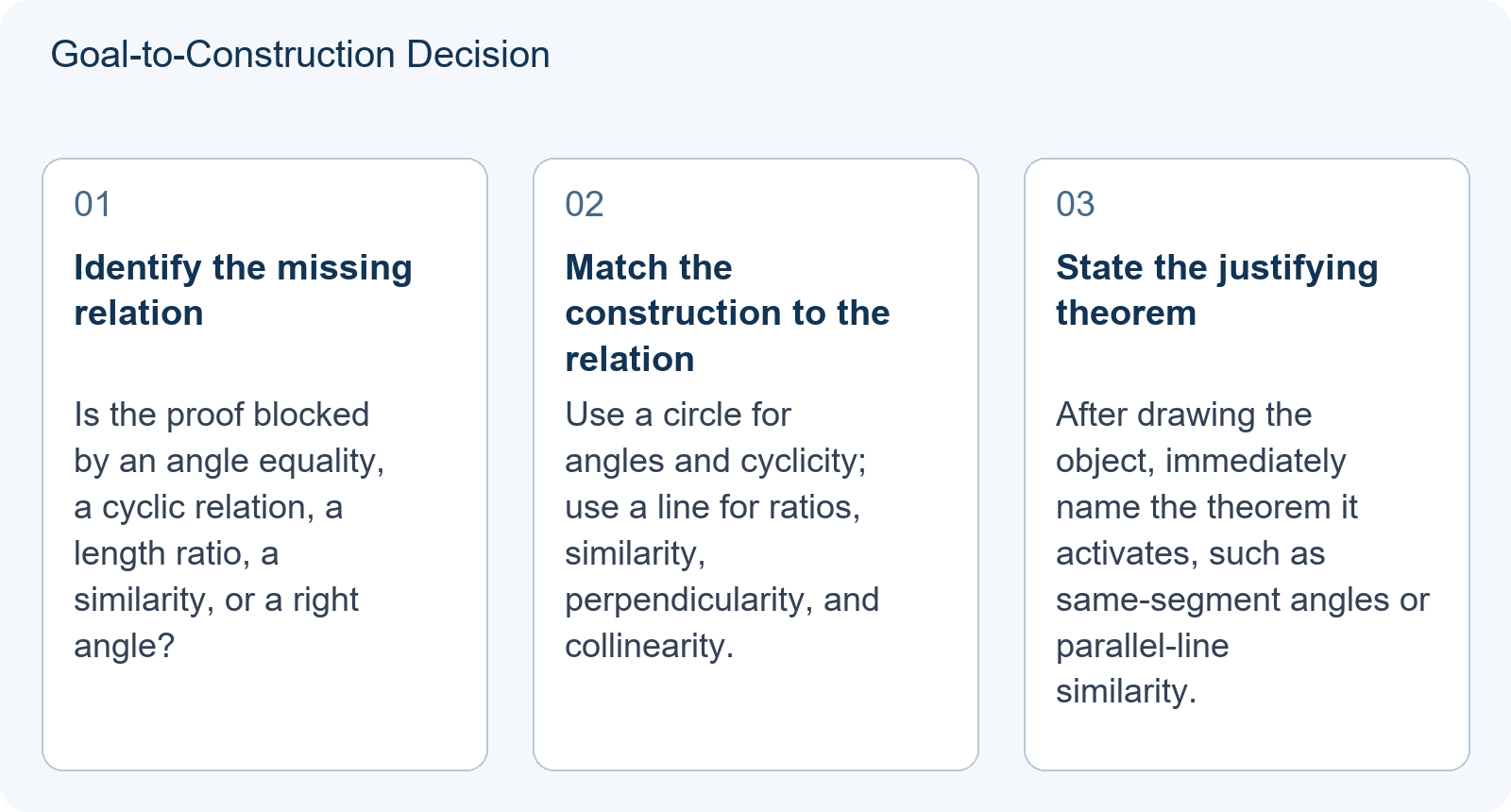
This guide gives a practical decision rule: let the missing relation choose the construction. If you need an angle equality, a cyclic configuration, or a tangent-chord relation, think auxiliary circle. If you need a length ratio, similar triangles, a right angle, or a collinearity/concurrency condition, think auxiliary line. The rule is not a magic formula, but it prevents the most common wasted move: adding a circle when the goal is metric, or adding a parallel line when the goal is angular.
Why one well-chosen construction matters
BMO problems are proof-based. A correct final number is not enough; the solution must show why the conclusion follows. An auxiliary construction is the bridge between the given data and the target relation. If the bridge is placed badly, the proof may still be salvageable, but it becomes longer, harder to justify, and more likely to contain an unproven assumption.
The construction should do one of three jobs: create a known theorem’s hypothesis, create a new relation, or convert one type of relation into another. For example, a parallel line can convert a length ratio into an angle equality. A circle can convert an angle equality into a cyclic quadrilateral, which then gives more angle equalities. Your first question should therefore be: what exact relation is missing?
Diagnostic 1: Are you missing an angle equality or cyclic relation?
If the target is any of the following, an auxiliary circle is usually the first object to consider:
- proving two angles are equal;
- proving four points are concyclic;
- using a tangent-chord relation;
- relating angles subtended by the same segment.
The reason is that circle theorems are angle-producing machines. Equal arcs produce equal inscribed angles. A cyclic quadrilateral produces supplementary opposite angles. A tangent and a chord produce the Alternate Segment Theorem. These are exactly the relations you need when the conclusion is angular.
Look for these triggers:
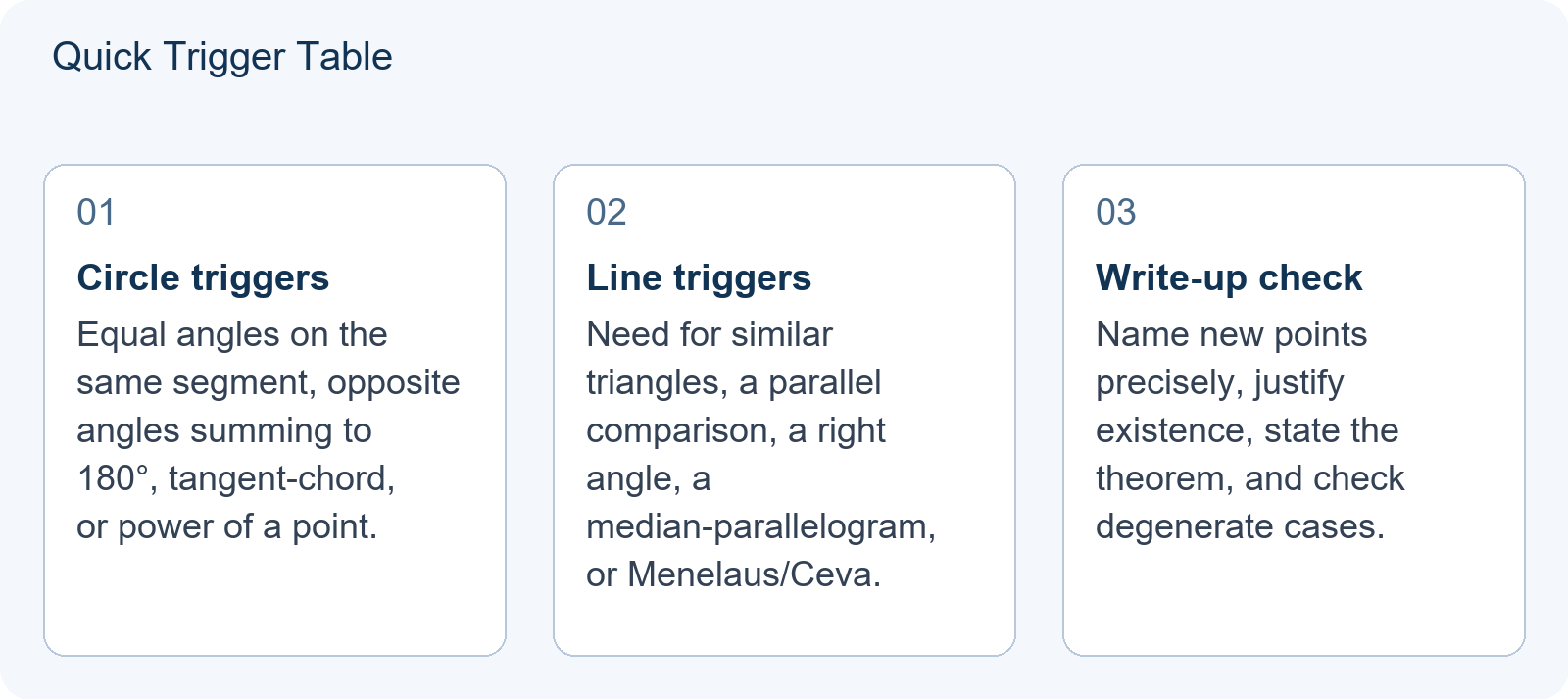
- Equal angles on the same segment. If C and D lie on the same side of AB and ∠ACB = ∠ADB, then A, B, C, D are concyclic. If C and D lie on opposite sides, the correct criterion is ∠ACB + ∠ADB = 180°. Drawing the circumcircle of ABC places D on the same circle and unlocks the rest of the cyclic-quadrilateral toolkit.
- Opposite angles summing to 180°. If a quadrilateral already has one pair of opposite angles summing to 180°, the other pair does too. This can replace a difficult angle chase with a single theorem.
- Tangent-chord. If a tangent meets a chord at a point on a circle, the angle between tangent and chord equals the angle in the alternate segment. If the circle is not yet drawn, constructing it makes the theorem available.
- Triangle centres. Among the geometry topics commonly listed for BMO preparation are circumcentre, orthocentre, incentre, and centroid. These centres often appear in configurations where right angles or equal distances force cyclic quadrilaterals. For example, the feet of two altitudes together with the opposite vertices form a cyclic quadrilateral, because two right angles subtend the same segment.
Diagnostic 2: Are you missing a length ratio, similarity or right angle?
If the target is metric rather than angular, an auxiliary line is usually more direct. Metric goals include:
- proving a ratio such as AX/XB = k;
- proving two triangles are similar;
- proving a product relation such as PA · PB = PC · PD;
- proving collinearity or concurrency through Menelaus or Ceva;
- creating a right angle so that Pythagoras or trigonometry applies.
Lines are useful because they create new triangles. A parallel line creates similar triangles, which convert ratios into equal angles. A perpendicular creates right triangles, which convert lengths into algebraic equations. A median extended by its own length creates a parallelogram, giving equal opposite sides and parallel directions.
Look for these triggers:
- Parallel lines for similarity. If two disjoint segments must be compared, draw a line parallel to one of them. This often produces a pair of similar triangles whose side ratios contain the desired lengths.
- Perpendiculars for right angles. Dropping a perpendicular from a vertex to the opposite side is the standard way to introduce Pythagoras or trigonometric ratios. It is especially natural when the problem involves an altitude, a distance from a point to a line, or an incentre.
- Medians and angle bisectors for symmetry. In an isosceles triangle, the median from the apex is also an altitude and an angle bisector. Extending a median can create a parallelogram. An angle bisector can create equal angles that feed back into similarity.
Auxiliary circle patterns: when to draw the round object
A circle is not just a shape; it is a way to import a set of angle identities. The most useful patterns in olympiad geometry are:
- Same-segment angles. If two points lie on the same side of a fixed segment and see that segment under the same angle, they lie on a common circle. If they lie on opposite sides, the supplementary-angle condition is needed. This is often the fastest route from an angle equality to concyclicity.
- Cyclic quadrilateral. Once four points are cyclic, opposite angles are supplementary and exterior angles equal interior opposite angles. This can turn a stubborn angle chase into two or three lines.
- Tangent-chord. The Alternate Segment Theorem is one of the circle laws commonly listed for BMO geometry. When a tangent appears, the circle is usually the intended tool.
- Power of a point. Intersecting chords, secants, or a tangent and secant produce product relations. Drawing the circle containing the relevant points lets you apply PA · PB = PC · PD, which directly relates lengths.
A useful pattern is the Miquel configuration: two triangles share a vertex, and their circumcircles meet again at a point that creates new cyclic quadrilaterals. Treat this as a teaching pattern, not a guaranteed shortcut. The safe method is always to ask whether the next theorem you want to use is an angle theorem. If it is, a circle is a strong candidate.
Auxiliary line patterns: when to extend or drop
Lines are the natural tool when the problem is about distance, ratio, or linear configuration. A parallel line is often the quickest way to manufacture similar triangles. A perpendicular is the quickest way to manufacture a right angle. These two moves cover a large share of metric geometry problems.
Other line constructions worth knowing:
- Extend a side to meet another line. This creates an external triangle and can set up Menelaus for collinearity or Ceva for concurrency.
- Double a median. If M is the midpoint of BC, extending AM to A′ with AM = MA′ creates a parallelogram ABA′C. This is useful when midpoints or vectors are involved.
- Drop perpendiculars from a centre. The incentre is equidistant from the sides. Dropping perpendiculars from the incentre to the sides creates congruent right triangles and proves the inradius is constant.
- Draw a line through a point parallel to a side. This is the standard similarity construction. It turns a ratio problem into an angle problem, because parallel lines give equal corresponding angles.
For BMO2 preparation, Heron’s formula is listed among the geometry topics, so constructing altitudes to express areas in terms of base and height is often a natural first step when a problem asks for an area relation.
Labelled teaching illustration: choosing by goal
This is a teaching illustration, not an official BMO problem. It is designed to show the decision rule in action.
Scenario A: a length identity. Let ABC be a triangle with AB = AC. Let D be any point on BC. Prove that AD² = AB² − BD · DC.
Approach using an auxiliary line. Drop a perpendicular from A to BC and call the foot M. Because AB = AC, M is the midpoint of BC. Set BM = CM = m. Let x be the directed distance from M to D, positive toward C. Then BD = m + x and DC = m − x, so BD · DC = (m + x)(m − x) = m² − x². By Pythagoras in right triangles ABM and ADM, AB² = AM² + m² and AD² = AM² + x². Therefore AB² − BD · DC = (AM² + m²) − (m² − x²) = AM² + x² = AD². This completes the proof.


Why the line was correct: the goal is a length identity involving squares and a product of segments. The perpendicular creates right triangles, and Pythagoras converts the geometry into algebra.
Scenario B: an angle equality. Suppose instead that ABCD is a cyclic quadrilateral with vertices in that order and you are told AB = AD. Prove that AC bisects ∠BCD.
Approach using the circle. Since ABCD is cyclic, all four points lie on one circle. Equal chords AB and AD subtend equal angles at the circumference. The chord AB subtends ∠ACB, and the chord AD subtends ∠ACD. Hence ∠ACB = ∠ACD, so AC bisects ∠BCD.
Why the circle was correct: the goal is an angle equality, and the circle already contains the theorem needed. If the circle were not given, constructing the circumcircle of triangle ABD would be the natural first move.
Write-up habits: justify every construction
Choosing the right auxiliary object is only half the work. The other half is explaining it clearly enough that a reader can follow the proof without guessing. In a BMO write-up, precision matters.
First, name every new point. Do not write “draw a circle.” Write “construct the circumcircle of triangle ABC.” Do not write “draw a parallel line.” Write “through D, draw the line parallel to AB, meeting AC at E.” This defines the object uniquely and tells the reader where it lives.
Second, state the theorem immediately after the construction. For example: “Since ABCD is cyclic, ∠ADC = 180° − ∠ABC.” Or: “Since DE is parallel to AB, ∠CDE = ∠CBA by corresponding angles.” This links the construction to the deduction.
Third, check for hidden assumptions. Do not assume that a point lies on a circle unless you have proved it or defined the circle through that point. Do not assume that two lines meet inside the triangle unless the problem guarantees it. If a construction introduces a new point, make sure its existence is justified by the given conditions.
Fourth, handle degeneracies. If a point could coincide with a vertex or a line could be parallel in a special case, either exclude that case explicitly or explain why the argument still works. Olympiad proofs are expected to be complete, not just convincing for a generic diagram.
How to practise the decision
The decision between circle and line becomes faster with deliberate practice. For each geometry problem, before reading any solution, write one sentence: “The missing relation is ____.” Then choose the construction that produces that relation. Only after committing to a choice should you read the official solution or a worked answer.
Compare your choice with the official one. If you chose a different construction but still completed a valid proof, that is useful. If you chose a construction that led nowhere, identify which relation you failed to create. Over time, you will build a personal trigger table: equal angles suggest a circle; proportional lengths suggest parallel lines; right angles suggest perpendiculars; midpoints suggest doubling or parallelograms.
For broader configuration and write-up habits, see BMO1 Geometry Decoded: The Configurations, Tools and Write-Up Habits That Earn Marks. For a non-geometric proof strategy that sometimes helps in mixed problems, see BMO Extremal Principle: Choosing the Largest or Smallest Object to Start a Proof. If you are moving from school-level problem solving to olympiad rigour, SMC to BMO Proof Writing: Replace a Plausible Pattern With a Complete Argument is a useful companion.
Conclusion
In BMO geometry, the auxiliary construction is not a random trick. It is a response to a precise logical need. Ask what is missing: an angle equality or a length ratio? A cyclic relation or a similarity? A right angle or a product of segments? Once the missing relation is clear, the choice between an auxiliary circle and an auxiliary line becomes much easier to justify—and much easier to write up.
This is an independent UKMT-pathway guide and is not affiliated with UKMT.
Frequently Asked Questions
Can I use both a circle and a line in the same proof?
Yes. Many olympiad proofs use multiple constructions. You might first draw a circle to establish an angle equality, then drop a perpendicular to convert that angle information into a length equation. The key is that each construction should serve a clear logical purpose.
What if my construction seems too complicated?
Simplicity is valued in proof writing. If a construction introduces many new points without a clear theorem to justify them, reconsider. Before inventing a new object, check whether a standard result such as Power of a Point, Ptolemy, Menelaus, or Ceva applies directly.
Do I lose marks if I choose the ‘wrong’ auxiliary object?
If you still complete a valid proof, the construction choice itself is not a mathematical error. The practical risks are time and complexity: an inefficient construction may lead to unproven assumptions or an incomplete argument. Choose the construction that exposes the needed relation most directly.