Why Equality Cases Matter in BMO Inequalities
In BMO proof problems, showing that an inequality holds is only half the battle. A complete solution must also identify when equality occurs. Many candidates lose marks not because the inequality direction is wrong, but because they stop once the bound is established and never verify that the claimed minimum or maximum is actually attainable. This article works through the specific reasoning failure, gives two contrasting hypothetical examples, and provides a practical diagnostic you can apply to your own practice.
For broader guidance on writing complete BMO proofs, see our article on How BMO Solutions Are Marked: Writing Proofs That Score (2026-2027).
Worked Hypothetical Example 1: AM-GM Done Correctly
Teaching illustration — not an official contest problem.
Suppose you need to prove that for positive real numbers a, b, c, the expression
a/b + b/c + c/a ≥ 3
with equality when a = b = c.
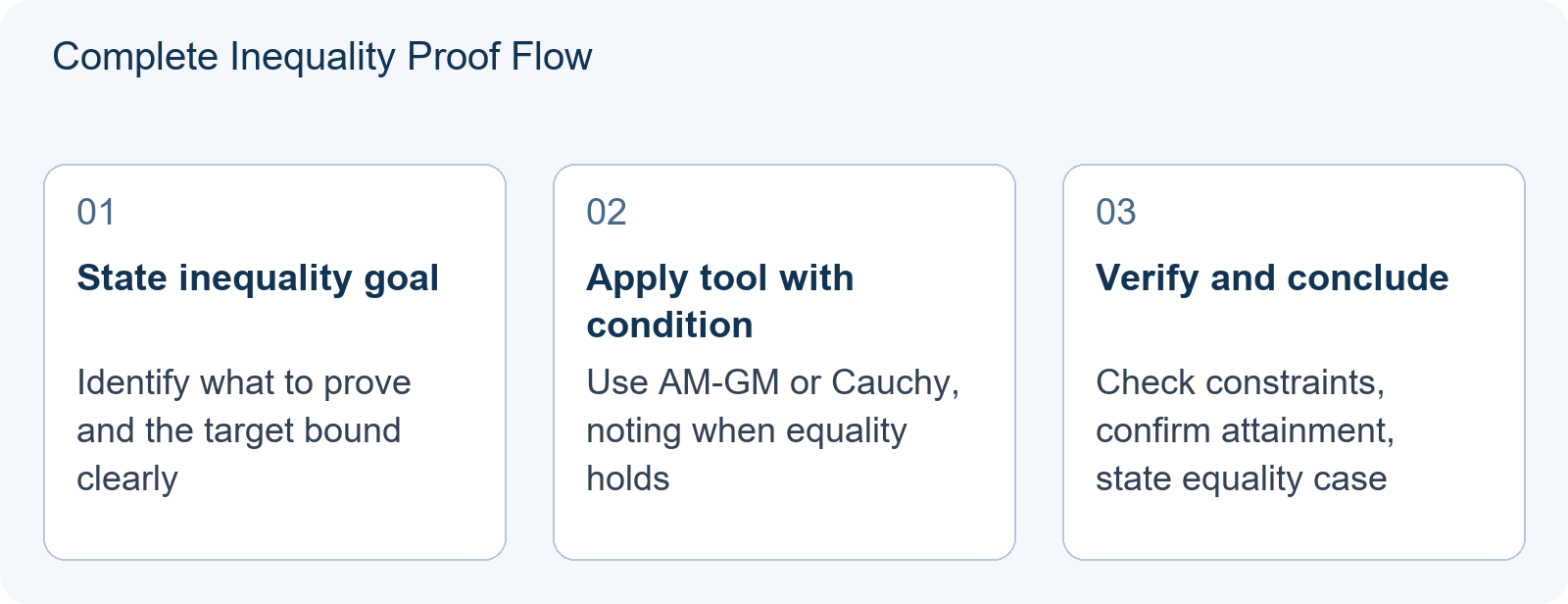
A correct approach proceeds in three stages:
- Apply the inequality: By AM-GM on the three terms, (a/b + b/c + c/a)/3 ≥ ∛(a/b · b/c · c/a) = ∛1 = 1, so a/b + b/c + c/a ≥ 3.
- State the equality condition: AM-GM equality requires a/b = b/c = c/a.
- Verify attainment: From a/b = b/c = c/a = k, we get a = kb, b = kc, c = ka. Substituting: a = k(kc) = k²c and c = ka = k(k²c) = k³c, so k³ = 1, hence k = 1. Thus a = b = c, and substituting back gives 1 + 1 + 1 = 3, confirming the bound is achieved.
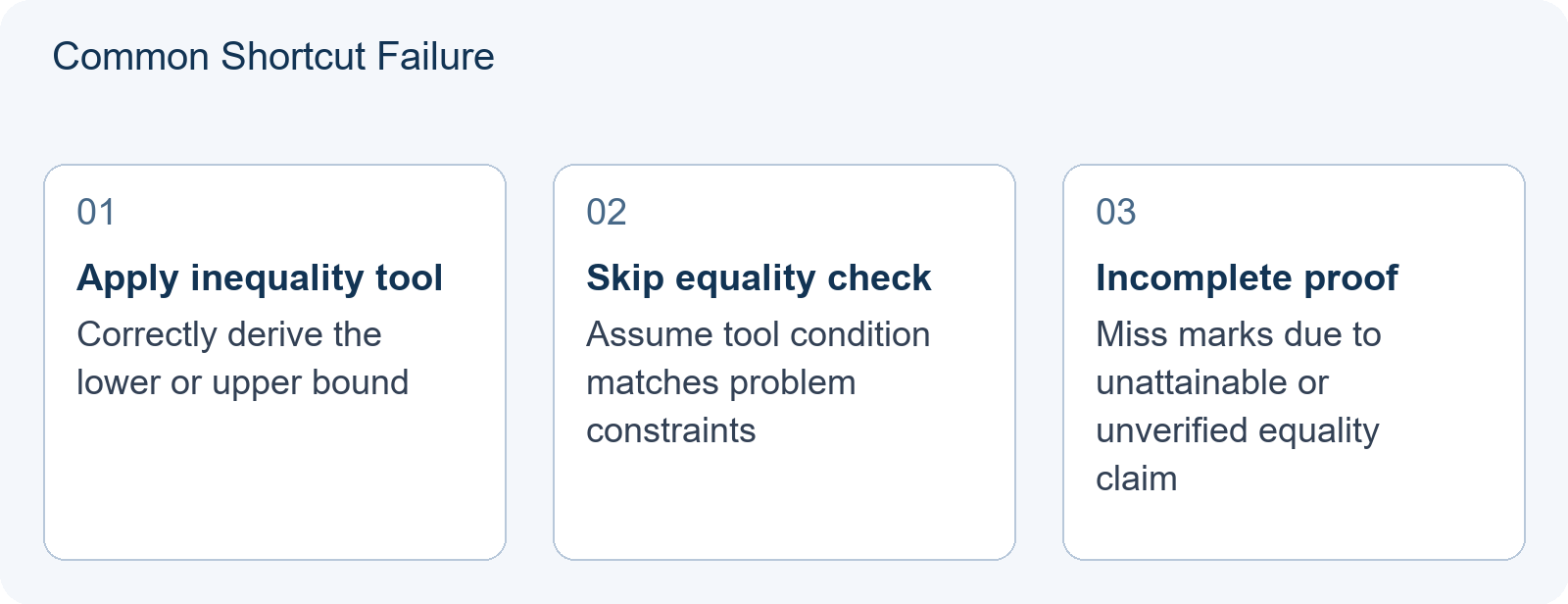
The critical third step is where many partial solutions stop. Without it, the proof asserts a minimum but never demonstrates that this minimum is reachable. In BMO marking, this gap typically costs at least one point and undermines the logical completeness of the argument.
Worked Hypothetical Example 2: Where the Shortcut Fails
Teaching illustration — not an official contest problem.
Consider proving that for positive reals with a + b + c = 6, we have a² + b² + c² ≥ 12, and finding when equality holds.
A candidate applies Cauchy-Schwarz in Engel form: (1² + 1² + 1²)(a² + b² + c²) ≥ (a + b + c)² = 36, giving a² + b² + c² ≥ 12. They then claim equality at a = b = c = 2 (since a + b + c = 6).


However, suppose the problem had an additional constraint: abc = 7. The candidate’s equality point a = b = c = 2 gives abc = 8 ≠ 7, violating the constraint. The Cauchy-Schwarz equality condition (a : b : c = 1 : 1 : 1, i.e., a = b = c) is incompatible with the simultaneous requirements a + b + c = 6 and abc = 7.
The hidden risk: Cauchy-Schwarz equality requires proportional vectors, but the original problem may impose additional constraints that prevent the proportional case from satisfying all conditions simultaneously. The minimum of 12 is not attained under the constraint abc = 7; the actual minimum is higher. If the candidate does not verify that the proposed equality point lies in the feasible region, the proof is incomplete and the answer is wrong.
This distinction between “the inequality tool permits equality” and “the problem constraints allow that equality” is subtle but decisive in BMO problems. For related preparation on avoiding structural proof gaps, see our discussion of What Each BMO Question Stem Requires: A Decoder Table for Determine All, Show That and Prove or Disprove.
Diagnostic Table: Is Your Inequality Proof Complete?
| Question | What to check | Consequence of omission |
|---|---|---|
| Have you stated the equality condition for each tool used? | AM-GM: terms equal; Cauchy-Schwarz: vectors proportional; Jensen: function linear on interval | Marker cannot tell if you understand when the bound is sharp |
| Does the equality point satisfy all original constraints? | Substitute back into every condition in the problem statement | Claimed minimum may be unattainable; proof is invalid |
| Have you verified the bound is attained, not just approached? | Explicit calculation at the equality point | Strict inequality may actually hold; claimed equality is false |
A Targeted Practice Sequence
To build reliable habits for equality-case verification, consider this progression:
- Isolate the tool: Practice problems where you deliberately identify the equality condition before applying the inequality. Write it down explicitly: “Equality holds when…”
- Constrain the check: After finding candidate equality points, write one sentence confirming each original condition is satisfied. If any constraint fails, your bound is not sharp — try a different approach.
- Stress-test with variation: Modify problem parameters slightly and observe whether the same equality case still works; if not, analyse why the constraint interaction changed. This builds sensitivity to hidden incompatibilities.
For students working through BMO preparation systematically, our BMO Algebra Decoded: Inequalities, Functional Equations and Polynomials (2026-27) guide covers inequalities and functional equations in depth.
What to Demonstrate Next
After working through this material, you should be able to: identify the equality condition for standard inequality tools; verify that proposed equality points satisfy all problem constraints; and write a concluding sentence in any inequality proof that explicitly confirms attainment. This skill directly supports the completeness standard expected in BMO solutions.
This is an independent preparation guide. The British Mathematical Olympiad is organised by the UK Mathematics Trust (UKMT). This site is not affiliated with UKMT.
Frequently Asked Questions
Do I need to verify equality cases for every inequality I use in a BMO proof?
You need to verify equality for the inequality that gives your final bound. Intermediate steps may not require full verification unless the problem specifically asks for the exact equality case. The key is that your claimed answer must be demonstrably attainable.
What if I cannot find the equality case after applying an inequality?
This often signals that you applied the wrong inequality or made an algebraic error. Try a different approach, or check whether your bound is actually sharp. In BMO problems, the intended solution usually has a clean equality case.
How much detail should I include when verifying an equality case?
Enough that a reader can follow without guessing. Typically one or two lines: state the values that achieve equality, confirm they satisfy all constraints, and show the calculation that attains the bound. Excessive detail is unnecessary; omission is the common error.