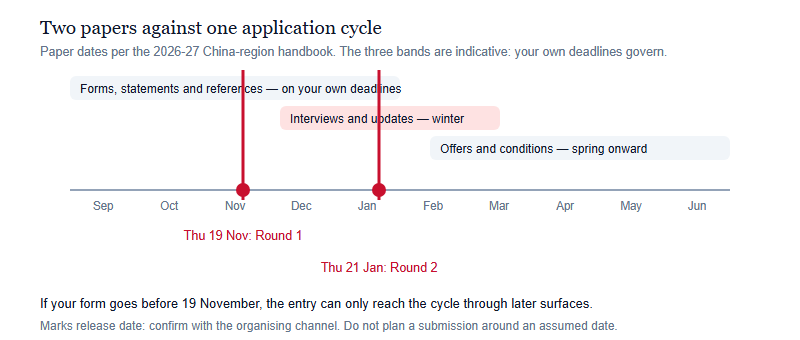
The China-region BMO Round 1 paper is on Thursday 19 November 2026, and Round 2 on Thursday 21 January 2027. Both sit late in a Year 13 application cycle, and for most autumn deadlines the form has already gone by then. This page is a reach table: which parts of an application a late-autumn olympiad entry can still touch, which it cannot, and what you may honestly write before a mark exists.
One date fixes the problem
Almost every timing question about UKMT and university applications collapses into a single comparison: your own submission deadline against 19 November. Everything downstream — whether the entry appears on the form, whether it can be mentioned at interview, whether it belongs to this cycle at all — follows from which of those two comes first.
Two things are fixed and one is not. Fixed: the China-region Round 1 sitting on Thursday 19 November 2026, 17:00 to 20:30, and Round 2 on Thursday 21 January 2027, both per the 2026–27 handbook circulated by the organising channel. Not fixed, at least not by anything we can confirm: when marks are released. Ask the organising channel, and until they answer, plan on the assumption that nothing is certified before the paper.
Your own deadline is the third variable, and it is the one we deliberately will not state for you. Course deadlines differ, universities differ, and reference deadlines are usually earlier than the ones students remember. Look yours up, write the date down, and then read the table below against it.
The reach table
Read each row as a question: can a 19 November entry get here, and if so in what form? The right-hand column is the honest version of what you would be saying.
| Application surface | Can a 19 November entry reach it? | What you would actually be saying |
|---|---|---|
| The application form and personal statement | Only if your own deadline falls after the paper — and after marks are released, if you want to name a result. Check your deadline, do not assume it | Either a stated result, if one exists by then, or nothing at all. A form is not the place for a mark you do not have |
| The school reference | Sometimes. References are usually finalised before the form goes, so this depends on your school’s internal timetable, not on UKMT | Your teacher describing sustained olympiad preparation, which they can do without any mark existing. Tell them what you are entering, in September, not in November |
| University admissions tests | Not directly — these are separate assessments with their own calendars. The overlap is real but indirect | Nothing is claimed. The training shows up as performance on the test rather than as a line of text |
| Interview | Yes, and this is the surface most students forget. Interviews generally sit in the winter, after 19 November | An honest account of a problem you worked on, including where you got stuck. A sat-but-unmarked paper is perfectly fair conversation |
| A post-submission update to an admissions office | Possibly. Some institutions accept updates and some do not; ask each one rather than sending unsolicited email | A short factual note of a result, once released, with no interpretation attached |
| Offer conditions | Conditions are set by the university and normally concern examinations. Do not assume a competition can become one; ask if it matters to you | Nothing, in most cases |
| Next year’s cycle | Yes, completely. For a Year 12 candidate, a November 2026 entry lands with months to spare | A dated, externally marked result with a full year of context around it |
The blunt reading: for a Year 13 candidate applying in autumn 2026, a November paper mostly reaches the interview and not the form. That is not a reason to skip it — interviews are where mathematics is actually discussed — but it does mean the entry should be planned as preparation, not as a line item.
By year group
| Where you are | What this season’s papers can realistically do | The decision in front of you |
|---|---|---|
| Year 13, applying now | Reaches interviews and, where accepted, a post-submission update. The form has usually gone | Enter because the training sharpens what you say in an interview room, not because a certificate will arrive in time |
| Year 12 | The best fit in the whole calendar. A November 2026 mark and a January 2027 Round 2 mark both sit comfortably inside next autumn’s file | This is the season that counts. Enter Round 1 and treat the whole window seriously |
| Year 11 and below | A first exposure, and a baseline you will beat. Nothing here needs to appear anywhere | Enter for calibration. In the China region, Round 1 registration is open at any high-school year with no qualifying score, per the handbook |
| Applying to universities outside the UK as well | Varies entirely by system. A UK olympiad is externally verifiable everywhere, but how it is read differs | Ask each system on its own terms rather than assuming a UK reading transfers |
If you are still working out which rounds are open to you from a school outside the UK, our eligibility reality check for international students sets out the boundaries, including the ones that do not move.
What you may claim before a mark exists
This is where otherwise careful students slip, usually by compressing a sentence rather than by intending to mislead. The test is simple: could a reader check the sentence, and would it survive the check?
| Sentence | Fair before results? | Why |
|---|---|---|
| “Entered BMO Round 1 in November 2026” | Yes, once you have sat it | It is a checkable fact and claims nothing about performance |
| “Spent the autumn working through past Round 1 questions in number theory and geometry” | Yes | More informative than a bare entry line, and it is the kind of statement an interviewer can pick up and test |
| “Achieved a Distinction in BMO Round 1” | No, not until the mark is released | An award you have not been given is not a forecast, it is a false statement |
| “Qualified for Round 2” | No, not before the official mark | Qualification is decided by the released mark, not by your reconstruction of the paper |
| “Ranked in the top quarter nationally” | Only with the published band and an attribution | Boundaries are set per season and published by the organiser. Quote them as theirs rather than stating a rank of your own |
| “On the UK national team pathway” | No | Per the handbook, non-UK nationals cannot be selected for the UK team at the International Mathematical Olympiad |
| “Passed the Senior Challenge to qualify for Round 1” | Not in the China region | The handbook allows direct Round 1 registration with no qualifying score, so this describes a route you did not take |
One observation from reading drafts at our own editorial desk, and it is an observation rather than a statistic: the strongest paragraphs we see about olympiad work contain no result at all. They describe one problem, one wrong approach, and the moment the student saw why it was wrong. That paragraph is available to you on 20 November, months before any mark is.
What the mark corroborates once it exists
The reason an externally marked olympiad result carries weight is not that it is impressive in isolation. It is that it is independent: set elsewhere, marked elsewhere, dated. An admissions reader checks it against everything else in the file, and the file becomes believable when several independent things point the same way.


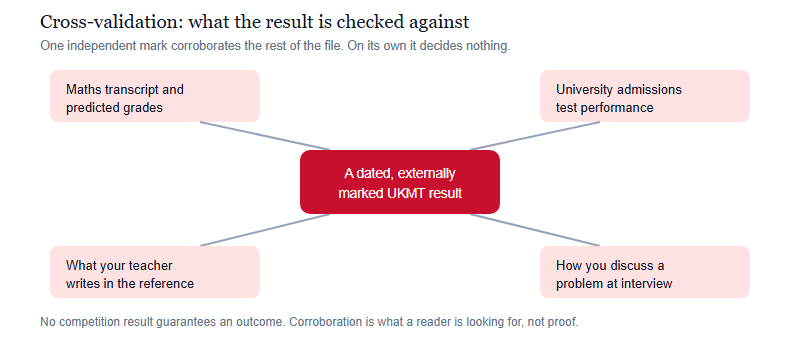
Two consequences worth planning around. First, corroboration works both ways: a strong olympiad mark alongside an unremarkable maths transcript invites a question, and the answer to that question had better be a real one. Second, the corroboration is strongest when it is specific. “Round 1, November 2026, with the mark stated” can be checked; a vague reference to olympiad involvement cannot, and a reader will discount it accordingly.
Also be careful with figures that are not yours. Entry numbers, boundary marks and pass rates belong to the organiser and should be quoted as the organiser’s. We attribute UK figures to ukmt.org.uk and China-region figures to the handbook throughout this site, and you should do the same in anything you write. Our line-by-line treatment of the paper itself lives in what the British Mathematical Olympiad actually is.
The three things worth doing this month
Everything above reduces to three September actions, and none of them takes long.
- Write down your own deadline next to 19 November. One line, two dates, in whatever you use to plan. That comparison answers most of the questions in this article for your particular case, and it answers them now rather than in November.
- Tell whoever writes your reference what you are entering, before they write it. A teacher who knows in September that you are preparing for a November olympiad can describe the preparation. A teacher told in December cannot go back and add it.
- Keep a dated record of what you actually sat and worked on. Paper, date, questions attempted, what you read. It is the raw material for every honest sentence you will write later, and for interview answers that do not sound rehearsed. Practice papers are in our Round 1 and Round 2 past-paper pack.
The last word on timing is the least glamorous one. A competition entry cannot be backdated into a submitted form, and no amount of good intention makes a November paper appear on an October deadline. What you can control is whether the entry exists, whether your reference writer knows about it, and whether you can talk about a problem properly when someone asks. Confirm the current dates and entry mechanics on ukmt.org.uk and with the organising channel before you plan around anything here.
Questions students ask about timing
Will my BMO1 result reach the form I submit this autumn?
Only if your own deadline falls after the marks are released. The China-region paper is on 19 November, so for most autumn forms it does not.
Can I mention an entry I have sat but not had marked?
Yes, if you describe the entry and the preparation and claim no mark. Never imply a result that does not exist yet.
Does a UKMT result guarantee anything in admissions?
No. It is corroboration that a reader checks against your transcript, tests and reference, not a decision on its own.
Which UKMT figures may I quote as fact?
Quote UK figures from ukmt.org.uk and China-region figures from the handbook, and attribute both rather than stating them bare.
This is an independent editorial guide operated by Hanlin Education for China-based international-school students. We are not affiliated with, endorsed by, or sponsored by UKMT or the BMO Subtrust. Admissions procedures, deadlines and update policies are set by individual universities, and UKMT dates, fees and entry routes change every season: confirm current details on ukmt.org.uk, with the organising channel that handles your entry, and with each university directly. Errors reported to our editorial desk are corrected within 7 working days.