Olympiad preparation fails on the calendar far more often than on the mathematics. UKMT lists the Senior Mathematical Challenge for Wednesday 7 October 2026 and British Mathematical Olympiad Round 1 for November 2026, and both land in the term that also carries applications, admissions tests and school mocks. Below is a week-by-week hour budget, a collision map, and rules for what to cut.
Two fixed points, and one you have to fill in yourself
A plan needs anchors. This autumn gives you two hard ones and one that you must look up before you can build anything around it.
The first anchor is the Senior Mathematical Challenge. Per ukmt.org.uk it is "A 90 minute first round Challenge, with 22 multiple choice questions and three 000-999 digit questions", and the site gives Wednesday 7 October 2026 for this cycle. Eligibility is listed as "England, Wales and Overseas: Year 13 and below", which is the line that matters for readers outside the UK.
The second anchor is Round 1, which UKMT lists for November 2026: a three-and-a-half-hour paper with six problems requiring full written solutions. UKMT also lists the Andrew Jobbings Senior Kangaroo — "60 minute, 20 question integer-answer challenge", which UKMT lists as open to UK schools only — for November 2026, and Round 2 for January 2027.
The gap in your plan is the exact Round 1 date, which UKMT publishes and which we are deliberately not guessing at here. Find it on ukmt.org.uk, write it in your own calendar, and count backwards. Everything in the final block of the grid below is expressed relative to that date rather than to a date we have invented, precisely so that it stays correct once you fill it in.
One China-specific point worth raising with your school this week: 7 October falls at the end of the early-October National Day holiday period, and international schools in China handle that week differently from one another. Whether your sitting is affected — and how the paper is administered around it — is a question only your UKMT coordinator can answer, so ask now rather than in the first week of October. The wider set of administrative questions is covered in our eligibility reality check for international students.
The hour budget: what a week actually has room for
Before the weekly grid, be honest about the ceiling. The numbers below are our coaching judgement from working with China-based students, not a UKMT standard and not a prediction of any result. They are deliberately lower than the figures students set for themselves in September, because a plan that collapses in week four is worse than a smaller plan that survives the term.
| Profile | Realistic weekly hours | The one non-negotiable block | First thing to cut in a bad week |
|---|---|---|---|
| Year 12, first serious attempt | 5 to 7 | One uninterrupted 2-hour weekend session on a single hard problem | Volume of easy problems. Keep the long session, drop the filler. |
| Year 13, applying this cycle | 3 to 5 until applications close, then 6 to 8 | One 90-minute midweek session, protected in the diary | Everything except the midweek session, for the two weeks around the application deadline. |
| Year 11 or below, building for a future cycle | 3 to 5 | One weekly session on intermediate olympiad problems, written up fully | Timed practice. At this stage the write-up matters more than the clock. |
| Training without a confirmed sitting | 3 to 4 | One weekly archive problem, worked untimed and written up | Timed full papers. Save them until entry is confirmed. |
Three principles sit behind those numbers. Long blocks beat scattered ones, because a three-and-a-half-hour paper rewards the ability to stay with one problem for forty minutes and nothing in a fifteen-minute gap trains that. Consistency beats intensity, because the student who does five hours every week for ten weeks finishes ahead of the one who does fifteen hours twice and nothing in between. And written output beats reading, because marks come from what is on the page — a point our guide to what the British Mathematical Olympiad actually is sets out in more detail.
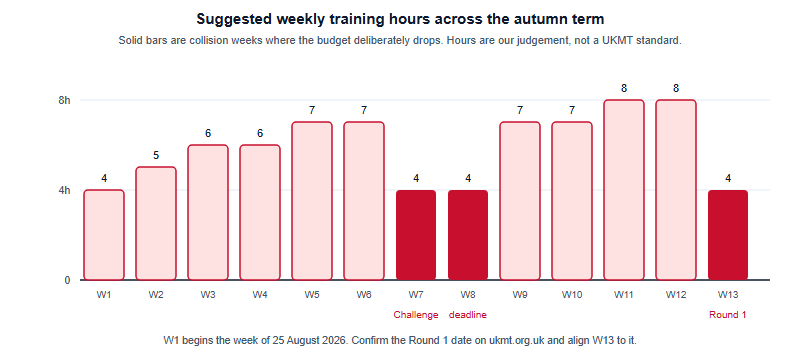
The week-by-week grid
| Week | Anchor | Hours | What the time is for | Collision warning |
|---|---|---|---|---|
| W1 w/c 25 Aug | Term has not started | 4 | Confirm entry with the coordinator; look up the Round 1 date; download the archive | None. This is the cheapest week of the term — use it for admin, not mathematics. |
| W2 w/c 31 Aug | Term begins | 5 | Baseline: attempt Round 1 questions 1 to 4 from one past paper, untimed | Settling-in workload is heavier than it looks. Do not overcommit in the first week. |
| W3 w/c 7 Sep | Monthly problem sheets begin | 6 | Challenge-format speed work; first topic block from your baseline's weakest area | None significant. |
| W4 w/c 14 Sep | — | 6 | Second topic block; one full timed Challenge paper | Application drafting begins for Year 13. Protect the midweek session. |
| W5 w/c 21 Sep | — | 7 | Third topic block; two timed Challenge papers with error logs | None significant. |
| W6 w/c 28 Sep | Final full week before the Challenge | 7 | Timed Challenge papers only; review the error log, not new material | The National Day holiday period starts. Confirm with school how the sitting is arranged. |
| W7 w/c 5 Oct | Senior Challenge, Wed 7 Oct | 4 | One light session before; nothing new after. Reconstruct what you did on paper | Holiday-period disruption plus the paper itself. Deliberately the lowest budget of the term. |
| W8 w/c 12 Oct | Application deadlines and admissions tests | 4 | Hold the midweek session only. No new topics | The heaviest collision week for Year 13. Confirm your own deadline and test dates with your counsellor. |
| W9 w/c 19 Oct | Restart | 7 | Switch from multiple choice to written proof; first full Round 1 problem written up properly | Post-deadline slump is real. Restart with a scheduled session, not enthusiasm. |
| W10 w/c 26 Oct | Half-term at many schools | 7 | One full timed Round 1 paper, three and a half hours, no interruptions | Half-term travel. If the block cannot happen, move it, do not delete it. |
| W11 Round 1 minus 3 | Follow-on entries confirmed | 8 | Second full timed paper; write-up quality drill on questions you solved but scored poorly | School mock season begins at many schools. |
| W12 Round 1 minus 2 | — | 8 | Third full timed paper; triage rehearsal — deciding which questions to commit to | Peak mock collision. This is where most plans break. |
| W13 Round 1 week | Round 1, November — the Senior Kangaroo is listed by UKMT as open to UK schools only; confirm with your coordinator | 4 | Two short sessions on familiar material. Sleep and logistics matter more than new problems | Do not attempt a new full paper in the final three days. |
Note what the grid does not do: it never asks for more than eight hours, it drops to four three separate times, and it puts the heaviest weeks where nothing else is competing. That shape is the entire point. A flat seven hours every week reads better on paper and survives about four weeks in a real Year 13 timetable.
The three collisions, and what gives
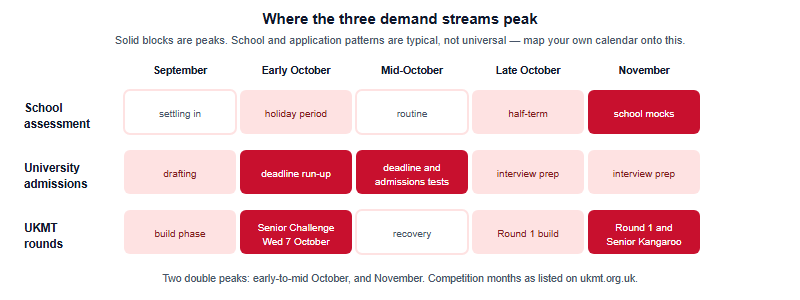
Collision one: the Challenge and the National Day holiday. The sitting is listed for Wednesday 7 October, which sits at the tail of the early-October holiday period — and on the China-region route, the organising channel’s handbook lists Thursday 8 October, 17:00–18:30, one day later and just as holiday-adjacent, with registration closing 28 September in China. This is an administrative problem, not a study problem, and it is solved by one email to your coordinator in September asking how the paper will be run. Left until October, it becomes a missed sitting.


Collision two: mid-October applications and admissions tests. For Year 13 students applying to UK universities, the mid-October application deadline and the autumn admissions tests land in the same fortnight as the Challenge aftermath. Confirm your own dates with your counsellor and the relevant test provider — they are not UKMT dates and they change. The grid drops to four hours across W7 and W8 for exactly this reason. Give up the volume; keep the single midweek session, because rebuilding a dropped habit costs more than maintaining a small one.
Collision three: November mocks and Round 1. This is the one students underestimate. School mock season and Round 1 sit on top of each other, and unlike the October collision there is no slack left to borrow. The answer is to move the full timed papers earlier — into W10 and W11, not W12 — so that the heaviest single commitment is already done before mocks peak. Deciding which past paper to sit in each of those slots is a separate question, and our past-paper pack and how to use it covers the sequencing.
Rules for cutting when the week collapses
Every plan meets a week it loses. What separates students who finish the term from students who quit in week eight is having decided in advance what to sacrifice. Use this order:
- Cut new topics first. Starting a new area in a compressed week produces half-learned technique that fails under pressure. Consolidate what you have.
- Cut volume, not the long block. Four easy problems teach less than one hard problem you sit with for ninety minutes. If only one session survives, make it the long one.
- Cut timed papers before untimed problems — except in the last three weeks. Early in the term, thinking time is worth more than clock practice. In the final block that inverts, because triage under time is itself the skill being tested.
- Never cut the write-up. A solved problem you did not write out has taught you almost nothing that the paper rewards. If you have twenty minutes, write up something you solved last week rather than starting something new.
- Log the cut. One line: what you dropped and why. Over a term this becomes the honest record of where your time actually went, which is the only reliable basis for planning next year.
A closing note on expectations. Round 1 is a hard national paper — per the BMO site, typically around 1,300 students sit it, and the top 100 receive prizes. A well-built term improves what you can do; it does not entitle you to a mark, and no preparation programme, ours included, can promise one. What the grid above is really for is making sure that when the paper arrives you have had eleven honest weeks rather than three panicked ones.
Common questions
When is the Senior Mathematical Challenge this year?
ukmt.org.uk lists Wednesday 7 October 2026 for this cycle (the China-region sitting per the organising channel runs Thursday 8 October; registration closes 28 September — confirm your route). Round 1 is listed for November 2026. Confirm both on ukmt.org.uk.
How many hours a week does BMO preparation really need?
We suggest five to eight in peak weeks and three to four in collision weeks. These are our coaching judgement, not a UKMT standard.
What if my school mocks clash with Round 1?
Move your full timed papers two to three weeks earlier so the heaviest sessions are finished before mock season peaks.
Should I sit the Senior Kangaroo as well?
UKMT lists it for November as a 60 minute, 20 question integer-answer challenge, and lists it as open to UK schools only, so confirm with your coordinator whether your school can enter before budgeting for it.
This is an independent editorial guide operated by Hanlin Education for China-based international-school students. It is not affiliated with, endorsed by, or sponsored by the UK Mathematics Trust or the BMO Subtrust. Competition dates, formats and eligibility are set by UKMT and change between cycles — confirm current details on ukmt.org.uk before planning around them. Weekly hour figures, week numbering and the collision map are our editorial judgement, not UKMT guidance; school and university-application dates should be confirmed with your school and your counsellor. Errors reported to our editorial desk are corrected within 7 working days.