If you have worked through the last few BMO papers, you have used a small fraction of what exists. The BMO site publishes a PDF of all BMO problems from 1993 onwards for both rounds, and UKMT publishes graded books, monthly olympiad sheets and a set of easier olympiad papers that calibrate the ladder below. Here is each source, matched to a difficulty band.
Start with the archive you probably have not opened
Almost every student who tells us they have "run out of past papers" means they have run out of the last five or six years. That is a supply problem they invented. Per the BMO site, "A PDF file with all BMO problems from 1993 onwards (both BMO1 and BMO2) is also available", alongside the individually listed papers going back much further still.
Do the arithmetic on that. Round 1 is a three-and-a-half-hour paper with six problems; Round 2 is a three-and-a-half-hour paper with four. Thirty-odd cycles of both rounds is a body of several hundred distinct olympiad problems, all written by the people who set the paper you are going to sit, in the house style you are going to meet. No third-party problem set can match that on relevance, and it costs nothing.
Two objections come up, and both are weaker than they look. The first is that older papers are "out of date". Olympiad syllabus drift is slow — the tools tested in the 1990s are largely the tools tested now, and where style has shifted you will notice it by comparing a run of old papers with a run of recent ones, which is itself a useful exercise. The second is that older papers have no solutions. That is partly true and mostly fixable, which is what the coverage map below is for.
If you have not yet built a systematic way to work through them rather than dipping in at random, our complete past-paper pack and how to use it covers the sequencing. This article is about what you reach for when the official papers themselves are no longer the constraint.
The difficulty calibration UKMT itself publishes
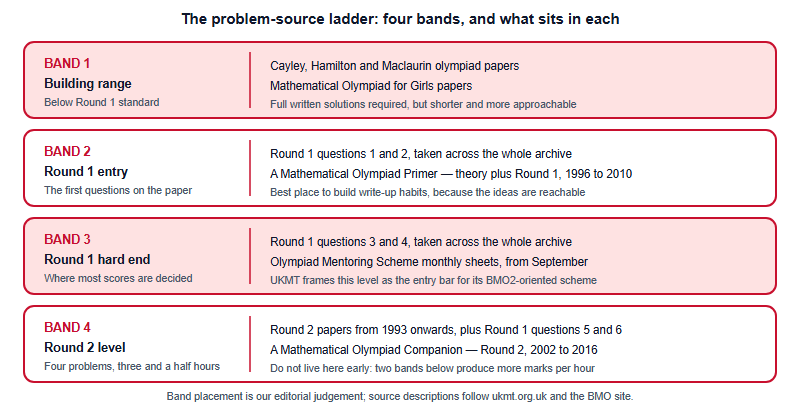
Most difficulty rankings on the internet are somebody's opinion. There is one on ukmt.org.uk that is not, and it is worth knowing about, because it lets you place yourself on the ladder without guessing.
Describing its Olympiad Mentoring Scheme, UKMT states that the scheme "is intended for students who already have some familiarity with Olympiads, and are aiming to commit to some work and improve towards BMO2 level", and frames the expected entry standard as students who can make progress on Round 1 questions 1 to 4, or on most questions from the Mathematical Olympiad for Girls, Hamilton and Maclaurin papers.
That single sentence does two useful things. It tells you that the intermediate olympiad papers and Round 1's first four questions sit at a broadly comparable working level in UKMT's own framing — which is precisely the calibration a student outside the UK system has no way to acquire otherwise. And it tells you where the ladder's rungs are: below that standard, you build range on the intermediate papers; at it, you drill the front half of Round 1; above it, you move towards Round 2 material.
Use it as a self-placement test rather than an ambition. Take three Round 1 papers from different decades, attempt only questions 1 to 4, and see honestly how many you can make real progress on. That result, not a feeling, tells you which row of the table below you should be living in this term.
The source table
| Source | What it actually is | Band | Access | Best used for |
|---|---|---|---|---|
| BMO problem archive, 1993 onwards | A single PDF of all BMO problems, both rounds, plus the individually listed papers and markers' reports for recent years | 2 to 4 | Free on the BMO site | Everything. This is the core supply; treat other sources as supplements to it, not replacements. |
| Round 1 video solutions | Video solutions for Round 1, available from 2005–2006 onwards per the BMO site | 2 to 3 | Free on the BMO site | Unsticking yourself after a genuine attempt, and hearing how an experienced solver decides what to try first. |
| A Mathematical Olympiad Primer (2nd edition) | UKMT title: theory across algebra, combinatorics and geometry, with Round 1 problems and solutions from 1996 to 2010 | 1 to 2 | UKMT shop, listed at £19 at the time of writing — confirm current pricing on ukmt.org.uk | Closing the gap between school syllabus and olympiad technique, with worked solutions attached to the same era of papers. |
| A Mathematical Olympiad Companion | UKMT title and sequel to the Primer, containing harder material and Round 2 problems from 2002 to 2016 | 4 | UKMT shop, listed at £19 at the time of writing — confirm current pricing on ukmt.org.uk | The only convenient route to written Round 2 solutions across a long run of papers. |
| Olympiad Mentoring Scheme sheets | A monthly problem sheet uploaded at the start of each month from September, with solutions posted at the end of the month | 3 to 4 | Nomination by a registered coordinator via the school Competition Profile; mentored places are limited and not guaranteed | A paced monthly rhythm you cannot get from an archive, plus the discipline of a deadline you did not set. |
| Intermediate olympiad papers | The Cayley, Hamilton and Maclaurin olympiads, listed by UKMT for March 2027 | 1 | Papers published by UKMT | Building proof-writing habits at a level where you can actually finish, which is where write-up quality is learned. |
| Mathematical Olympiad for Girls papers | A UKMT olympiad listed for September 2026, named by UKMT alongside Hamilton and Maclaurin as a calibration reference | 1 | Papers published by UKMT | The same purpose as the intermediate papers, with a slightly different flavour of problem. |
| Senior Kangaroo papers | A 60 minute, 20 question integer-answer follow-on round to the Senior Challenge, which UKMT lists as open to UK schools only | Not on this ladder | Papers published by UKMT | Speed and technique under time pressure. It trains something real, but it does not train proof writing at all. |
Which sources come with solutions, and for which years
The practical constraint on the archive is not problems, it is feedback. Working an unsolved problem with no route to a solution is occasionally valuable and usually a waste of an evening. The map below shows where written or video solutions exist across the archive, so you can pick years deliberately rather than discovering the gap after you have already spent three hours.
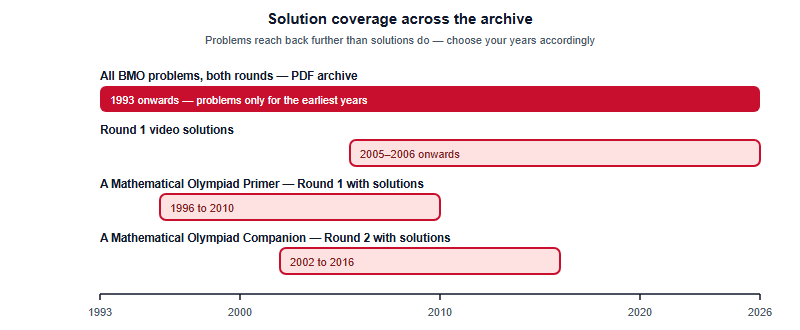
Two planning conclusions fall straight out of that picture. Recent papers are the best-supported years, so save some of them — sitting an unseen recent paper under timed conditions is a resource you can only spend once. And the deep archive, roughly the first decade from 1993, is the least supported, which makes it excellent for one thing in particular: untimed problem-solving where the point is the struggle rather than the mark.
Use each source for a different job
The mistake is treating all problems as interchangeable practice. They are not, and matching source to purpose roughly doubles what an hour returns.


- Timed full papers — recent years, rationed. Three and a half hours, no interruptions, written up properly. This is the only source that tests endurance and triage together, so do not burn recent papers casually on a topic drill.
- Single problems by position — the whole archive. Pull every question 3 from twenty different years and work them in a batch. Working one position across many papers teaches you what that slot looks like far faster than working single papers front to back.
- Monthly sheets — the Olympiad Mentoring Scheme. The value is the cadence, not just the problems: a sheet at the start of the month and solutions at the end forces a month-long relationship with hard problems, which is exactly what an archive fails to impose.
- Books — when your problem is technique, not supply. The Primer's theory sections exist because most students who cannot start a problem are missing a tool, not effort. If you keep failing at the same step, read rather than grind.
- Intermediate papers — when your write-ups are the weak link. You cannot learn to write a proof on a problem you cannot solve. Drop a band deliberately, solve completely, and write as if a marker who is unwilling to guess your meaning will read it.
One structural note for students outside the UK. Because entry to every round runs through a registered centre, some readers will be training without a confirmed sitting; and the mentoring sheets in particular require a coordinator at a registered school to nominate you. That is worth knowing before you build a term around a source you cannot access — our eligibility reality check for international students sets out which routes are open from where.
Sources to treat with care
Not every problem supply is good for you, and a few are actively harmful at this stage.
Other countries' olympiad papers. These are real mathematics and openly published, and there is nothing wrong with using them once you are working reliably at band 3. But difficulty labels do not transfer between systems, formats differ, and a paper that looks comparable by name may be pitched somewhere quite different. Check each organiser's own site for what its rounds actually are, rather than assuming an equivalence, and do not let them displace the archive that matches the paper you are sitting.
Undated problem dumps and forum threads. Problems circulate stripped of source, year and round. Without provenance you cannot calibrate difficulty, which means you cannot tell whether an hour of failure was informative or simply misjudged. Prefer sources that tell you which paper a problem came from.
Machine-generated problems. Language models will produce olympiad-shaped questions on demand, and the failure mode is not that they are too hard — it is that some of them are subtly broken, unprovable as stated, or have no clean solution. Failing on a problem with no solution teaches you the wrong lesson about your own ability. Use real papers.
Solutions read before a real attempt. Not a source problem but a usage one, and the most common way strong students waste an archive. If you are new to the whole structure and want the shape of the pathway before you choose material, start with our complete guide to what the British Mathematical Olympiad is, then come back to this table.
Common questions
How far back do BMO past papers go?
The BMO site publishes a PDF of all BMO problems from 1993 onwards for both rounds, with individual papers listed from earlier decades too.
Are there solutions for the older papers?
Coverage thins with age. Round 1 video solutions run from 2005–2006 onwards, and the UKMT titles listed above cover Round 1 from 1996–2010 and Round 2 from 2002–2016, and UKMT’s current catalogue is the place to check what else is in print.
Can I join the Olympiad Mentoring Scheme myself?
No. Per ukmt.org.uk, nomination is made by a registered UKMT coordinator through the school Competition Profile, and mentored places are limited.
Should I use other countries' olympiad problems?
Only once you are solid at Round 1 questions 3 to 4. Difficulty labels do not transfer between systems, so check each organiser's own site.
This is an independent editorial guide operated by Hanlin Education for China-based international-school students. It is not affiliated with, endorsed by, or sponsored by the UK Mathematics Trust or the BMO Subtrust. Resource availability, book contents, scheme eligibility and prices are set by UKMT and change between cycles — confirm current details on ukmt.org.uk before relying on anything above. Band placements are our editorial judgement, not a UKMT ranking. Errors reported to our editorial desk are corrected within 7 working days.