Score yourself out of 40 across five dimensions — topic reach, proof production, timed output, stuck tolerance and diagnosis habit — then read your band below. Under 13 means foundations; 13 to 21 means you start things you cannot finish; 22 to 30 means you need timed repetitions; above 30 means you should be sitting full papers. The audit is ours, not UKMT's, and it takes twenty minutes.
Why a number beats a feeling
Ask a student whether they are ready for BMO Round 1 and you will usually get a mood rather than an answer: "probably not", "I think so", "I need more practice". None of those can be acted on, because none of them says which practice.
The paper itself is specific. Per ukmt.org.uk, BMO Round 1 is a three-and-a-half-hour paper of six problems requiring full written solutions rather than answers, and the guidance printed on the paper is blunt about what earns credit: one complete solution gains far more than several unfinished attempts. Exact format, entry route and dates for the current cycle should be confirmed on ukmt.org.uk. If you are new to how the round sits inside the wider pathway, our guide to what the British Mathematical Olympiad is sets out the structure first.
Read that description carefully and you will notice it demands several different things at once. You need enough mathematical range to open an unfamiliar problem. You need the writing discipline to turn a solved problem into a scoring one. You need the endurance to keep producing for three and a half hours. You need the temperament to sit with a problem that is not yielding. And you need a feedback loop, or none of the previous four improve.
Those five capabilities fail independently. A student can be strong in three and crippled by one, and the crippling one is usually invisible from the inside — you do not notice the habit you have never had. The audit below exists to make the weakest of the five visible, because that is the one worth six weeks of work. It does not predict a mark and it cannot: thresholds are set by UKMT each year and published with results.
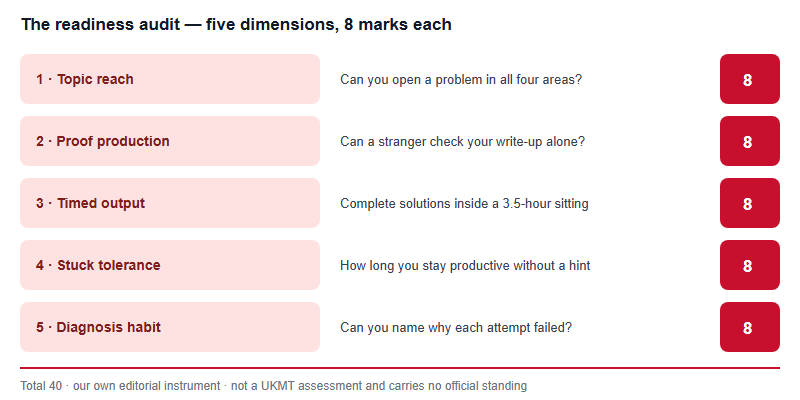
The audit: score each dimension out of 8
Three rules make the result usable. Score the last four weeks, not your best-ever day — the question is what you currently do, not what you are capable of when everything aligns. If you sit between two descriptors, take the lower one; generous scoring produces a comforting number and a useless plan. And write the five scores down with the date, because the sequence over a season matters far more than any single total.
| Dimension | 0–2 marks | 3–5 marks | 6–8 marks |
|---|---|---|---|
| 1. Topic reach Algebra, number theory, combinatorics, geometry |
You recognise the topic names but cannot begin a problem that sits outside the syllabus you were taught. | You are solid in one or two areas and effectively blank in the rest. You skip geometry on sight. | You can open a problem in any of the four areas and produce at least one credible line of attack. |
| 2. Proof production Written output a marker can verify |
You write the answer plus a few lines of working. Key results are asserted rather than proved. | Your arguments are broadly right but contain gaps you would have to explain out loud. | You state what you are proving, justify every non-obvious claim, and close with an explicit conclusion. |
| 3. Timed output Under a full-length sitting |
Under timed conditions you finish nothing completely, or you have never sat a timed paper. | You reliably complete one problem and leave partial work elsewhere. | You complete two or more, and the partial work on the others is substantial rather than decorative. |
| 4. Stuck tolerance Time spent productively without help |
You stop within roughly ten minutes of your first failed idea. | You work for around half an hour, then go looking for a hint or a solution. | You work productively for an hour, and you park and return rather than abandoning. |
| 5. Diagnosis habit The feedback loop |
You keep no record. Failed attempts blur together and repeat. | You keep some notes, but they summarise the published solution rather than your own error. | For each failed problem you can name the missing idea and the exact point where your attempt diverged. |
Add the five numbers. That total is your band. Note that dimension 5 is the multiplier: at 0–2 it caps how quickly any of the other four can move, because you are re-running the same mistakes without noticing. In our editorial experience students tend to score themselves highest on dimension 1 and lowest on dimensions 2 and 5, which is roughly the inverse of what the paper rewards.
Read your band, then do one thing
Each band below carries a single prescribed move for the next six weeks and, more importantly, a list of what to stop. The stopping matters: most students in the middle two bands are not under-working, they are working on the wrong dimension because it is the pleasant one.
| Score | Band | What it actually means | The one move for six weeks | Stop doing |
|---|---|---|---|---|
| 0–12 | Foundation | You are not yet training for BMO1; you are building the base it stands on. | Senior Challenge fluency, plus your first genuinely complete written proofs on easy material. | Sitting full olympiad papers. They will not teach you anything at this stage. |
| 13–21 | Assembling | You can start most problems and finish very few. Your work looks better than it scores. | Finish easy problems completely, every single time, written up as though a marker will read them cold. | Collecting new techniques. You already own more than you can currently deploy. |
| 22–30 | Converging | You produce complete work, just not enough of it inside a timed sitting. | Timed repetitions on a fixed schedule, plus deliberate repair of your weakest of the four topic areas. | Re-reading solutions to problems you already understand. It feels like study and is not. |
| 31–40 | Contending | Your binding constraint is problem difficulty, not process. The machinery works. | Full-length papers under genuine exam conditions, and harder problems than you are comfortable with. | Drilling material you already own. Comfort work at this stage is pure time cost. |
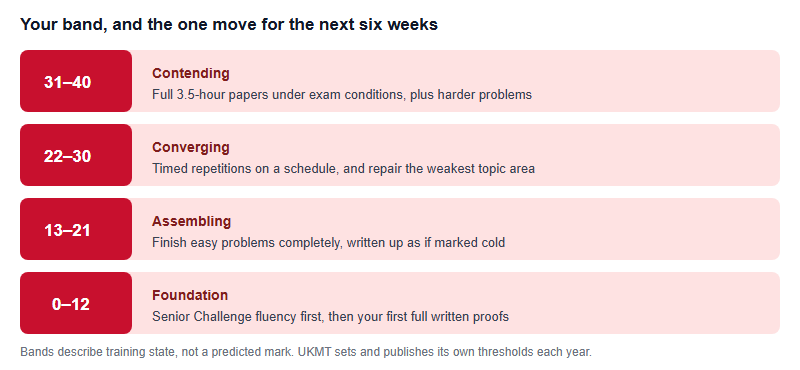
Two practical notes before you act on a band. First, practice material should match the band, not your ambition — our compiled BMO1 and BMO2 past-paper pack is far more useful once you are out of Foundation, and a Foundation student who spends the autumn on it will simply have burned papers they could not read yet. Second, before you commit a season to this at all, check that you can actually enter under the current rules from where you study; our eligibility reality check for international students covers the entry routes, and the authoritative version is always on ukmt.org.uk.
Three profiles the total score hides
The total picks the band. The shape picks the work. Three students can land within a point of each other and need completely different months.


- Profile A — 7 / 3 / 3 / 6 / 2 = 21. Knows a great deal, finishes almost nothing. This student reads widely, recognises every technique by name, and writes fragments. The binding constraint is dimension 2, and the fix is unglamorous: take problems they have already solved in their head and write them out in full, then hand them to someone who will point at the first unjustified line. Nothing else moves until this does.
- Profile B — 3 / 7 / 4 / 5 / 3 = 22. Neat but narrow. Writes beautifully, and only about the two topics they like. Almost always this means geometry has been quietly abandoned, sometimes for years. The constraint is dimension 1, and the fix is a fixed weekly geometry slot that survives being unpleasant for about a month.
- Profile C — 6 / 6 / 2 / 2 / 3 = 19. The sprinter. Genuinely capable, but has never sat still. Ten minutes of no progress reads as a verdict on their ability rather than a normal feature of olympiad problems. The constraint is dimension 4, and dimension 3 will not move until it does, because timed output is mostly stuck tolerance under a clock.
The rule to take away: your lowest dimension is your plan. If two dimensions tie for lowest, fix whichever is further left in the list, because reach precedes writing, writing precedes timed output, and diagnosis makes all of them faster.
When to re-audit, and what counts as real movement
Re-audit every six weeks, on a fresh copy of the same five rows, dated, and keep the old sheets. Also re-audit once after your Senior Challenge result, because that result changes which season you are actually in rather than merely how you feel about it.
Do not re-audit after a single bad session. One paper where nothing worked is noise; students who re-score themselves in a bad mood produce a downward spiral that has no informational content. Equally, do not re-audit the day after a breakthrough.
As a working rule of thumb, we would read a movement of three to four points across six weeks as good, normal progress. A jump of ten usually means you scored generously the second time rather than that you improved unusually fast — go back and check the descriptors against actual evidence from your notebook. And a flat total with a changed shape (dimension 2 up three, dimension 1 down three) is not stagnation; it is a real gain in the thing that scores, plus a topic you have started avoiding again.
The sequence is the point. Four dated sheets across an autumn tell you whether your training is compounding, which is a question no single number can answer and no amount of confidence can substitute for.
Frequently asked questions
Does a high audit score mean I will qualify for BMO1?
No. Entry runs through UKMT's own rules and thresholds, which move each year. The audit measures training state only.
How honest should I be when scoring myself?
Score the last four weeks, not your best-ever day. If you sit between two descriptors, always take the lower one.
Which dimension should I fix first?
Your lowest, almost always. The total picks which band's advice applies; the weakest dimension picks the actual work.
Can I use the audit if I have never sat a timed paper?
Yes. Score timed output at 0 to 2 and treat that as the finding: your first task is one honest timed sitting.
This is an independent editorial guide operated by Hanlin Education for China-based international-school students. It is not affiliated with, endorsed by, or sponsored by the UK Mathematics Trust (UKMT) or the British Mathematical Olympiad Subtrust. The readiness audit above is our own editorial instrument and carries no official standing. Competition formats, entry routes, eligibility, dates and award thresholds are set by UKMT and change from year to year — confirm current details on ukmt.org.uk before acting on anything here. Factual corrections are made within 7 working days.