For most students the serious BMO1 attempt should be the Year 12 one, not the Year 13 one. The reason is calendar arithmetic rather than mathematics: BMO Round 1 sits in mid-November, which is after several university application deadlines have already closed. A result you sit in Year 13 arrives too late to appear on a form that went in October.
The two calendars that decide this
Per ukmt.org.uk, the senior season this year runs as follows: the Senior Mathematical Challenge is on Wednesday 7 October 2026, BMO Round 1 is on Wednesday 18 November 2026, and BMO Round 2 follows in the new year — confirm the current BMO2 date on ukmt.org.uk. Results are released some weeks after each paper rather than on the day.
Set that against the application calendar. Several UK universities and course groups operate an earlier deadline in mid-October, and many US universities run early rounds with deadlines around the start of November; confirm the current dates on ucas.com and with each individual university, since these move. The consequence is structural and does not depend on the exact day: a paper sat on 18 November cannot appear on an application submitted in October, and its result is not even released by then.
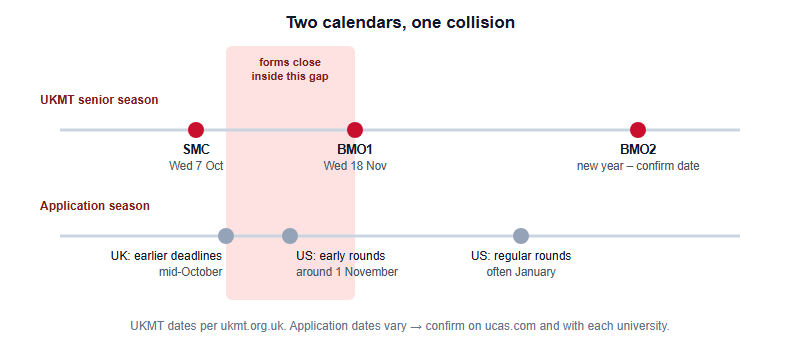
Two qualifications keep this honest. First, an application is not the only reason to sit an olympiad, and treating it as one produces bad mathematicians and thin applications. Second, no competition result guarantees any admissions outcome; a score is one line of evidence read alongside everything else. What the calendar decides is narrower than that: which of your results is available to be read at all.
What the rules actually permit
Before deciding which year to target, it is worth being precise about which years are open. Per ukmt.org.uk, BMO Round 1 eligibility is Year 13 and below in England, Wales and Overseas; S6 or below in Scotland; Year 14 or below in Northern Ireland. There is a ceiling and no published floor. A Year 11 student is inside the rules.
Entry runs through two routes, also per ukmt.org.uk: by invitation based on a qualifying SMC score, or by discretionary entry. Around 1,000 students qualify from the SMC each year, and the published fee is £40 per discretionary entry, with automatic qualifiers free. The SMC itself is sold to schools in packs — £16 per pack of 10 posted papers, £15 per pack of 10 download-and-print — so the per-student cost at that stage is small. Confirm all fees on ukmt.org.uk.
One published figure is worth sitting with. Roughly 1,000 students qualify from the SMC, while bmos.ukmt.org.uk notes that typically 1,300 students sit BMO1. The difference between those two published figures, on the order of 300 places a year, is our own arithmetic, and discretionary entry is the likeliest explanation for much of it. It is not a side door: it is a designed part of the entry system, and it is the route most relevant to candidates outside the UK. Our note on BMO eligibility for international students sets out how that interacts with the separate question of representing the UK at the IMO, which gates automatic invitations but not participation.
There is one asymmetry in the follow-on structure that changes the calculus for candidates outside the UK, and it is easy to miss. Per ukmt.org.uk, the roughly 8,000 students who fall below the BMO1 qualifying band go on to the Andrew Jobbings Senior Kangaroo — but that round is described as being for UK schools only. Confirm the current position on ukmt.org.uk. The practical consequence for an international candidate is that there is no intermediate rung: you are either on a BMO1 paper or you are not sitting a follow-on round at all. Where a UK student who narrowly misses the threshold gets a 60-minute consolation round and another data point, an overseas student gets neither, which makes an early, deliberate BMO1 sitting worth more rather than less.
Why Year 12 is usually the scoring attempt
Four arguments point the same way, and only one of them is about applications.
- The result exists in time. A Year 12 sitting in November produces a result that is known months before any Year 13 deadline. It can be referred to in a personal statement, discussed with the teacher writing your reference, and mentioned at interview. The Year 13 sitting cannot do the first two of those.
- The reference is written before the deadline. This is the point students most often miss. Whoever writes about your mathematics does so in the autumn of Year 13, drawing on what you have already done. A Year 12 olympiad result is inside that evidence base; a paper you have not yet sat is not.
- Year 12 has the free calendar. Autumn of Year 13 carries the application itself, admissions tests where they apply, and school mock examinations. Autumn of Year 12 carries none of that. The thirteen weeks between mid-August and 18 November are genuinely available in Year 12 and genuinely contested in Year 13.
- You get a second attempt afterwards. A Year 12 attempt leaves a Year 13 attempt still on the table. A Year 13 attempt is the last one available under the eligibility ceiling.
There is also a quieter argument about how a two-year arc feels. Sitting a first BMO1 with nothing riding on it, in a year when a modest score is entirely expected, is a much better introduction to a 3.5-hour paper with six problems and no calculator than sitting it for the first time in the term you are applying to university. Our overview of what the British Mathematical Olympiad is describes the format that first sitting will introduce you to.


When Year 13 is the right answer
The Year 12 default is a default, not a rule. Several situations invert it.
| Situation | Why Year 13 becomes the serious attempt | What to do about it |
|---|---|---|
| You only discovered the pathway in Year 12 | There is no earlier attempt to have made | Sit Year 12 anyway as reconnaissance; treat Year 13 as the scoring year |
| You are applying in the regular round only | Deadlines in January sit after a November paper | Check whether your universities accept an update after submission |
| You are taking a gap year before applying | The whole application moves a year later | Year 13 becomes your last eligible sitting and your best-prepared one |
| You are chasing BMO2, not a form | Round 2 selection follows Round 1 performance | Peak mathematically whenever you are strongest; the calendar is secondary |
| Your Year 12 sitting went badly | A weak first score is not the story you want to leave | Sit again; a later, stronger result still matters at interview |
The fourth row deserves emphasis, because it is the case where the whole framing of this article stops applying. Per bmos.ukmt.org.uk, up to 100 students who are eligible to represent the UK at the IMO are invited to BMO2 based on performance in BMO1, with selection taking account of age and other factors, and others may enter on payment of the entry fee. If your goal is genuinely Round 2 and beyond rather than a line on a form, then you should peak when your mathematics peaks, and application timing is a footnote.
The two-year plan, and what it costs
Treating BMO1 as a two-sitting project rather than a single event changes what each year is for. The diagram below sets out the three eligible windows and the job each one does.
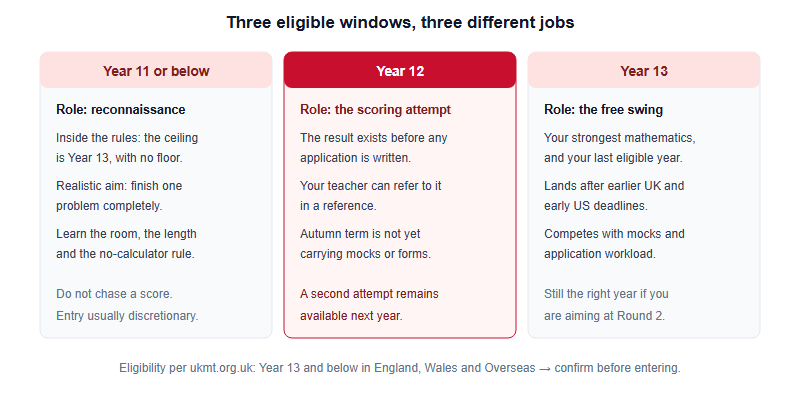
The costs of running the full arc are modest and worth knowing in advance. Two SMC sittings cost your school a fraction of a pack price each. If you qualify automatically in both years, the BMO1 entries are free. If you enter discretionarily in both years, you are looking at two £40 entries. The largest cost by far is time, and time is precisely what the Year 12 autumn has and the Year 13 autumn does not. Verify current fees on ukmt.org.uk before budgeting.
A practical sequencing note for anyone starting now. The single most useful thing a prospective Year 12 candidate can do in August is sit one past paper under real conditions — 3.5 hours, six problems, no calculator, written solutions — and find out what actually happens. Our guide to the BMO past-paper pack covers how to run and mark that. Students discover far more from one honest attempt in August than from three months of deciding whether they are ready.
Questions students and parents ask
Can a Year 11 student sit BMO1?
Per ukmt.org.uk, eligibility is Year 13 and below in England, Wales and Overseas, with no published lower limit. Confirm entry arrangements with your school and on ukmt.org.uk.
Does a Year 13 BMO1 score help my application at all?
Not on a form submitted in October, but it can matter at interview and in any later round. No competition result guarantees an admissions outcome.
Is it damaging to sit BMO1 early and score low?
No. Entry is not a public ranking, and an early sitting is normal reconnaissance. Treat the first attempt as a measurement, not a verdict.
What does two years of entry cost?
Automatic qualifiers pay nothing for BMO1. Discretionary entry is published at £40 each, so two years is around £80 plus SMC pack costs. Confirm on ukmt.org.uk.
This is an independent editorial guide operated by Hanlin Education for China-based international-school students. It is not affiliated with, endorsed by, or sponsored by UKMT or the BMO Subtrust. Competition dates, formats, fees and eligibility change between seasons — confirm current details on ukmt.org.uk before acting on anything here. Factual errors are corrected within 7 working days of being reported.