An A* in A-Level Further Maths or a 7 in IB HL Analysis is not preparation for BMO1, and the reason is not that olympiad topics are more advanced. It is that a school paper asks you to apply a method the topic already implies, while BMO1 hands you six problems, three and a half hours and no named method. The gap is real, fairly narrow, and closable in a term.
The gap is not the topic list
Most students who move from a strong school course to olympiad work assume the fix is more content: another year of calculus, more linear algebra, harder integration. That instinct is wrong, and it wastes the autumn.
The BMO1 page on ukmt.org.uk sets out the operating conditions of the paper — the date, the duration, the entry routes, the rules of the room — rather than a topic checklist of the kind an exam board publishes as a specification. Per ukmt.org.uk, BMO Round 1 for this season is on Wednesday 18 November 2026, runs for 3.5 hours and contains six problems; full written solutions are required, not just answers, with complete proofs of any assertions you make. Confirm the current details on ukmt.org.uk before you plan around them.
Because there is no published topic list, the honest way to find out what a BMO1 paper assumes is to read BMO1 papers. That is not a rhetorical flourish; it is the single most useful hour of the whole preparation, and it is the reason our guide to the BMO past-paper pack exists. Our overview of what the British Mathematical Olympiad is covers how Round 1 sits inside the wider UKMT pathway.
What those papers show, consistently, is that the mathematics required is elementary in the technical sense — the objects are integers, polynomials, triangles, finite sets — while the reasoning required is not elementary at all. That combination is exactly what school courses are least likely to have trained.
What your school course actually gives you
Before the list of gaps, the credit side of the ledger, because students routinely under-use what they already have. A strong IB HL, A-Level or AP background delivers four things worth protecting:
- Algebraic fluency. Expanding, factorising, manipulating fractions and surds without error under time pressure. Olympiad problems are lost to slips at least as often as to missing ideas, and school drilling genuinely prevents that.
- Notation discipline. Knowing that a symbol has to be introduced before it is used, that a function needs a domain, that an equation needs to be an equation. This transfers directly to written proofs.
- Proof by induction. Where a specification includes it — typically A-Level Further Maths and IB HL Analysis, though specifications differ and change, so check your own — you already own one of the genuinely load-bearing olympiad techniques.
- Stamina in a silent room. Three and a half hours is a long paper. Students who have sat full mock seasons handle it better than students who have only done problem sets at home.
None of that is trivial. The problem is that these are all execution skills, and BMO1 marks are mostly awarded for something upstream of execution.
Topic by topic: what transfers into a BMO1 paper
The table below maps common school topics against how much they carry into Round 1. Treat the middle column as an editorial judgement drawn from reading past papers, not as an official UKMT statement — and treat the left column as indicative, since exam-board specifications vary by course and are revised periodically.
| School topic | Where it usually sits | Carries into BMO1? | What the paper actually wants |
|---|---|---|---|
| Proof by induction | A-Level FM, IB HL AA | Directly, and heavily | Strong induction, and induction on a structure rather than on a counter |
| Algebraic manipulation | Every course | Directly | Confident handling of symmetric expressions and substitutions |
| Circle theorems, angle chasing | IGCSE / GCSE, then largely dropped | Heavily — and usually rusty | Cyclic quadrilaterals, tangents, similar triangles, configuration sense |
| Complex numbers | A-Level FM, IB HL AA | Partly | Roots of unity as a counting and geometry device, not as an end in itself |
| Vectors and coordinate geometry | Every course | Partly, often a trap | A synthetic argument is usually shorter than a coordinate bash |
| Differentiation and integration | IB HL, A-Level, AP Calculus | Rarely load-bearing | Extremum arguments are normally algebraic; calculators are forbidden anyway |
| Statistics and distributions | IB HL AA/AI, AP Statistics | Almost never | Counting arguments, not probability models |
| Mechanics | A-Level applied modules | No | — |
| Modular arithmetic, divisibility | Absent from most school courses | Not available to you yet | Congruences, orders, factorisation arguments |
| Combinatorics beyond nCr | Barely present | Not available to you yet | Bijections, pigeonhole, invariants, extremal arguments |
| Inequalities beyond basic quadratics | Barely present | Not available to you yet | AM-GM, Cauchy-Schwarz, and knowing when equality holds |
| Functional equations | Absent | Not available to you yet | Systematic substitution and justifying that a solution set is complete |
Read the bottom four rows together. They are the real content gap, and they are all reachable: none of them requires university mathematics, and all of them can be learned from scratch inside a term by a student who is already fluent algebraically. The rows above them are the reason a strong school student can start olympiad work in Year 12 rather than Year 8 and still get somewhere.
One row deserves a warning. Circle theorems sit in most students' memory as GCSE or IGCSE material finished two years ago, and geometry is where the loss of that material shows most sharply. If you have not drawn an accurate diagram since Year 11, that is not a small gap.
Four exam habits that cost marks in November
The content gap is the part students expect. The habit gap is the part that surprises them, and it is visible directly in the instructions printed on the paper. Per the BMO1 rubric published on ukmt.org.uk: full written solutions with complete proofs are required; marks awarded depend on the clarity of your mathematical presentation; one complete solution will gain far more credit than several unfinished attempts; rough work is not to be handed in; and rulers, set squares and compasses are allowed while calculators and protractors are forbidden.


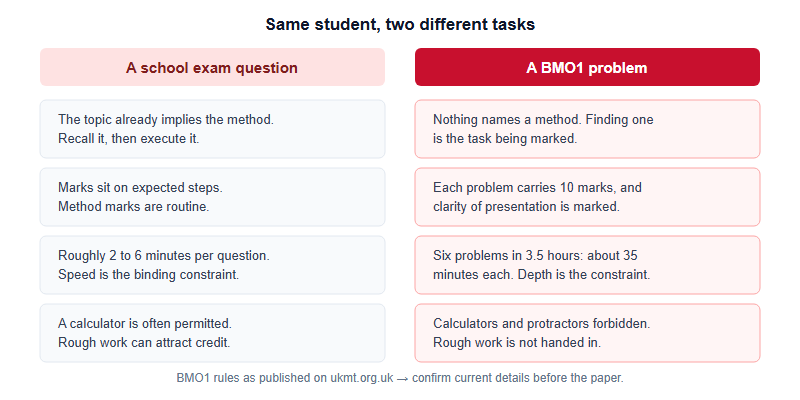
Each of those lines contradicts a habit that school examinations actively reward. Writing down everything you tried is a sensible strategy when a mark scheme hunts for partial credit; it is explicitly not the strategy here. Sharing your effort evenly across six problems is sensible when every question is worth the same and all are attemptable in the time; it is directly warned against here. And a student who has done three years of calculator-permitted papers will reach for arithmetic shortcuts that are simply unavailable in the room.
The practical consequence is that your first full-length practice paper should be run under the real rules — no calculator, one script, rough work kept separate — rather than as a relaxed problem set. Students are routinely shocked by how much of their apparent score in casual practice depended on conditions the real paper does not grant.
From mid-August to 18 November, and how to test where you are
The senior season has a fixed shape. Per ukmt.org.uk, the Senior Mathematical Challenge is on Wednesday 7 October 2026 and lasts 90 minutes, and BMO1 follows on Wednesday 18 November 2026. Entry to Round 1 is by invitation based on a qualifying SMC score, or by discretionary entry, with around 1,000 students qualifying from the SMC each year and a published fee of £40 per discretionary entry while automatic qualifiers are free. All of that should be confirmed on ukmt.org.uk, and students outside the UK should read our note on BMO eligibility for international students before assuming which route applies to them.
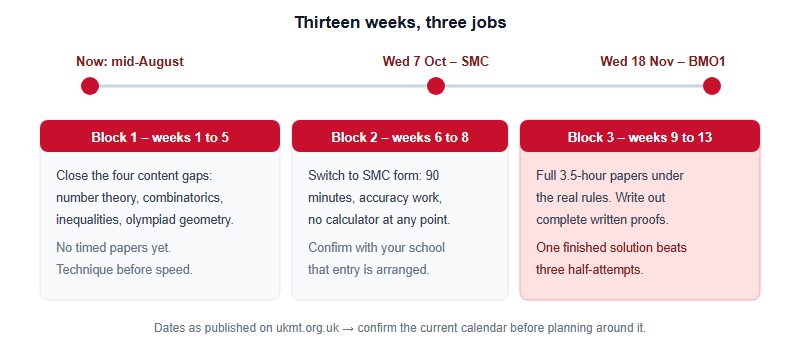
Two notes on sequencing. First, the SMC on 7 October is not a distraction from BMO1 preparation for most students — it is the qualification route, so the weeks immediately before it have a job of their own. Second, the six weeks between the two papers are the only period in which full-length Olympiad practice is genuinely realistic, so protect them from school mock timetables where you can.
Before committing to any of those blocks, though, measure where you actually stand rather than guessing. Take any past BMO1 paper, sit down with 35 minutes and question 1 — the first problem is intended to be the more accessible one — and then score yourself against four checks rather than against the official solution.
| Check | What a pass looks like | What a fail tells you |
|---|---|---|
| Did you find an idea within 35 minutes? | You had a plan, even an incomplete one | Content gap, most likely in one of the four missing areas |
| Did you write a full argument, not a sketch? | Every assertion has a stated reason | Presentation gap — the cheapest one to fix |
| Would a classmate follow it without you present? | They can, without asking a question | You are writing notes to yourself, not a solution |
| Did you answer the question that was asked? | Your last sentence mirrors the question's wording | You solved a nearby problem, which scores nothing |
Most students fail checks two and three while passing check one, which is good news: those are habit repairs measured in weeks, not content repairs measured in terms. The students who fail check one need the content blocks above, and starting in mid-August rather than in October is exactly why that is still comfortably possible.
Questions students ask
Do I need calculus for BMO1?
Past papers are built on elementary objects rather than calculus, and calculators are forbidden in the room. UKMT does not publish a topic syllabus — confirm on ukmt.org.uk.
Is IB HL Analysis better preparation than A-Level Further Maths?
Neither is decisive. Both give algebra and induction; neither typically covers number theory, olympiad combinatorics or inequalities, which is the real gap.
I got full marks in school maths but cannot start a BMO1 problem. Why?
School questions name the method through the topic. BMO1 does not, so finding the method is itself the marked task. That is a trainable skill, not a talent gap.
How long does closing the content gap take?
For a fluent Year 12 student, roughly five focused weeks on the four missing areas is a realistic first pass, with technique work before any timed papers.
This is an independent editorial guide operated by Hanlin Education for China-based international-school students. It is not affiliated with, endorsed by, or sponsored by UKMT or the BMO Subtrust. Competition dates, formats, fees and eligibility change between seasons — confirm current details on ukmt.org.uk before acting on anything here. Factual errors are corrected within 7 working days of being reported.