Two facts decide everything about junior UKMT planning outside the UK. The Kangaroo rounds are described by UKMT as open to UK schools only, while the Olympiad rounds are available to both UK and overseas schools. And before any of it applies, your school itself must qualify as a registered centre: UKMT states that an institution must be in the UK, a Crown Dependency, or be a British International School, and its Competition Handbook adds that overseas schools must additionally be registered with an approved inspectorate of the British Schools Overseas inspection scheme and appear on its list.
The eligibility gate almost nobody reads first
Families in Shanghai, Beijing and Shenzhen usually start this conversation at the wrong end — with which paper a Year 9 student should sit — when the binding constraint sits one level up. UKMT entries are made by registered centres on behalf of their students rather than by individuals, and the registration page states the requirement plainly: your institution must be in the UK, a Crown Dependency or be a British International School. UKMT’s Competition Handbook then adds the condition that decides most cases in China: overseas schools must additionally be registered with an approved inspectorate of the British Schools Overseas inspection scheme and appear on its list.
Those two conditions together produce very different outcomes across the Chinese international-school landscape:
- British-curriculum international schools teaching IGCSE and A-level are often assumed to qualify automatically. The test is whether the school is listed under the British Schools Overseas inspection scheme — not which curriculum it teaches. A Cambridge or Pearson exam-centre number does not carry over.
- IB and American-curriculum international schools need to check directly with UKMT rather than assume. Curriculum alone does not settle it, and neither does having international students on roll.
- Public-school international divisions in mainland China sit in the least predictable position and should ask before promising anything to students or parents.
Ask UKMT in writing, well before the entry window, and get the answer for your specific institution. All UKMT competitions are now paper-format only, for UK and overseas centres alike. The overseas-specific rule to plan around is timing: candidates in time zones more than 2 hours ahead of GMT sit the paper on the preceding day as defined locally — confirm current arrangements on ukmt.org.uk. Our companion piece on BMO eligibility for international students covers the same gate at senior level.
The round-by-round map, Years 7 to 13
Below is the structure as UKMT currently describes it, with formats quoted from the official competition pages. Year groups are given in the England, Wales and Overseas convention that UKMT applies to schools abroad; Scotland and Northern Ireland use different designations. One change is worth flagging for this season: UKMT describes the Senior Mathematical Challenge as trialling a new format in which the last three questions are 000–999 integer answers rather than multiple choice, so the end of that paper no longer rewards guessing between options — confirm on ukmt.org.uk.
| Round | Year band (England, Wales, Overseas) | Format | How you get in | Overseas centres |
|---|---|---|---|---|
| Junior Mathematical Challenge | Junior band — confirm cut-off on ukmt.org.uk | 60 minutes, 25 multiple choice | School entry | Challenge entry via a registered centre |
| Junior Kangaroo | Follows the JMC | 60 minutes, 25 multiple choice | Qualifying JMC score, or discretionary entry | Open to UK schools only |
| Junior Mathematical Olympiad | Year 8 and below | 2 hours, 6 questions (Section A removed from 2025) | Qualifying JMC score, or discretionary entry | Available to UK and overseas schools |
| Intermediate Mathematical Challenge | Year 11 and below | 60 minutes, 25 multiple choice, paper-based | School entry | Challenge entry via a registered centre |
| Grey and Pink Kangaroo | Follows the IMC | 60 minutes, 25 multiple choice | Qualifying IMC score, or discretionary entry | Open to UK schools only |
| Cayley Olympiad | Year 9 and below | 2 hours, 6 Olympiad-style problems | Qualifying IMC score, or discretionary entry | Available to UK and overseas schools |
| Hamilton Olympiad | Year 10 | 2 hours, 6 Olympiad-style problems | Qualifying IMC score, or discretionary entry | Available to UK and overseas schools |
| Maclaurin Olympiad | Year 11 | 2 hours, 6 Olympiad-style problems | Qualifying IMC score, or discretionary entry | Available to UK and overseas schools |
| Senior Mathematical Challenge | Year 13 or below | 90 minutes, 22 multiple choice + 3 integer-answer (000–999) questions — format change UKMT describes as being trialled from 2026 | School entry | Challenge entry via a registered centre |
| Senior Kangaroo | Follows the SMC | 60 minutes, 20 integer-answer questions | Qualifying SMC score, or discretionary entry | Open to UK schools only |
| BMO Round 1 | Year 13 and below | 3.5 hours, 6 Olympiad-style questions | Qualifying SMC score, or discretionary entry | Overseas listed in the eligibility wording |
| BMO Round 2 | Follows Round 1 | 3.5 hours, 4 Olympiad-style problems | Qualifying BMO1 score, or discretionary entry | Overseas listed in the eligibility wording |
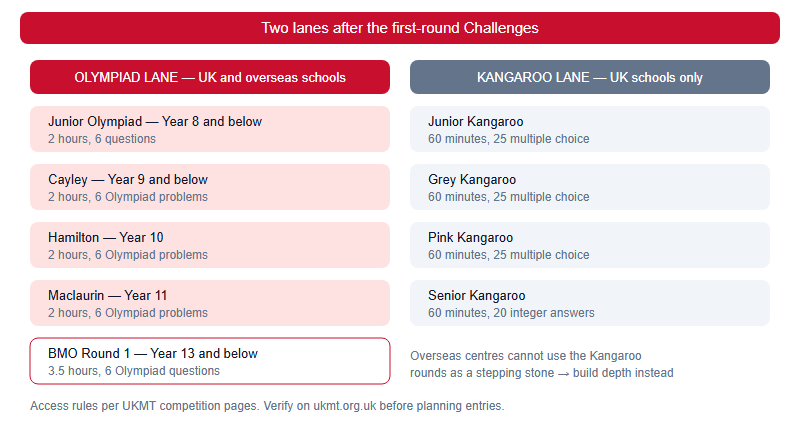
Why the closed Kangaroo lane matters less than it looks
The instinctive reaction from a head of maths in Suzhou or Guangzhou is that being locked out of the Kangaroo rounds is a loss. In our editorial view it is close to irrelevant for a student aiming at Round 1, and here is the reasoning.
The Kangaroo papers are multiple-choice: 60 minutes, 25 questions at junior and intermediate level, and 20 integer-answer questions at senior level. They test speed and accuracy on short problems. The Olympiad rounds are structurally different animals — two hours for six problems requiring written reasoning — and that is precisely the format that BMO Round 1 scales up into: 3.5 hours, six Olympiad-style questions. A student who has sat Cayley, then Hamilton, then Maclaurin has spent three years writing extended mathematical arguments under timed conditions. That is the transferable skill.
Put crudely: the Kangaroo lane trains the skill that gets you invited to the Olympiad lane, and the Olympiad lane trains the skill that the Olympiad lane actually rewards. Overseas centres are excluded from the first and admitted to the second, which is the better half of the deal. The invitation problem does not disappear, though, which is where discretionary entry comes in.
Getting in without the qualifying-score route
Entry to the Junior Olympiad and to Cayley, Hamilton and Maclaurin is by invitation based on a qualifying Challenge score, or by discretionary entry — the school pays to enter a student who did not reach the automatic threshold. UKMT lists £25 per discretionary entry for the intermediate Olympiads, with free entry via qualification, and around 1,800 students qualifying from the IMC each year. At senior level, discretionary entry to BMO Round 1 is listed at £40, with roughly 1,000 SMC qualifiers invited automatically. Confirm all current prices and thresholds on ukmt.org.uk.


For a school in China this changes the planning question from "will our students qualify?" to "how many discretionary places will we budget for, and who gets them?" Three points of practice we would put to a maths department:
- Budget the discretionary entries in the summer, not in January. Entry windows close, and a decision made in a rush after IMC results tends to be made on Challenge scores alone — which is the wrong signal for a written-proof paper.
- Select on written work, not only on multiple-choice speed. A student who writes careful, complete arguments but reads slowly under time pressure is often a better Cayley or Maclaurin candidate than a fast guesser.
- Keep the year-band logic straight. Cayley is Year 9 and below, Hamilton is Year 10, Maclaurin is Year 11 in the England, Wales and Overseas convention. A student cannot choose a lower band to improve their odds.
What a full season looks like on a China school calendar
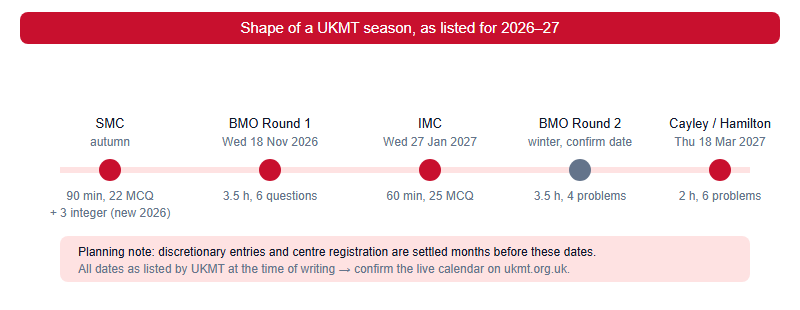
The dates UKMT currently lists for the 2026–27 season give the shape of the year. BMO Round 1 is listed for Wednesday 18 November 2026, the Intermediate Mathematical Challenge for Wednesday 27 January 2027, and the Cayley, Hamilton and Maclaurin Olympiads for Thursday 18 March 2027. Verify each on ukmt.org.uk, as UKMT publishes competition calendars season by season.
A realistic Years 7 to 11 progression
Assuming your school clears the registration gate, this is the build-up we would recommend to a department starting from nothing, and the reasoning is about format rather than difficulty.
- Years 7–8: the Junior Challenge as the entry point, then the Junior Olympiad for qualifiers or discretionary entrants. Two hours and six questions is the first real exposure to writing, not selecting, an answer.
- Year 9: the Intermediate Challenge, then Cayley. This is where a student first meets Olympiad-style problems that resist a five-minute solution.
- Year 10: Hamilton, with the training emphasis moving from getting the answer to justifying it. A written-solution club, marked against published solutions, does more here than extra problem volume.
- Year 11: Maclaurin, plus first contact with old Round 1 material for the strongest students — not as a target, as a calibration exercise.
- Years 12–13: the Senior Challenge in the autumn and Round 1 in November. By this point the six-problem written format is familiar and only the time budget and difficulty have changed.
For the senior end of that ladder, our overview of what the British Mathematical Olympiad is sets out how Round 1 and Round 2 fit together, and our guide to past papers and how to use them applies just as well to Cayley, Hamilton and Maclaurin practice as it does to Round 1.
Frequently asked questions
Can a school in China enter students for UKMT competitions?
Only if it qualifies as a registered centre. UKMT states institutions must be in the UK, a Crown Dependency, or be a British International School, and its Competition Handbook adds that overseas schools must also be registered with an approved inspectorate of the British Schools Overseas inspection scheme and appear on its list.
Why can overseas students not sit the Kangaroo rounds?
UKMT lists the Junior, Grey, Pink and Senior Kangaroo rounds as open to UK schools only. The Olympiad rounds are open to overseas schools.
Which Olympiad does a Year 10 student sit?
Hamilton, under the England, Wales and Overseas year convention. Year 9 and below sit Cayley; Year 11 sits Maclaurin.
Can a student enter an Olympiad without a qualifying Challenge score?
Yes, through discretionary entry by the school. UKMT lists £25 for intermediate Olympiads; confirm current fees on ukmt.org.uk.
This is an independent editorial guide operated by Hanlin Education for China-based international-school students. We are not affiliated with, endorsed by, or sponsored by UKMT or the BMO Subtrust. Centre registration rules, year bands, formats, fees and dates are set by the organisers and can change — confirm current details on ukmt.org.uk. Errors reported to our editorial desk are corrected within 7 working days.