UKMT runs a set of mentoring schemes — nine programmes named after mathematicians — that quietly do a lot of the heavy lifting behind strong olympiad results. They are free, they release monthly problem sheets, and they graduate students from Key Stage 3 material all the way toward A-level and olympiad problem-solving. The catch for anyone reading this from a Chinese international school: access is by school nomination through UKMT-registered schools, usually one student per school. This guide explains what the schemes are, why they are hard to access from China, and how to replicate their rhythm if you cannot get a place.
What the UKMT mentoring schemes actually are
The mentoring schemes are structured, months-long problem-solving programmes that sit alongside the challenges and olympiads rather than replacing them. Where the SMC and BMO are single high-stakes papers, mentoring is the slow-burn training that builds the problem-solving maturity those papers demand. According to UKMT, the scheme provides eight sheets per programme, released monthly, with students working through problems and receiving worked solutions after each submission deadline. Mentees are supported by mentors, and the whole scheme is free.
The programmes are tiered by mathematical maturity rather than raw age, which is what makes them genuinely progressive. UKMT names nine schemes after mathematicians and groups them by the content a student is confident with — an important detail, because it means a fast-moving younger student can be placed by ability. For the olympiad-bound, the top tiers matter most: these are pitched at students confident with full GCSE content, suited to A-level or Higher students, and they feed directly into the kind of thinking BMO1 and BMO2 reward. If you are mapping the whole ascent, our guide to what the British Mathematical Olympiad is shows where this training slots in.
| Tier grouping (per UKMT) | Programmes | Roughly who they suit |
|---|---|---|
| Entry / school-led | Pythagoras, Hypatia, Archimedes | Year 7–10 students (or Scottish/NI equivalents) |
| Middle | Mary Cartwright, Julia Robinson, Emmy Noether | Confident with Key Stage 3 and some GCSE content |
| Advanced | Hanna Neumann, G.H. Hardy, Srinivasa Ramanujan | Confident with full GCSE content; A-level / Higher students |
Why China-based students usually can’t just sign up
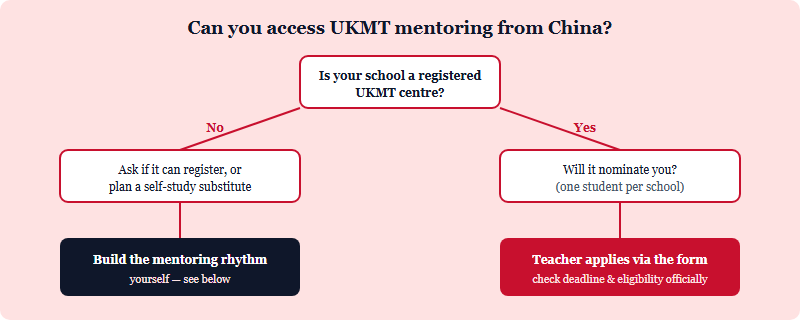
This is the part that catches out ambitious families, so it is worth stating plainly. The mentoring schemes are not an open online course you enrol in. UKMT states that only UKMT-registered schools can nominate students, with a maximum of one student per school, and that teachers apply on a student’s behalf via an application form. Some elements of the wider programme also carry age and eligibility conditions.
Stack that against the geographic requirement for UKMT participation more broadly — your institution must be in the UK, a Crown Dependency, or be a British International School to register as a centre — and the picture for a typical Chinese international-school student is clear: whether you can access mentoring depends entirely on your school’s status and its willingness to nominate you. Because nomination is capped at one student per school, even at an eligible school it is competitive internally. Note too that some UKMT follow-on rounds (such as the Kangaroo papers) are described as open to UK schools only, which is a reminder that not every part of the UKMT ecosystem is internationally accessible. Do not assume a place is available to you — the honest first step is to confirm your school’s registration and nomination practice, and to check current eligibility on the official site.
The deadline and logistics, if your school can nominate you
If you are at an eligible, registered school, treat this as a calendar item, not an afterthought. UKMT has published that applications for a given year run to a set autumn deadline — for the 2026/27 cycle, a September date — and that new mentees for certain programmes must meet an age condition by the preceding 31 August. The schemes run through an online classroom, with monthly sheets and post-deadline solutions.
- Who applies: your teacher, on your behalf — not you directly.
- How many per school: one student maximum, so make the case to your maths department early.
- When: applications close on a set autumn deadline; UKMT lists a September date for 2026/27. Confirm the exact date and any age cut-off on ukmt.org.uk.
- Format: eight monthly sheets per programme via an online classroom, with worked solutions released after each submission deadline.
Because dates and age conditions are set per cycle and can change, do not plan around a date you saw quoted elsewhere — verify the current cycle’s deadline directly with the official source before you rely on it.
How to replicate the mentoring rhythm if you can’t get a place
Here is the reassuring part, and it is a genuinely first-party editorial take: the magic of the mentoring schemes is not a secret curriculum — it is the rhythm. Monthly problem sets slightly above your current level, a hard deadline that forces you to commit written solutions, and worked solutions you study only after you have struggled. You can rebuild that loop from China without a place, and most of the value survives the substitution.


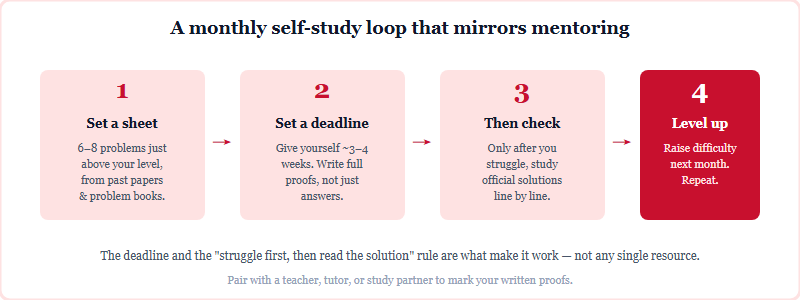
Three details make the substitute genuinely work rather than turning into passive reading. First, difficulty must sit just above where you are comfortable — too easy and you coast, too hard and you stall. Second, the deadline has to be real; the mentoring schemes work partly because a submission date forces committed written solutions, so give yourself a monthly cut-off and honour it. Third, resist reading the solution until you have genuinely wrestled with the problem — the learning lives in the struggle, and the official worked solutions are far more valuable once you have your own attempt to compare against. A teacher, tutor, or study partner who will actually mark your written proofs closes the loop that a mentor would otherwise provide.
Whether you land a real mentoring place or build your own version, the destination is the same: the fluent, rigorous problem-solving that the olympiad rounds demand. This training compounds over years, which is exactly why students who start on the intermediate ladder pull ahead — our year-by-year JMO-to-Cayley reading plan lays out how to structure that long build. And before you invest heavily, sanity-check that the competitions themselves are open to you with our eligibility reality check for international students.
Frequently asked questions
Are the UKMT mentoring schemes free?
Yes. UKMT states the mentoring scheme is free. Access, however, is by nomination through UKMT-registered schools, not open enrolment.
Can a student in China join UKMT mentoring directly?
No. Only UKMT-registered schools can nominate students, one per school, and a teacher applies on your behalf. Confirm your school’s eligibility on ukmt.org.uk.
How are the mentoring programmes structured?
UKMT describes eight sheets per programme released monthly via an online classroom, with worked solutions provided after each submission deadline.
What’s the best substitute if I can’t get a place?
Recreate the rhythm: monthly problem sets just above your level, a firm deadline for written solutions, and studying official solutions only after you have struggled.
This is an independent editorial guide operated by Hanlin Education for China-based international-school students. It is not affiliated with, endorsed by, or sponsored by UKMT or the BMO Subtrust. Mentoring programmes, tiers, deadlines and eligibility change each cycle — always confirm current details on ukmt.org.uk. We correct any inaccuracy within 7 working days of notification.