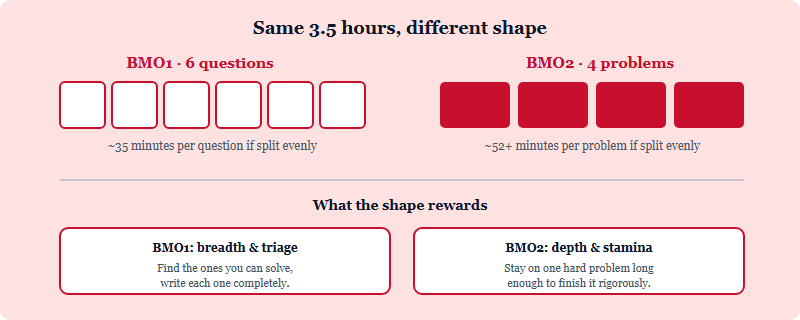
Both rounds of the British Mathematical Olympiad last three and a half hours, but they are not the same exam scaled up. UKMT describes BMO1 as a 3.5-hour challenge of six olympiad-style questions, and BMO2 as a 3.5-hour olympiad of four olympiad-style problems. Fewer problems in the same time is the whole story: BMO2 gives you far more minutes per problem because each one is meant to be deeper. This guide compares the two rounds head-to-head and shows what actually changes in how you should think, write, and prepare.
The two rounds side by side
Start with the facts UKMT publishes, then read what they imply. The headline difference is the problem count against a fixed clock. Six questions in 210 minutes is 35 minutes each if you split evenly; four problems in 210 minutes is over 52 minutes each. That extra time is not generosity — it is a signal that BMO2 problems are built to resist a quick idea.
| Dimension | BMO1 | BMO2 |
|---|---|---|
| Duration (per UKMT) | 3.5 hours | 3.5 hours |
| Number of problems | 6 olympiad-style questions | 4 olympiad-style problems |
| Rough time per problem | ~35 minutes if split evenly | ~52+ minutes if split evenly |
| How you get in | Qualifying SMC score or discretionary entry | Qualifying BMO1 score or discretionary entry |
| What it rewards | Breadth: cash in the ones you can crack, write them fully | Depth: sustained attack on a hard problem, complete rigour |
| Typical experience | You will likely solve several | Solving one or two fully is a strong outcome |
Note the entry rule, because it defines who is even in the room. UKMT states BMO2 entry is by invitation based on a qualifying BMO1 score, or by discretionary entry. So BMO2 is a self-selecting field: everyone sitting it already cleared BMO1. That raises the effective difficulty beyond what the problem count alone suggests — the competition around you is sharper. If you are still working out how the earlier gate functions, see our guide to what the British Mathematical Olympiad is.
What changes in how you should think
In BMO1, with six questions, the meta-skill is triage. You will not necessarily solve all six, so the winning behaviour is scanning the paper, recognising which problems play to your strengths, and banking full solutions to those before time runs out. A student who fixates on one stubborn problem and writes nothing complete elsewhere leaves marks on the table.
In BMO2, with four problems and more time each, the meta-skill is sustained attack. These problems are designed so that your first idea usually is not enough. The ability to keep going — try a construction, watch it fail, extract what you learned, try again — is what separates a complete solution from a page of scratch work. Triage still matters (you should not spend all 210 minutes on one problem), but the balance shifts decisively toward depth and stamina. That is why students who reach BMO2 invest in specific proof techniques; our JMO-to-Cayley reading plan shows how the habit of writing full proofs is built years earlier on the intermediate ladder.
What stays the same: rigour is non-negotiable in both
Here is the trap that catches strong international students moving up from multiple-choice contests: in both BMO rounds, a correct final answer with a gap in the argument is not a correct solution. Olympiad marking rewards complete, logically watertight proofs. A half-finished argument — even one that is clearly heading the right way — can score surprisingly low, because the marks live in the reasoning, not the destination.
- Both rounds: every claim needs justification; “it is obvious that” is where marks disappear.
- Both rounds: a clean write-up of a solved problem beats messy work on two unsolved ones.
- BMO1 emphasis: convert your solves into full marks — do not lose points to rushed presentation on problems you actually cracked.
- BMO2 emphasis: the problems are harder, so partial progress is more common — but only complete arguments carry the big marks, and examiners are strict about the final gap.
The practical takeaway: whichever round you are aiming at, train yourself to write solutions as if a strict marker will hunt for the one step you skipped. That discipline transfers directly between the two rounds and is the single biggest lever for a student coming from a speed-and-answer contest background.
The invitation link: BMO2 is a filtered field
One structural fact quietly reshapes how hard BMO2 feels, and it is easy to miss. UKMT states that BMO1 entry is by a qualifying SMC score or discretionary entry, and that BMO2 entry is by a qualifying BMO1 score or discretionary entry. In other words, the two rounds are links in a chain: the SMC filters into BMO1, and BMO1 filters into BMO2. Around 1,000 students qualify from the SMC for BMO1 — and only a fraction of those go on to BMO2.


Why does that matter to your preparation? Because “difficulty” is not just about the problems on the page; it is also about the field sitting the paper. By BMO2, everyone in the room has already cleared BMO1, so the cohort is sharper and the problems are pitched accordingly. A student who treats BMO2 as “BMO1 with two fewer questions” will under-prepare. The honest framing is: BMO1 is where a broad group of strong students competes, and BMO2 is where the subset who thrive on hard problems is concentrated. Plan your training for the field you will actually face, and confirm the current cycle’s qualifying arrangements on ukmt.org.uk rather than assuming last year’s applied unchanged.
- SMC → BMO1: qualifying score or discretionary entry; roughly a four-figure qualifying pool.
- BMO1 → BMO2: qualifying BMO1 score or discretionary entry; a smaller, self-selected field.
- Implication: each step up compounds difficulty from both the problems and the competition.
Common mistakes when moving up from BMO1 to BMO2
International students who reach BMO2 tend to lose ground in a few predictable ways. None are about talent — they are about mis-reading what the second round asks for.
| Mistake | Why it hurts in BMO2 | The fix |
|---|---|---|
| Bailing on a problem after 15 minutes | BMO2 problems are built to resist first ideas; quitting early wastes the extra time you are given | Commit to staying productive past your first dead end |
| Spreading thin across all four | Shallow progress on four problems rarely earns as much as one complete proof | Pick your strongest one or two and finish them fully |
| Writing the idea, not the proof | Marks live in the rigour; a sketched argument leaves points behind | Write every step a strict marker would demand |
| Only practising full mixed papers | Breadth drills do not build single-problem stamina | Add sessions on one hard problem at a time |
How to prepare differently for each round
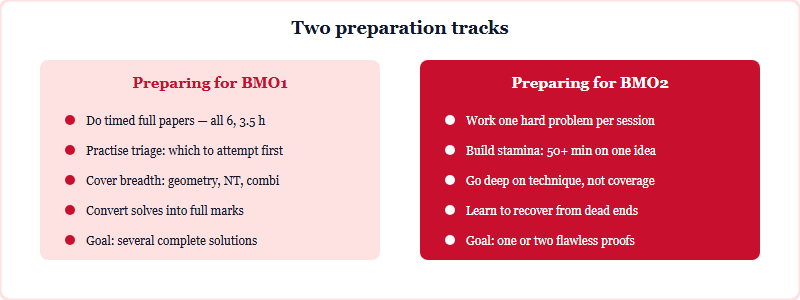
For BMO1, your practice should mirror the paper: sit full past papers under the 3.5-hour clock, deliberately rehearse the decision of which problems to attempt in which order, and make sure you are strong across the main olympiad areas so you always find enough problems you can crack. For BMO2, shrink the width and add depth — spend a whole session wrestling a single hard problem, building the mental stamina to stay productive past the point where your first approach dies. Both tracks should end the same way: a written-up solution that a strict examiner cannot poke a hole in. Whether you self-study or work with a coach, the format difference is what should drive your plan; before that, confirm you are even eligible to sit the rounds via our eligibility reality check for international students.
Frequently asked questions
Is BMO2 just a harder version of BMO1?
Not exactly. It has four problems instead of six in the same 3.5 hours, so it rewards depth and stamina on hard problems rather than breadth across many.
How do you get into BMO2?
UKMT states entry is by invitation based on a qualifying BMO1 score, or by discretionary entry. Everyone sitting BMO2 has already cleared BMO1.
How many problems should I expect to solve in BMO2?
Fully solving one or two of the four is a strong outcome for most students, because the problems are built to resist quick ideas. Aim for complete, rigorous proofs.
Does presentation matter as much in both rounds?
Yes. In both BMO1 and BMO2, marks live in the reasoning. A correct answer with a gap in the proof can score low, so write complete arguments.
This is an independent editorial guide operated by Hanlin Education for China-based international-school students. It is not affiliated with, endorsed by, or sponsored by UKMT or the BMO Subtrust. Competition formats, problem counts, dates and entry rules change each cycle — always confirm current details on ukmt.org.uk. We correct any inaccuracy within 7 working days of notification.