The China-region handbook for the 2026-27 UKMT senior season is out, and the single most useful thing it settles is the calendar. Per the organising channel (ASDAN, which administers the China region): the SMC China sitting runs Thursday 8 October 2026, 17:00–18:30, with registration and payment closing 28 September; BMO Round 1 follows on Thursday 19 November, and BMO Round 2 on Thursday 21 January 2027. UKMT’s own calendar, which governs UK school centres, lists the SMC on Wednesday 7 October. Two sittings, one day apart, both real — and with the China registration deadline twenty-six days away, this is the week to know which one is yours.
Two calendars, clearly labelled
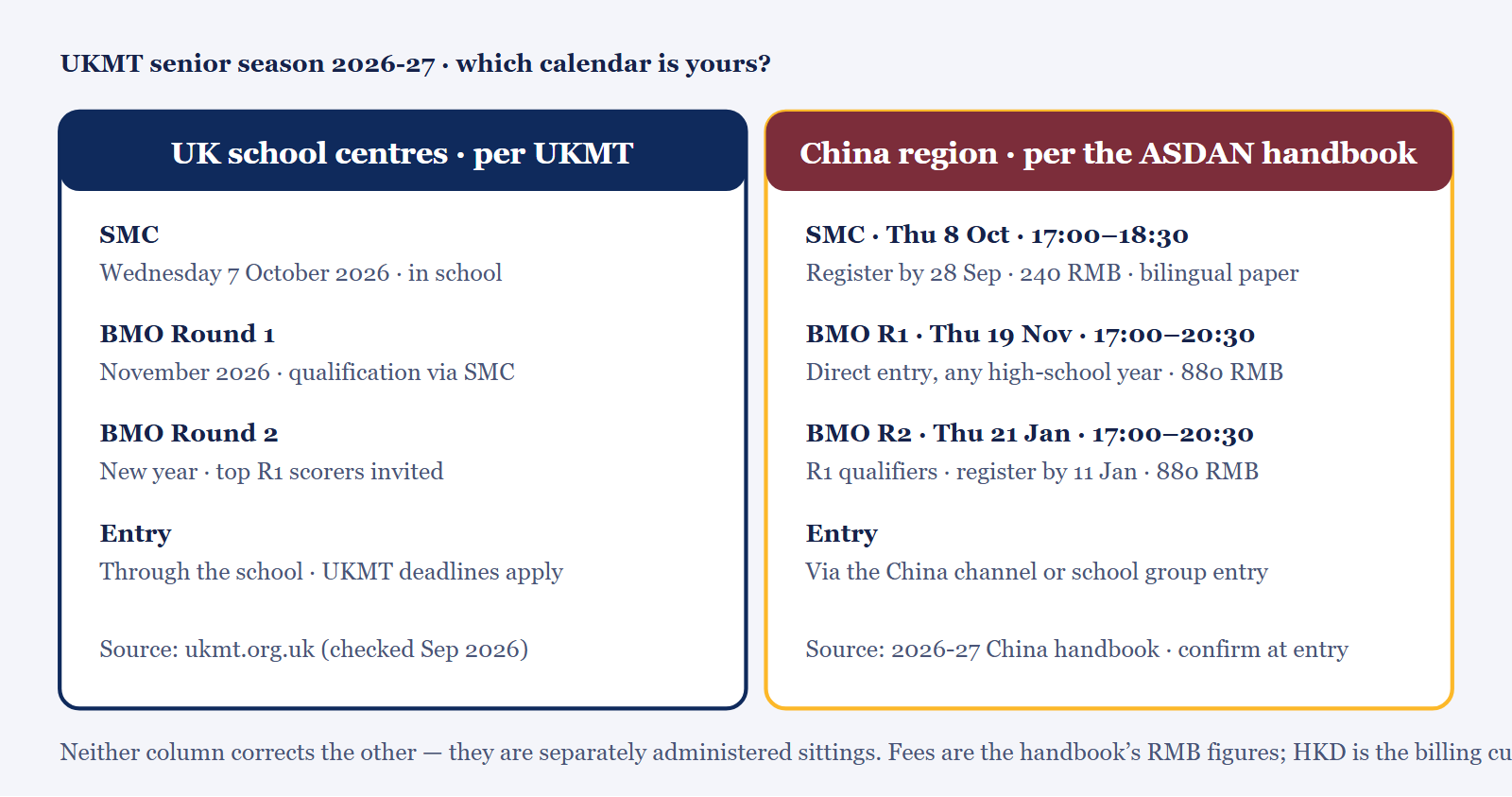
If your school is a registered UKMT centre, you sit on UKMT’s dates and none of the China logistics apply to you. If you enter through the China region — the route most of our readers use — the handbook’s dates govern you, including the detail our autumn hour-budget planner flagged about the National Day holiday: the China sitting lands on 8 October, the first Thursday after the break, so the final revision week and the holiday overlap completely. Plan for that now, not in October.
The headline structural difference: direct entry to BMO Round 1
In the UK, BMO Round 1 is gated: you qualify through a strong SMC score or a discretionary entry — the mechanics we mapped in the invitation-gateway guide. The handbook states the China-region difference plainly: China-based students may register for BMO Round 1 directly, at any high-school year, without an SMC qualifying score. That changes autumn strategy. The SMC stops being a gate and becomes a calibration instrument — still worth sitting seriously, because it tells you honestly whether a 3.5-hour proof paper six weeks later is a stretch or a reach, and because its award lines are the cleanest external benchmark available. Our SMC gatekeeper analysis reads differently under this rule: the gate is open, but walking through unprepared still costs you an evening and 880 RMB.
One eligibility rule cuts the other way, and the handbook is explicit about it: students enrolled at UK schools may not sit the China-region papers. The two calendars do not double up. And a note the handbook itself volunteers, which we appreciate for its honesty: non-UK nationals cannot be selected for the UK’s IMO team — the ladder for China-based students runs to BMO Round 2 and the Asia Camp, not to the UK squad.
Formats and scoring, as the handbook states them
The China SMC paper matches the format UKMT itself describes — 25 questions: 1–22 multiple choice, 23–25 numeric with answers from 0 to 999 — delivered bilingually in the China region. Scoring per the handbook: start from 25, +4 for a correct answer, −1 for a wrong one, 0 for a blank. BMO Round 1 runs 3.5 hours with around six proof questions at 10 marks each; Round 2 runs 3.5 hours with around four proofs at 10 marks each; both award partial credit for partially correct reasoning, and both are English-language papers. Question counts are “approximately” in the handbook’s own wording — the exact count follows the year’s paper.
Every boundary the handbook publishes
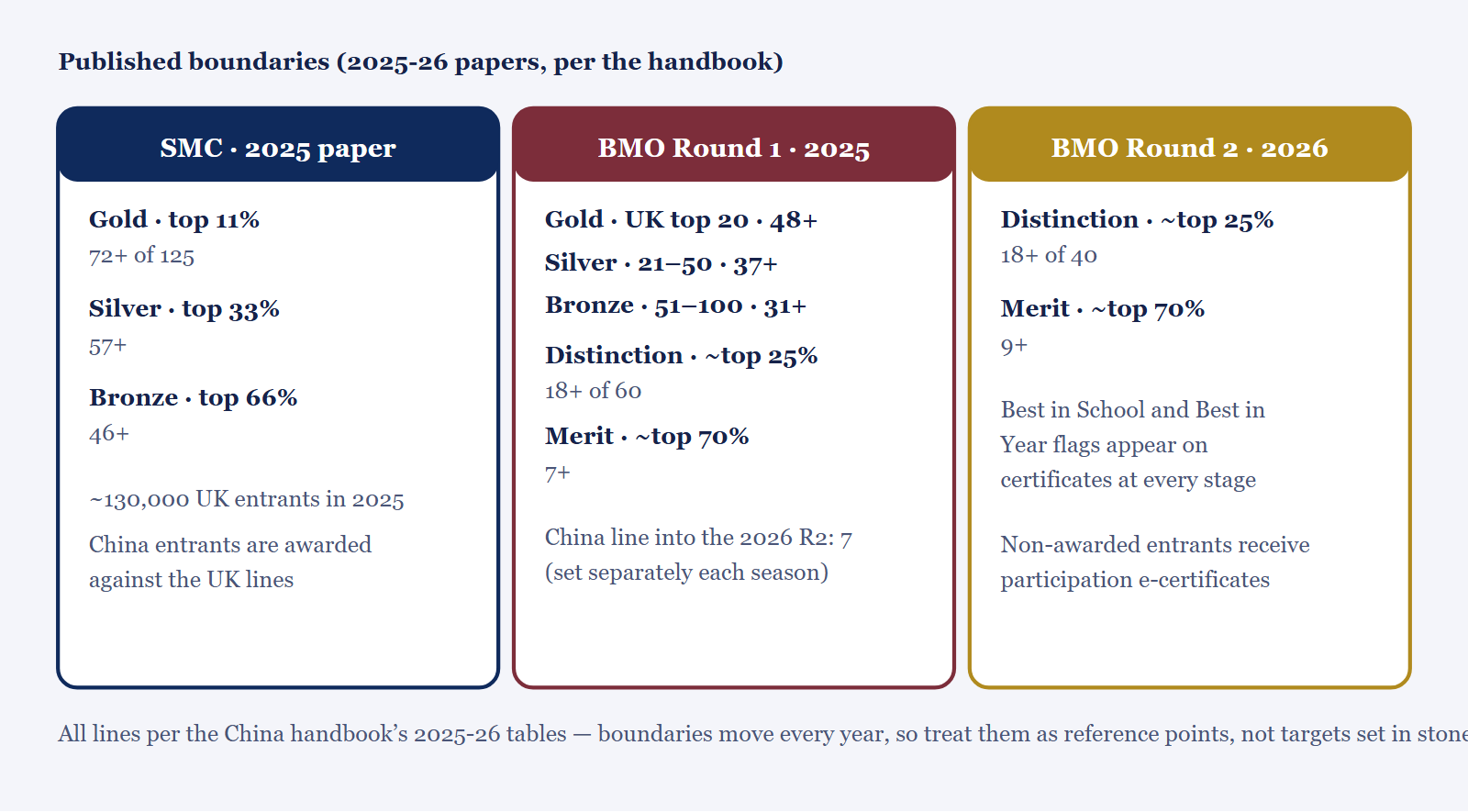
Three readings of that table worth spelling out. First, the SMC gold line at 72 of 125 means gold is reachable on 22-question accuracy alone — the three numeric questions are a bonus lane, not a requirement, which matches the pacing advice in our SMC score-raising guide. Second, the BMO1 medal lines (48/37/31) describe the UK’s top hundred; the honest China-region target for a first serious attempt is the Distinction line at 18 — three problems’ worth of credit — and the handbook’s separately-set China qualifying line for Round 2 (7 points last season) means a China-based student with two well-written part-solutions was already in Round 2 territory. Third, awards for China entrants are issued against the UK boundaries, so a certificate here means exactly what it means in Britain — which is what makes it legible to an admissions reader cross-checking a maths-heavy application against MAT, TMUA and STEP evidence.
The Asia Camp at the top of the ladder
The handbook closes the ladder with the BMO Asia Camp: the UK’s olympiad training camp model — Trinity College, Cambridge-supported, led by Dr Geoff Smith of the UK olympiad committee — brought to China since 2023 by the BMO organising committee together with ASEEDER Hong Kong. The 2027 edition is listed for August 2027 in China, date to be confirmed, with entry by invitation to BMO awardees across Asia, taught in English by UK national-coach-level staff. It is the China-region answer to “what comes after Round 2” for students who cannot, by nationality, progress to the UK team — a training destination rather than a selection one.


What to do before 28 September
Three moves. Register — through your school if it organises group entry, otherwise through the China channel, before the 28 September cutoff. Decide your BMO1 posture — direct entry means the question is not “will I qualify” but “will six proof questions in November be a serious attempt”; our BMO1 readiness self-audit answers that in forty marks. And put the two sittings a day apart out of your mind once you know your route: your date is your date, and the other calendar belongs to someone else’s school.
Frequently asked questions
Is the SMC on 7 October or 8 October 2026?
Both, for different routes. UKMT’s calendar lists Wednesday 7 October 2026 for UK school centres. The China-region sitting, per the organising channel’s 2026-27 handbook, runs Thursday 8 October 2026, 17:00–18:30, with registration closing 28 September. Confirm which sitting your entry route uses; neither date corrects the other.
Can China-based students enter BMO Round 1 without an SMC score?
Yes, per the handbook: in the China region, students at any high-school year may register directly for BMO Round 1 (Thursday 19 November 2026), without the SMC qualification the UK route requires. The SMC remains worth sitting as a calibration benchmark, but it is not a gate on this route.
What boundaries should a China-based candidate aim for?
Per the handbook’s published lines from the 2025-26 papers: SMC gold sat at 72 of 125 (top 11%), silver 57, bronze 46. On BMO1, Distinction sat at 18 of 60 and the China-region qualifying line into the 2026 Round 2 was 7 points, set separately from the UK’s top-100 rule. Boundaries move every year — treat these as reference points.
How much does the China-region season cost?
Per the handbook: 240 RMB for the SMC and 880 RMB for each BMO round, billed in Hong Kong dollars (284 and 1,039 HKD respectively), covering entry, administration, marking, certificates and reference past papers. RMB figures float with the exchange rate — confirm at registration.
We are an independent editorial guide and are not affiliated with UKMT or the BMO Subtrust. UK-calendar facts are as published at ukmt.org.uk (checked September 2026); China-region dates, fees and boundaries are as stated in the organising channel’s 2026-27 handbook (ASDAN · seedasdan.asia) and should be confirmed at registration. Corrections within 7 working days of notice.