Chinese Grade 11 is not UK Year 11 — it is UK Year 12. The numeric grade used by most international schools in China, and by every US-curriculum school, sits one number below the UK year group that UKMT works in. Get the conversion wrong and you either enter a year late or plan a runway that does not exist. Below is the table, and the count of seasons you actually have left.
The off-by-one that quietly costs a season
The two numbering systems disagree because they start in different places. English schools begin with Reception, then Year 1, so a pupil has already completed one named year before the numbering that Chinese and American schools call Grade 1 begins. From that point on the offset never closes: numeric grade plus one equals UK year group, all the way to the top of the school.
That single digit does real damage in both directions. A Grade 11 student who assumes they are "Year 11" believes there are three more senior seasons ahead, plans a slow build, and discovers in the following autumn that the runway was two. A Grade 12 student who translates their grade as "Year 12" defers a year deliberately — and there is no following autumn to defer into. The first error wastes preparation; the second removes the attempt entirely.
The line that matters is published by UKMT itself. The Senior Mathematical Challenge, listed for Wednesday 7 October 2026, carries the eligibility line "England, Wales and Overseas: Year 13 and below". The wording differs by nation on the UKMT pages, and the clause that applies to a reader in Shanghai or Shenzhen is the Overseas one. Everything downstream — Round 1 in November 2026, Round 2 in January 2027 — hangs off that autumn window. Confirm the current wording and dates on ukmt.org.uk before you commit to a plan, and if you are still working out whether the pathway is open to you at all, start with our eligibility reality check for international students.
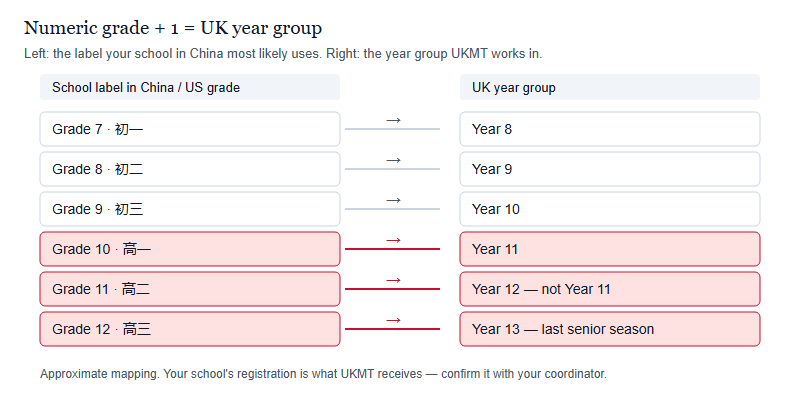
The conversion table
Use the row that matches the label printed on your own school report. If your school issues two labels — many bilingual schools in China print both a Chinese year name and a US grade — they should land on the same row.
| Chinese year name | Numeric grade (China / US) | UK year group | Typical age during the year | Curriculum stage you are likely in |
|---|---|---|---|---|
| 初一 | Grade 7 | Year 8 | 12–13 | Lower secondary / MYP 2 |
| 初二 | Grade 8 | Year 9 | 13–14 | Lower secondary / MYP 3 |
| 初三 | Grade 9 | Year 10 | 14–15 | IGCSE year 1 / MYP 4 |
| 高一 | Grade 10 | Year 11 | 15–16 | IGCSE year 2 / MYP 5 |
| 高二 | Grade 11 | Year 12 | 16–17 | AS / IB DP1 / AP year 1 |
| 高三 | Grade 12 | Year 13 | 17–18 | A2 / IB DP2 / AP year 2 |
Two caveats sit on top of this table, and both are worth two minutes of your time rather than an assumption.
Birthday cut-offs. The UK school year runs from September to August, and pupils are grouped by that window. Mainland Chinese schools use a comparable early-autumn cut-off, which is why the mapping is usually clean. International schools in China are not uniform, and a small number use a calendar-year or December cut-off instead. If you were born in September, October, November or December, you are the case most likely to be placed differently from the table, and you should ask rather than infer.
Repeated or skipped years. A student who joined an international stream late, repeated a year on entry, or accelerated a year is registered wherever the school has placed them — not wherever the age table says. What UKMT sees is the year group your school submits on the entry, so that number, not your birth certificate, is the operative one.
How many autumn seasons you have left
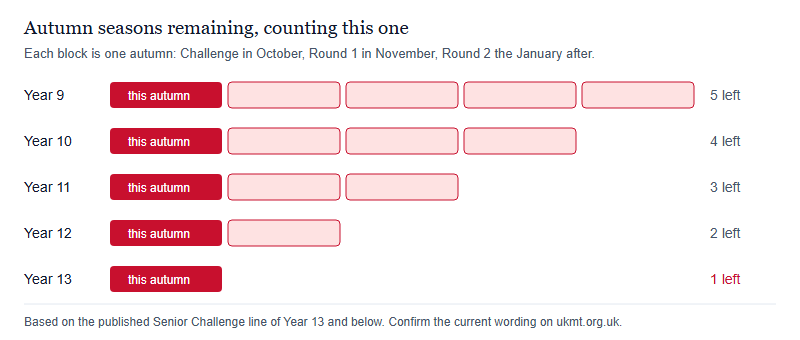
Preparation plans in this subject are usually written in months, which hides the thing that actually constrains you. The senior pathway is annual and it is all bolted to a single autumn: the Challenge in early October, Round 1 in November, Round 2 the following January. Miss an autumn and you have not lost six weeks, you have lost a whole cycle. So count seasons, not months.


The table below assumes the published Senior Mathematical Challenge eligibility line of Year 13 and below, and counts this coming autumn as season one. Check the current line on ukmt.org.uk, because a change to it changes every number in the right-hand column.
| Your UK year group this autumn | Autumn seasons remaining, including this one | A realistic aim for this season | The thing to protect |
|---|---|---|---|
| Year 9 (Grade 8) | 5 | Sit whatever your school enters at your level; build arithmetic fluency and the habit of writing full sentences. | Do not touch recent Round 1 papers. You will want them intact in three years. |
| Year 10 (Grade 9) | 4 | A strong Challenge score; first serious contact with written proof. | Topic coverage. Breadth now buys speed later. |
| Year 11 (Grade 10) | 3 | Challenge score in the range that puts Round 1 in play; two or three timed olympiad-style problems a week. | The habit, through a heavy public-exam year. Small and continuous beats intense and abandoned. |
| Year 12 (Grade 11) | 2 | A genuine Round 1 attempt, treated as the calibration run rather than the final answer. | Your unseen past papers. This is the year students burn the archive and arrive in Year 13 with nothing left to sit. |
| Year 13 (Grade 12) | 1 | Peak on the one paper you have. Everything is sequenced backwards from the November date. | Time. This season runs alongside applications and mocks, so the plan has to be cut to what survives contact with them. |
Three things your year group does not settle
Knowing your year group tells you the size of your runway. It does not tell you which papers are available at the end of it, and three of those answers do not come from the conversion table at all.
- Which papers your school actually enters. UKMT papers are administered by schools. A school that enters the Senior Mathematical Challenge does not automatically enter anything after it, and a large number of international schools stop at the Challenge because nobody has asked them to go further. Your year group is irrelevant to a paper your school has not registered for.
- The papers that are closed to you regardless. UKMT lists the Andrew Jobbings Senior Kangaroo — a 60-minute, 20-question integer-answer challenge in November 2026 — as open to UK schools only. For a reader in China this matters more than it looks: the familiar UK description of "the two follow-on routes from the Challenge" collapses to one. Your onward route is Round 1.
- How you get to Round 1. Entry follows from Challenge performance, with a discretionary route alongside it. The thresholds are set each cycle and we do not publish guesses at them here; check ukmt.org.uk, and read our guide to what the British Mathematical Olympiad actually is if you have not yet mapped the rounds.
What to do this week, by year group
It is early September. The Challenge is listed for 7 October, which means the administrative window is now and the study window is what is left after it.
- Every year group. Send one message to your school's UKMT coordinator asking two things: whether the school is entering the 7 October Challenge, and which year group they will register you in. The second question takes them ten seconds and removes the entire off-by-one risk described above.
- Year 9 and Year 10 (Grades 8–9). Enter what is offered at your level and leave the senior archive alone. Recent Round 1 papers are a finite, non-renewable diagnostic resource; our past-paper pack and how to use it explains the sequencing, and the short version for you is that the newest papers should still be unopened in three years.
- Year 11 (Grade 10). Treat the Challenge as the real target this autumn. It is the gate, and a public-exam year gives you less slack than you think.
- Year 12 (Grade 11). This is your calibration season. Sit Round 1 if you are entered, expect the score to be low, and record what the paper actually asked rather than how it felt. You still have one more autumn to act on the answer.
- Year 13 (Grade 12). Plan backwards from the November date and be honest about what applications and mocks will take. One well-prepared attempt beats a schedule that collapses in week seven.
Common questions
Is Chinese Grade 11 the same as UK Year 11?
No. Grade 11 maps to UK Year 12. Add one to the numeric grade to get the UK year group your school will register you in.
Does my age or my year group decide eligibility?
UKMT lists eligibility by year group, and your school submits it on the entry. Ask your coordinator which year they will register you as.
Can I enter the Senior Kangaroo from a school in China?
UKMT lists the Andrew Jobbings Senior Kangaroo as open to UK schools only. From overseas, the route on from the Challenge is Round 1.
I am in Year 13. Is it too late to start?
This is your last senior season, so plan backwards from the November Round 1 date rather than building a multi-year programme.
This is an independent editorial guide operated by Hanlin Education for China-based international-school students. It is not affiliated with, endorsed by, or sponsored by the UK Mathematics Trust or the BMO Subtrust. Competition dates, formats and eligibility are set by UKMT and change between cycles — confirm current details on ukmt.org.uk before planning around them. The grade-to-year mapping, the seasons-remaining count and the year-group action lists are our editorial judgement, not UKMT guidance, and your school's own registration takes precedence over any table here. Errors reported to our editorial desk are corrected within 7 working days.