A UKMT result is evidence, not currency. Sitting the Senior Challenge evidences interest; reaching Round 1 evidences that a score or a teacher put you there; reaching Round 2 evidences sustained mathematical ability. The table below maps each milestone to what it honestly demonstrates, which part of the application form it belongs on, and what it cannot do. No result guarantees an outcome anywhere.
What an admissions reader can actually infer
Assume the person reading your application has thirty seconds and no detailed knowledge of British maths competitions. Two things follow.
The first is that an uncalibrated line does very little work. "Maths Olympiad" could mean a school lunchtime club or a national round; the reader cannot tell, and readers do not research. One clause of context — the organiser, the round, the year — converts a vague claim into a checkable fact. If you want the underlying structure straight before you describe it, our overview of what the British Mathematical Olympiad is lays out how the rounds sit inside the UK pathway.
The second is that calibration must stay inside what you can support. UKMT publishes award thresholds and outcomes with each year's results, and those figures move from year to year. If UKMT has published a figure that genuinely applies to you, you may use it. If it has not, do not estimate one. An invented percentile is the single most common way a real achievement becomes a liability, because the one reader who does know the competition will notice, and everything else you wrote is now suspect.
There is a third thing worth saying plainly, because it changes how you use the whole table below. The strongest application value of an olympiad round is usually not the label at all — it is that it licenses you to write or talk, concretely, about a problem you failed to solve for two weeks and then solved. That is evidence of how you think. A certificate is evidence that something happened.
The mapping: milestone, evidence, destination
Find your row. The "does not evidence" column matters as much as the others, because it tells you which claims to keep out of your draft.
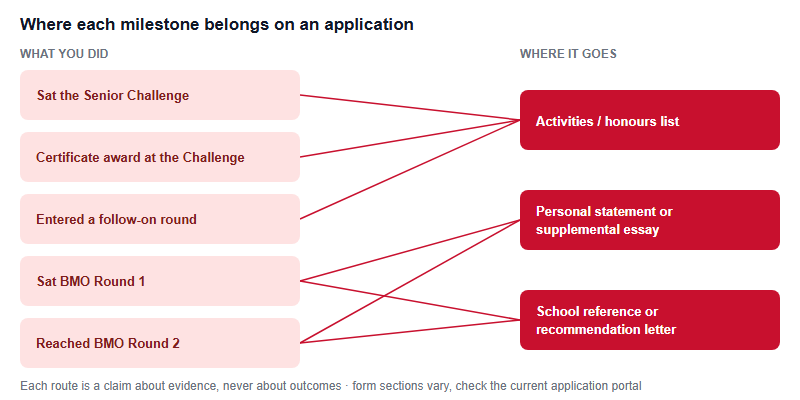
| Milestone | What it honestly evidences | Where it belongs | What it does not evidence |
|---|---|---|---|
| Sat the Senior Challenge | Interest, and that you sought out mathematics beyond the syllabus. | One line on an activities or honours list if your application has one; UK and US forms differ here, so check the portal. Nothing more. | Ability. Large numbers of students sit it; sitting it is not a selection event. |
| Certificate award at the Challenge | Measured performance against a national cohort, at the level UKMT printed on the certificate. | Activities or honours list, using the exact award wording, plus the year. | Any percentile you have not seen UKMT publish. Do not translate the award into a rank. |
| Entered a follow-on round | That you continued past the entry round rather than stopping at the certificate. | Activities list, same line as the Challenge — progression reads better than two separate entries. | Olympiad-level proof ability, which the follow-on rounds do not all test. |
| Sat BMO Round 1 | That you met UKMT's entry conditions for a national olympiad round and produced written proofs under a long timed paper. | Activities list, and legitimately available as material in a personal statement or essay. | A result. Sitting a round and scoring well on it are different claims — keep them separate. |
| Scored well or received an award at Round 1 | Demonstrated proof-writing ability under time, assessed nationally. | Activities list; worth a sentence in an essay; worth telling your referee about explicitly. | Comparability with other countries' olympiads. Do not equate rounds across systems. |
| Reached BMO Round 2 | Sustained ability on harder material, and that Round 1 was not a single good afternoon. | Activities list, essay material, and a specific point for a referee to corroborate. | An offer. It is one strong line of evidence in a file that contains many. |
One row deserves emphasis. "Sat Round 1" and "did well in Round 1" are separate claims, and conflating them is the most common overstatement we see in drafts. Writing that you "competed in the British Mathematical Olympiad" is true and fine; writing it in a way that implies a result you did not get is neither. If you are unsure whether you can enter these rounds at all from your school, settle that first — our eligibility reality check for international students covers the routes, and the authoritative version is on ukmt.org.uk.
Writing the line: four rules and three rewrites
Four rules cover almost every case:
- Name it in full, once. "British Mathematical Olympiad Round 1 (UK Mathematics Trust)" on first use. Abbreviate afterwards if space is tight.
- State the round and the year. Rounds are the unit of information. A competition name without a round is uninterpretable.
- Use only wording that appears on your certificate or result notification. If it is not printed, it is not a claim you can make.
- Never convert to a percentile you cannot cite. If UKMT published a figure that applies to you, cite it as theirs. Otherwise say nothing about rank.
| What students write | The problem | What it should say |
|---|---|---|
| "Participated in British Maths Olympiad" | No round, no year, no organiser. Unverifiable and reads as a club. | "British Mathematical Olympiad Round 1 (UK Mathematics Trust), November 2026" |
| "Top scorer in national maths olympiad" | A ranking claim with no published source behind it. High risk, no upside. | "[Award exactly as printed], Senior Mathematical Challenge 2026, UK Mathematics Trust" |
| "Maths olympiad — 2 years" | Duration is not an achievement, and it hides the actual progression. | "Senior Mathematical Challenge 2025 and 2026; qualified for Round 1 in 2026" |
In an essay, the rules change shape. Nobody wants a paragraph restating a line already on your activities list. What earns space is a specific problem: the configuration you could not see for a fortnight, the invariant that made a combinatorics question collapse, the moment you realised your proof had a gap you had been stepping over. Working from a genuine set of Round 1 and Round 2 past papers gives you that material as a by-product of training, which is the honest way to acquire it — there is no way to write convincingly about a problem you never sat with.
The recording calendar: when to do what
Most lost value here is not overstatement; it is omission. Students genuinely forget the exact wording of an award, cannot find the certificate eighteen months later, or brief a referee after the reference has been written. The fix is a short dated routine.


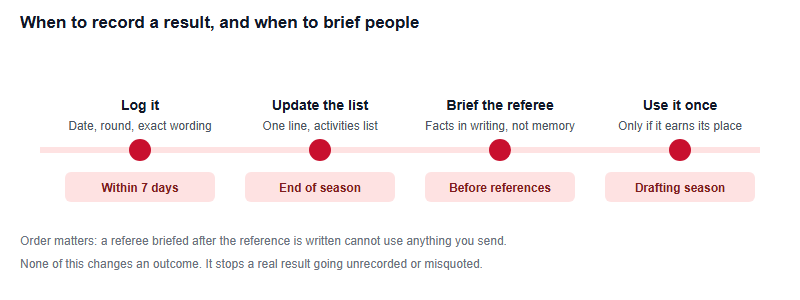
| When | Action | Why then |
|---|---|---|
| Within 7 days of any result | Photograph the certificate or result notification. Type the exact wording, the round, the organiser and the date into one running file. | Wording is forgotten within weeks and paper certificates are genuinely lost. You are reconstructing this eighteen months later otherwise. |
| End of the competition season | Add or update one line on a running activities list — progression across years on a single line, not one entry per sitting. | You will be assembling applications under deadline pressure, months later, and will not do this well then. |
| Before your school's reference deadline | Send your referee a short factual note: what you sat, which round, what the result said, and one sentence on a problem that interested you. | References are written earlier than students expect, and a teacher cannot corroborate what they were never told. |
| Drafting season | Decide whether it belongs in an essay at all. Include it only if you can attach a specific problem and a specific way of thinking. | Space in an essay is expensive. A line already on the activities list does not need repeating in prose. |
| Before any interview | Re-read the problem you mentioned, and be able to talk through the argument — including where it went wrong first. | Anything you put in writing is fair material for questions, and a half-remembered problem is worse than none. |
What a UKMT result does not do
Four honest limits, because pretending otherwise sets students up badly.
It does not guarantee admission anywhere. Universities publish their own entry requirements and selection criteria and assess applications as a whole. Any source implying that a particular olympiad round produces a particular outcome is telling you something it cannot know.
It does not substitute for your actual academic record. A strong olympiad line attached to weak school mathematics reads as an anomaly rather than a strength, and it invites exactly the questions you would rather not face.
It does not transfer neatly across systems. Rounds in different countries' olympiad structures are not equivalent, and asserting equivalence is a factual claim you cannot support. Describe what you sat; let the reader place it.
It should not become the goal. This is the practical one. Training aimed at a label tends to be shallow — wide coverage, no depth, nothing you could discuss for ten minutes under questioning. Training aimed at the mathematics produces the label more often and gives you something to say. If the eligibility rules mean you cannot sit these particular rounds, the mathematics is still entirely available to you, and the thinking it builds is the part that shows up in an interview.
Frequently asked questions
Does a BMO result guarantee an offer from a top university?
No. No competition result guarantees admission anywhere. Decisions are holistic and each university publishes its own criteria.
Where should I list a Senior Challenge certificate?
On the activities or honours list, using the exact wording printed on the certificate, plus the year and the organiser.
Can I claim a percentile ranking?
Only if UKMT published a figure that applies to you. Never estimate one; an unverifiable rank claim damages a good line.
Is it worth entering if I will not win anything?
Yes, if you want the mathematics. As an application line alone participation is weak; as training it is anything but.
This is an independent editorial guide operated by Hanlin Education for China-based international-school students. It is not affiliated with, endorsed by, or sponsored by the UK Mathematics Trust (UKMT) or the British Mathematical Olympiad Subtrust, and it is not affiliated with any university or admissions body. Nothing here predicts or guarantees an admissions outcome. Competition formats, entry routes, award wording and thresholds are set by UKMT and change from year to year — confirm current details on ukmt.org.uk, and confirm application form requirements on the relevant application portal. Factual corrections are made within 7 working days.