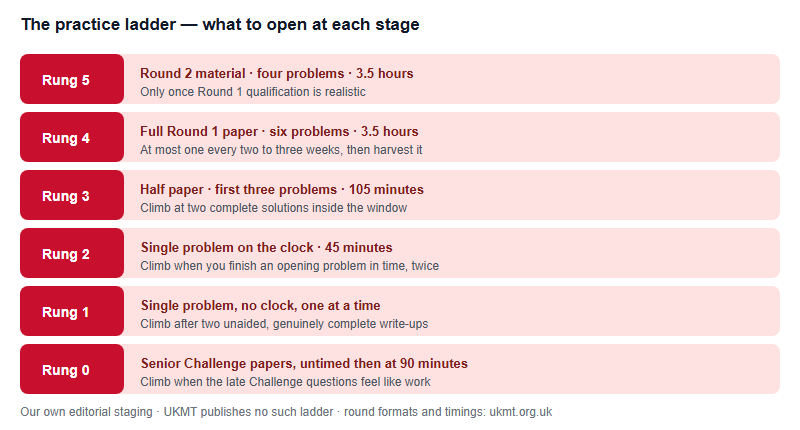
Do not open a full BMO1 paper until you can finish a single problem completely. The ladder below has six rungs, each with one paper type, one clock setting and one promotion test you must pass before climbing. In our experience students often sit full papers two rungs too early, learn almost nothing, and permanently spend a paper that could have diagnosed them later.
A past paper is a one-shot diagnostic, not renewable practice
Textbook exercises are renewable: you can redo them, and redoing them is fine because their job is drilling a technique. Olympiad papers are not like that. The single most valuable thing a paper can tell you is what you do when you meet six unfamiliar problems with no idea which method applies — and it can only tell you that once. The second time you meet that paper you are partly remembering, and the diagnosis is contaminated.
This has a consequence students rarely draw. Your stack of papers is a finite budget of cold reads, and spending one badly is a permanent loss. Sitting a full BMO1 paper when you cannot yet write a complete solution to anything does not measure you; it produces three and a half hours of fragments, a demoralising afternoon, and a paper that can never test you properly again.
The paper is demanding by design. Per ukmt.org.uk, BMO Round 1 runs three and a half hours over six problems and asks for full written solutions rather than answers, and the guidance printed on the paper is explicit that one complete solution gains more credit than several unfinished attempts. Round 2 is four problems over a similar length of time. Confirm the current format, entry route and dates on ukmt.org.uk; if you are still placing these rounds inside the wider pathway, start with our overview of what the British Mathematical Olympiad is.
So the question "which paper should I sit today?" is really a resource-allocation question, and the ladder below answers it by stage rather than by ambition.
The ladder: six rungs, six promotion tests
Find the lowest rung whose promotion test you have not passed. That is your rung, regardless of how long you have been training or what your friends are sitting. The promotion tests are deliberately concrete so that you cannot argue yourself upwards.
| Rung | You are here if… | What to open | Clock | Promotion test |
|---|---|---|---|---|
| 0 Challenge fluency |
You have never written a complete mathematical proof of anything. | Senior Challenge papers — first with no time limit, later at the full sitting length. | None, then 90 minutes | The questions at the back of a Challenge paper feel like hard work rather than a blank wall. |
| 1 One problem, no clock |
You can reach an answer but your written argument has holes. | The opening problem of an older Round 1 paper. One problem per session. | None — up to an hour, then return the next day | Two consecutive complete, unaided write-ups that a reader could verify without you present. |
| 2 One problem, clocked |
You finish problems, but only when time is unlimited. | One unseen opening or second problem. Stop when the clock stops, then continue untimed on a separate page. | 45 minutes | You complete an opening problem inside the 45 minutes on two separate occasions. |
| 3 Half paper |
You can finish under time but have never had to choose between problems. | The first three problems of a paper you have not seen. | 105 minutes | Two complete solutions inside the window, with the third at least seriously attempted. |
| 4 Full paper |
You are choosing, pacing and finishing. Now you need endurance and triage. | A full six-problem paper under genuine exam conditions. | 3.5 hours, no interruptions | This is a maintenance rung, not a staging post. Sit one every two to three weeks at most. |
| 5 Round 2 material |
Qualification for Round 1 is realistic and you want the harder register. | Four-problem Round 2 papers, or single Round 2 problems untimed. | 3.5 hours, or untimed singles | None — at this level the paper is training, not assessment. |
Two structural notes. Round 1 problems are conventionally arranged with the more approachable ones earlier, which is why rungs 1 to 3 work from the front of the paper — but the ordering is a convention rather than a promise, and some years genuinely upset it. Second, if you cannot get past rung 1 because you never know whether your write-up is complete, that is a writing problem rather than a paper-selection problem, and no amount of extra papers will fix it.
Scoring your own attempt without lying to yourself
Self-marking is where most training loops fail, because the marker and the candidate share a brain and the marker knows what the candidate meant. The test is not "did I have the idea". The test is: reading only what is on the page, would a stranger be forced to agree?
Rather than guessing at official mark allocations — which are UKMT's and are applied by trained markers — use three blunt buckets for your own records:
- Complete. Every non-obvious claim is justified on the page. No step relies on you being there to explain it. Only these count towards promotion tests.
- Substantial. The central idea is present and proved, but there is exactly one gap and you can state precisely what it is. If you cannot name the gap in one sentence, it is not substantial.
- Fragment. Ideas, observations, small cases, a conjecture. Genuinely useful for learning; worth very little on a paper that rewards completed arguments.
Two habits make the buckets honest. Read your own script forty-eight hours later, when you have forgotten your intentions — gaps that were invisible on the day become obvious. And where possible have someone else read it and point at the first line they cannot verify; that single line is usually your entire write-up problem, repeated.


Where worked solutions are available in the pack, read them only after you have bucketed your own attempt, never before. A solution read first converts a diagnostic into a comprehension exercise.
Budgeting the stack before the season starts
Count the papers you actually have, then split them into four piles on day one — not later, when you are tempted. Our compiled Round 1 and Round 2 past-paper pack is the usual starting stack for students working from China; worked solutions accompany some years rather than all of them, and coverage keeps being added to, so treat the solution set as a bonus rather than the plan.
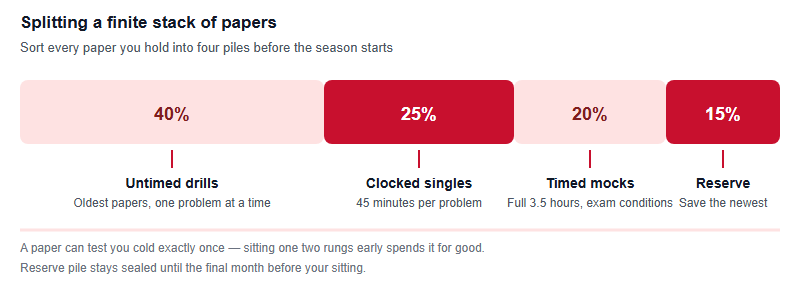
Three rules govern the piles:
- Oldest papers to the drills pile. Style drifts slowly over decades, so the most recent papers are the best proxy for what you will actually sit — which is exactly why they should not be spent on untimed practice at rung 1.
- Never re-sit a paper cold. A repeated paper tests recall, and recall flatters you. If you want to revisit one, do it as a write-up exercise: reproduce the argument in full from memory and check it, which is a different and genuinely useful drill.
- Harvest before you move on. A sat, unprocessed paper is a spent asset with nothing bought. Budget as long for the review as for the sitting — and if that sounds excessive, it is the review that produces the learning, not the three and a half hours.
Six weeks on rung 2, worked through
An example of what the ladder looks like in practice for a student whose promotion test is "finish an opening problem inside 45 minutes, twice".
| Week | Session 1 | Session 2 | Review block | Rung check |
|---|---|---|---|---|
| 1 | Clocked single, 45 min, opening problem | Untimed drill from the oldest pile | Bucket both attempts; name the gap in each | — |
| 2 | Clocked single, 45 min | Rewrite last week's "substantial" attempt to complete | Second read of the rewrite, 48 hours later | — |
| 3 | Clocked single, 45 min | Untimed drill in your weakest topic area | Bucket; log which topic the gaps cluster in | First pass? Log it |
| 4 | Clocked single, 45 min | Topic repair session, no paper at all | Rewrite one earlier fragment into a full proof | — |
| 5 | Clocked single, 45 min | Untimed drill, second problem rather than first | Bucket; compare week 1 and week 5 write-ups side by side | Second pass? Promote |
| 6 | Rung 3 trial: 105 minutes, first three problems | Rest | Full harvest of the half paper | Set the new promotion test |
Note what is not in that grid: no full papers, no Round 2 problems, and only six clocked papers consumed in six weeks. That is deliberate. Before you invest a season in this at all, it is worth confirming that you can enter the round from where you study — our eligibility reality check for international students sets out the routes, and UKMT's current rules on ukmt.org.uk are the authority.
Frequently asked questions
How many full papers should I sit before the real thing?
Fewer than you think. One every two to three weeks once you reach rung 4, each one fully reviewed, beats weekly unprocessed sittings.
Is it cheating to look at a hint during a rung 1 session?
Not cheating, but it voids the promotion test. Promotion counts only unaided complete write-ups; hinted attempts still teach you plenty.
Should I sit Round 2 papers if I have not qualified?
Only as untimed single problems, and only from rung 4 upwards. Sat as full timed papers they mostly teach discouragement.
What if I run out of papers?
Stop sitting and start rewriting: reproduce old solutions from memory, and work single problems from other olympiad sources instead.
This is an independent editorial guide operated by Hanlin Education for China-based international-school students. It is not affiliated with, endorsed by, or sponsored by the UK Mathematics Trust (UKMT) or the British Mathematical Olympiad Subtrust. The rungs, promotion tests and marking buckets above are our own editorial conventions and carry no official standing. Round formats, timings, entry routes and dates are set by UKMT and change from year to year — confirm current details on ukmt.org.uk. Factual corrections are made within 7 working days.