Number theory and combinatorics feel like the unteachable half of BMO Round 1, because there is no formula sheet and no obvious first line. In practice they are the most systematic areas on the paper: a short list of signals in the problem statement maps onto a short list of techniques, and most lost marks come from stopping halfway through a two-part argument rather than from missing an idea.
Why these problems look unteachable and are not
UKMT describes BMO Round 1 as a 3.5-hour challenge consisting of six Olympiad-style questions; each carries 10 marks, giving a paper marked out of 60. Confirm the current allocation on the paper itself at bmos.ukmt.org.uk. Round 2 narrows to four problems over the same 3.5 hours, so the pattern of rewarding depth over coverage only intensifies.
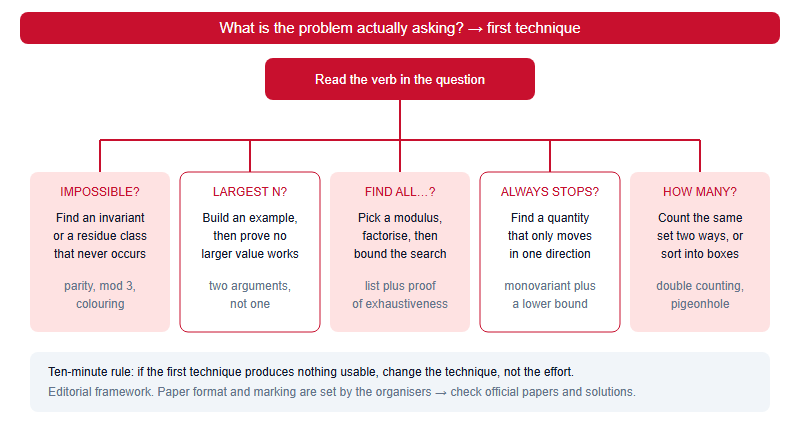
Geometry candidates arrive with school theorems they can name. Number theory and combinatorics candidates arrive with nothing that looks like a syllabus, which is why students from A-level, IB and AP backgrounds often treat these problems as lottery tickets: read, stare, hope. The correct model is different. Almost every accessible problem in these areas is asking you to do one of four things:
- Show something is impossible — which almost always means finding a quantity that never changes, or a residue class that never appears.
- Find the extreme value of some quantity — the largest number of pieces, the smallest number of moves — which always means two separate arguments, not one.
- Characterise all solutions to an equation or condition — which means both verifying your list works and proving nothing else does.
- Count something exactly — where the risk is a plausible-looking count with a double-counted or missing case.
Identify which of the four you are facing and the shape of a complete solution is already fixed. That is the whole argument for treating these areas as trainable, and it is why they reward preparation more predictably than students expect. If you are still working out how Round 1 fits into the wider pipeline, our overview of what the British Mathematical Olympiad is gives the map.
Number theory: five moves that finish most problems
The five below are ordered by how often, in our editorial reading of the papers in our practice pack, they are the move that actually cracks an accessible problem. Work through the papers yourself and calibrate the ordering for the years you care about.
- Choose a modulus and take residues. The single highest-value skill. The art is picking the right modulus: mod 2 for parity, mod 4 for squares, mod 3 or 9 for digit sums and cubes, mod 8 for squares of odd numbers, and the modulus suggested by the coefficients in the problem. Most impossibility proofs are three lines once the modulus is right.
- Factorise, including the tricks. Difference of two squares, adding and subtracting a term to force a factorisation, and Simon-style rearrangement into a product of two brackets. Diophantine equations that look hopeless often collapse into a small list of factor pairs.
- Bound the variables. If a variable can only be small, test the small cases exhaustively. Size arguments — showing one side grows faster than the other — convert an infinite search into a finite one, and a finite search you complete is a proof.
- Use divisibility structure. Greatest common divisors, coprimality, and the observation that a prime dividing a product divides one of the factors. If the problem names a prime, that is a signal, not decoration.
- Use order and Fermat-style results carefully. Useful, and easy to misapply. If you invoke a named theorem, state the hypotheses you are relying on; a marker cannot credit a step whose conditions you never checked.
Combinatorics: the arguments that carry marks
Combinatorics problems are where strong students most often submit a page of correct observations that never becomes a proof. The techniques below are all methods of turning observation into argument.
- Invariants. A quantity unchanged by every permitted move. If the start and target differ in that quantity, the task is impossible — and you have a complete proof rather than a failed search. Parity is the most common invariant; a sum taken modulo some number is next.
- Monovariants. A quantity that only ever moves one way. These prove that a process must terminate, which is what "show the procedure always stops" problems are really asking.
- Colouring. Colour a board or a set so that every permitted move interacts with the colours in a fixed way. Tiling and covering impossibility results usually reduce to a colouring plus a counting sentence.
- Pigeonhole. Easy to state, harder to deploy well. The skill is designing the boxes: the interesting step is choosing what to sort the objects by, not the final sentence about two objects sharing a box.
- Extremal principle. Consider the largest, smallest, or leftmost object with a property and derive a contradiction. This is the standard tool for "prove there is always some configuration" problems.
- Double counting. Count the same set two ways and equate. This turns geometric or graph-shaped situations into equations, and it is the cleanest route to many exact-count problems.
| Signal in the problem | Reach for | A complete solution must contain |
|---|---|---|
| "Prove it is impossible to…" | Invariant, parity, or a residue class | The invariant, proof that every move preserves it, and the mismatch at the target |
| "Find the largest / smallest N such that…" | Extremal principle plus construction | An explicit example achieving N, and a proof that N cannot be beaten |
| "Find all integers satisfying…" | Modulus, factorisation, bounding | Verification that each listed solution works, and proof the list is exhaustive |
| A prime, a square, or a digit sum is named | Mod 4, mod 8, mod 9, or divisibility structure | The chosen modulus justified, and every residue case handled |
| A repeated move, operation or game | Invariant or monovariant | What the quantity is, how each move changes it, and what that forces |
| A board, grid or tiling | Colouring plus counting | The colouring stated precisely, and the count that produces the contradiction |
The rule that decides the marks: construction plus bound
If there is one habit worth importing from this article into your next practice session, it is this. Any problem asking for the largest, smallest, maximum or minimum value requires two independent arguments, and a script containing only one of them is an incomplete solution no matter how impressive the other half is.
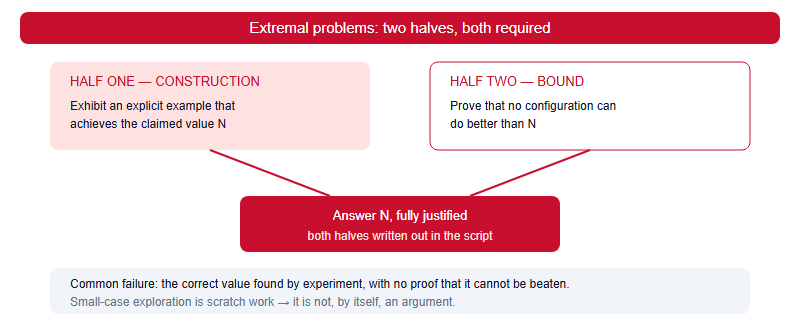
The same principle has a number-theoretic twin. When a problem says "find all integers such that", the list is half the answer; the proof that nothing else qualifies is the other half. Students routinely write four lines finding the solutions and no lines excluding everything else, then are surprised by the mark.


Two further write-up disciplines apply specifically to these areas:
- Checking small cases is not induction. Verifying a pattern for n equal to 1, 2, 3 and 4 is evidence for you, not proof for a marker. Either complete the induction step or find the structural reason.
- State the invariant as a definition. Write "let S be the sum of the labels, taken modulo 2" explicitly, show what each permitted move does to S, and only then draw the conclusion. Invariant arguments that gesture at parity without defining the quantity are hard to credit.
A six-week drill plan
This block assumes roughly four hours a week, sitting alongside geometry and algebra work rather than replacing it. It is built around recognition speed first and write-up completeness second, because that is the order in which the two skills bind.
- Weeks 1–2 — residues and parity. Twenty short problems where the only task is to pick a modulus and justify the choice. Do not write full solutions; write the first three lines of twenty solutions. Recognition is the bottleneck, so drill only the bottleneck.
- Weeks 3–4 — invariants and colourings. Ten process or board problems. For each, write the invariant as a formal definition and the effect of every permitted move on it, even when the conclusion is already obvious to you.
- Week 5 — extremal problems. Six problems, each written up with the construction and the bound clearly labelled as separate sections of the script. Mark yourself out of two: one point per half delivered.
- Week 6 — integration under time. Two past-paper problems from these areas under a strict 35-minute limit each, followed by an untimed rewrite the next day, and a comparison of the two versions.
Sourcing is the easy part: we keep a gathered pack of BMO past papers, with worked solutions for many of the years (coverage is still being added to), and our guide to BMO past papers and how to use them sets out a marking routine that keeps you honest about the difference between "I saw the idea" and "I wrote a proof". Before building a season around any of this, confirm with your school that you can actually be entered — our eligibility guide for international students covers the centre requirements that decide it.
Frequently asked questions
Which modulus should I try first?
Start with parity, then mod 4 for squares, mod 3 or 9 for digit sums and cubes. Let the coefficients in the problem suggest the rest.
Is checking small cases enough for a proof?
No. Small cases are exploration. A complete solution needs an induction step or a structural reason that covers every case.
Why did my correct answer score few marks?
Extremal problems need a construction and a bound. An answer found by experiment, with no proof it cannot be beaten, is incomplete.
How long is BMO Round 1?
UKMT lists Round 1 as a 3.5-hour challenge of six Olympiad-style questions. Confirm the current format on ukmt.org.uk.
This is an independent editorial guide operated by Hanlin Education for China-based international-school students. We are not affiliated with, endorsed by, or sponsored by UKMT or the BMO Subtrust. Competition formats, dates, eligibility and mark schemes are set by the organisers and can change — confirm current details on ukmt.org.uk. Errors reported to our editorial desk are corrected within 7 working days.