BMO Round 1 is a 3½-hour, six-problem paper marked out of 60 — each problem carries 10 marks. Medal and book prizes go to the highest scorers each year (the exact boundary is set yearly — confirm on ukmt.org.uk), while a separate published high-scorers list sat at 52 or more out of 60 in the 2025–26 cycle. But a raw “31/60” tells you almost nothing until you know how olympiad marks behave: scores cluster low, a full solution is worth far more than two half-solutions, and the line that matters most for you depends on whether you’re chasing a prize, a BMO2 invitation, or simply your first complete proof.
This is a score-literacy guide, not a marking-mechanics walkthrough. It answers the question students actually ask after results day — “is my score good?” — and helps you set a target that’s honest for where you are. Treat every threshold below as cycle-specific and confirm current figures on ukmt.org.uk; thresholds and prize boundaries move every year.
The number behind the number: how BMO1 marks are distributed
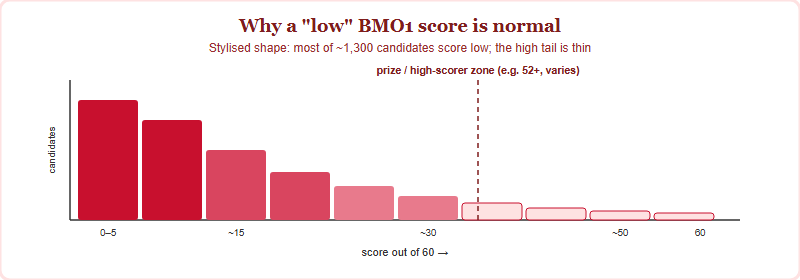
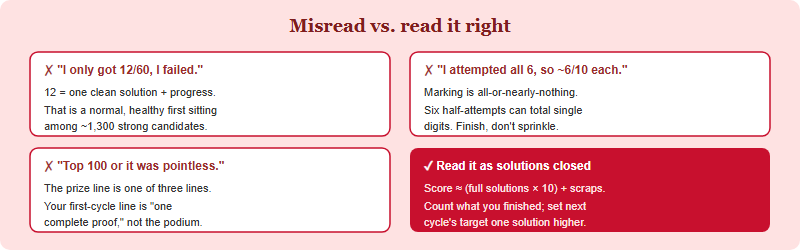
The single most important thing to internalise: BMO1 is scored all-or-nearly-nothing per problem. A complete, rigorous solution earns 10; a promising-but-incomplete attempt with a real gap often earns 0–2. This is the opposite of a school exam, where method marks reward partial work generously. The consequence is brutal but clarifying — your score is essentially a count of problems you fully solved, times ten, plus a little.
Because of this, BMO1 scores don’t spread out smoothly. They pile up at the bottom and thin out fast. The first problem is deliberately the most accessible; the rest climb steeply. With well over a thousand candidates each year — most of them already strong enough to have cleared the Senior Maths Challenge — a low score is normal, not a failure. Understanding why the marks behave this way is the subject of our companion piece on what the BMO is and how it works.
| What you did on the day | Roughly translates to | How to read it |
|---|---|---|
| Solved Q1 cleanly, made real progress elsewhere | ~10–15 / 60 | A solid, normal first sitting. You can do BMO maths. |
| Two full solutions | ~20 / 60 | Above the crowd. You’re converting, not just attempting. |
| Three full solutions | ~30 / 60 | Strong. Now in genuine prize/BMO2 conversation territory. |
| Four+ full solutions | 40+ / 60 | Elite for an international first-timer. Olympiad-track signal. |
These bands are illustrative reference points for interpreting your own paper, not official boundaries. The actual prize and qualification cut-offs are set by UKMT after each sitting and published with the results. Use the table to understand the shape of scoring, then check the real numbers for your year.
Three lines that matter — and which one is yours
“Is my score good?” has no single answer because there are at least three different finish lines, and the one you should care about depends on your stage:
- The prize line. UKMT awards medal and book prizes to the highest scorers each year; the exact boundary is set yearly (confirm on ukmt.org.uk). Separately, the published high-scorers list sat at 52+/60 in 2025–26. This is the hardest line and the wrong target for most first-timers.
- The BMO2 invitation line. Up to 100 students (eligible to represent the UK at the IMO) are invited to BMO2, “with selection taking account of age and other factors”; others may enter on payment of the entry fee. Note this is built around IMO-eligibility, not purely on raw score — an important nuance for international candidates covered in our eligibility reality check.
- Your personal line. For a strong international student sitting BMO1 for the first time, the honest target is often one full solution — a complete, watertight proof. That single 10 is worth more as a learning milestone than a scatter of 2s and 3s.
Choosing the right line keeps you sane. A Year 12 student aiming for “top 100” on a first attempt is setting up to feel like a failure at a score that is, in reality, perfectly respectable. A student aiming for “my first complete proof” walks away with momentum.
How to set an honest target for your year
First-party coaching observation: the students who improve fastest set process targets, not score targets, in their first cycle. You can’t fully control whether this year’s Q3 happens to suit you. You can control how many problems you can fully close out under time. Here’s a staged framework many China-based students find realistic:


| Stage | Process target | Likely score band (out of 60) |
|---|---|---|
| First BMO1 sitting | Produce at least one complete, rigorous solution | ~10–15 |
| Second cycle | Two full solutions; no “almost” attempts left at 2/10 | ~20 |
| Building toward BMO2 | Three full solutions reliably; clean write-ups | ~30 |
| Olympiad track | Four+ solutions; speed plus rigour | 40+ |
Notice that every row is phrased as “solutions completed,” because that’s what BMO1’s all-or-nothing marking rewards. If your practice habit is “I attempted all six,” reframe it to “I closed out two.” Converting attempts into complete proofs is the entire game — and it’s the skill that the lower-round build, like the JMO-to-Cayley reading plan, is designed to grow over years rather than weeks.
Common ways students misread their score
What to do with the score after results day
A BMO1 score is most useful as a diagnostic, not a verdict. Three concrete moves:
- Map which topic you converted. Did your full solution come from geometry, number theory, or combinatorics? That’s your current strength; the gaps are your study list.
- Audit your “almost” problems. Re-solve every problem you scored 0–3 on, slowly, with the official solutions. The lesson is usually a missing rigour step, not a missing idea.
- Reset the line, not the goal. If you closed one problem, next cycle’s process target is two. The score will follow the conversion rate.
No score here implies any admissions outcome — universities read the whole picture, and there is no guaranteed result from any single mark. What a rising BMO1 score does show is a student who can produce rigorous proof under pressure, which is exactly the habit the UK olympiad pathway is built to develop. Set an honest line, count solutions, and let the number out of 60 be a coach rather than a judge.
Frequently asked questions
What is BMO1 marked out of?
BMO1 is a six-problem paper marked out of 60, with 10 marks per problem, sat over 3½ hours. The first problem is intended to be the most accessible.
What BMO1 score gets a prize?
UKMT awards medal and book prizes to the highest scorers each year — the exact boundary is set yearly (confirm on ukmt.org.uk). Separately, the published high-scorers list sat at 52+/60 in 2025–26.
Is 15 out of 60 on BMO1 bad?
No. Around 15 typically reflects one complete solution plus progress, a normal first sitting among well over a thousand strong candidates. Count solutions closed, not raw marks.
Does a BMO1 score decide BMO2 entry?
Up to 100 IMO-eligible students are invited to BMO2 with age and other factors considered; others may pay to enter. It is not purely a raw-score cut-off.
This is an independent editorial guide operated by Hanlin Education for China-based international-school students. It is NOT affiliated with, endorsed by, or sponsored by UKMT or the BMO Subtrust. Score boundaries, prize counts, dates and BMO2 invitation rules change each cycle — confirm current details on ukmt.org.uk before relying on any figure here. We correct any factual error within 7 working days of notification.