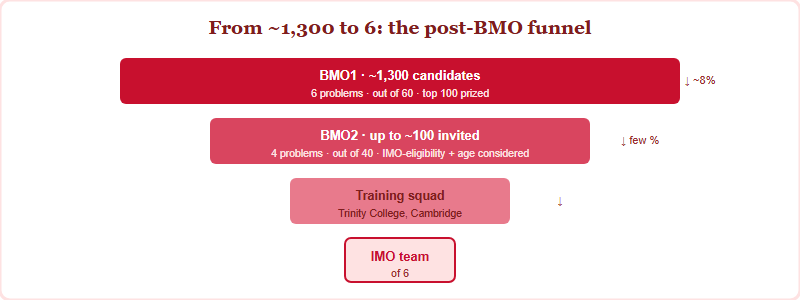
After BMO Round 2, the UK olympiad pathway narrows hard. Strong BMO2 performers progress to training camps held at Trinity College, Cambridge, where an IMO squad is built and, through further training and selection tests, the UK team of six for the International Mathematical Olympiad is chosen. From well over a thousand students who sit BMO1, to up to ~100 invited to BMO2, to a single team of six, the funnel sheds more than 99% of entrants — and that math is exactly why, for almost every international applicant, the meaningful achievement is reaching BMO2 at all, not making the team.
This guide maps the post-BMO2 funnel honestly and explains how to read it as an admissions signal without overclaiming. Some downstream details — squad camp formats, named training rounds, mentoring schemes and exactly which other olympiads feed the selection — change year to year and aren’t fully spelled out publicly, so where this piece can’t verify a specific, it says so and points you to ukmt.org.uk. For where BMO2 sits in the overall structure, start with our overview of what the BMO is.
The shape of the funnel after Round 2
Here is the verified backbone of the pathway, stage by stage. The candidate counts are the ones UKMT and its BMO subtrust describe; the named end point is the team of six at the IMO.
| Stage | Approx. who’s left | What it is |
|---|---|---|
| BMO1 | ~1,000+ | 3½-hour, 6-problem paper (out of 60); top scorers win prizes (boundary set yearly) |
| BMO2 | up to ~100 | 3½-hour, 4-problem paper (out of 40); invitation built around IMO-eligibility, age and other factors |
| Training camps | a squad (small) | Held at Trinity College, Cambridge; further training + selection tests |
| UK IMO team | 6 | The students who represent the UK at the International Mathematical Olympiad |
The exact squad size and the number of selection rounds between “training camp” and “team of six” are not fixed public figures and have varied; treat the middle of this table as a shape, not a spec, and verify the current cycle’s arrangements on the official site. What is stable is the dramatic compression: each stage keeps a small fraction of the one before it.
The international-student reality check
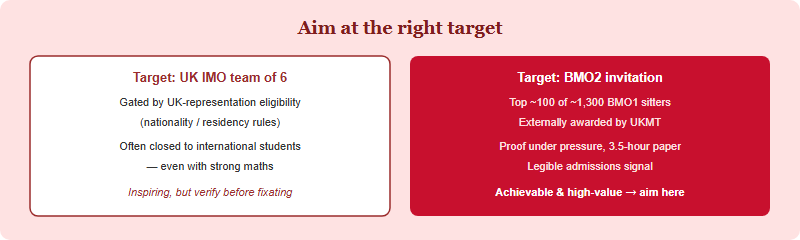
Here is the part that’s easy to miss and important to get right: the elite end of this funnel is structured around representing the UK. The BMO2 invitation list prioritises students “eligible to represent the UK at the IMO,” and the squad and team are, by definition, the UK’s IMO selection process. For a China-based international student, IMO-representation eligibility depends on nationality and residency rules that are not the same as “can I sit the paper” — and they can stop you well before the team stage even if your maths is good enough.
We unpack that distinction in detail in our BMO eligibility reality check for international students. The short version: sitting BMO1 and BMO2 is one question; entering the UK’s national-team selection is a separate, stricter one. Confirm both on the official site rather than assuming the pathway is open end to end. This is not a reason to avoid the BMO — it’s a reason to aim at the right target.
| Two different questions | What governs it | Realistic for a China-based student? |
|---|---|---|
| Can I sit BMO1 / BMO2? | Registered UKMT centre + qualification | Yes, via a British International School centre (verify) |
| Can I be on the UK IMO team? | UK-representation eligibility (nationality/residency) | Often no — this is the strict gate |
Why reaching BMO2 is already the signal that counts
If the team of six is out of reach for eligibility reasons, does the pathway still matter for an international applicant? Yes — and arguably more cleanly, because it lets you focus on the achievement universities can actually read. Consider the arithmetic: a BMO2 invitation means you were among roughly the top ~100 of the BMO1 field, who are themselves a pre-selected group that cleared the Senior Maths Challenge. That is a top-tier, externally verified mathematics result regardless of what happens next.
- It’s selective and external. A BMO2 invitation or a strong BMO1 score is awarded by UKMT, not self-reported. Admissions readers trust third-party selection.
- It demonstrates proof under pressure. A 3½-hour written proof paper shows rigour and stamina that a multiple-choice score can’t — the exact qualities a maths-heavy course wants.
- It’s legible to UK and US readers alike. For applicants comparing pathways, the BMO is a recognised reference point; see how it lines up against the US ladder in our companion comparison of the olympiad routes.
No olympiad result guarantees an admissions outcome, and we’d be wrong to imply otherwise — universities weigh the whole application. But as a single, hard-to-fake line on a maths-focused application, “invited to BMO2” or a rising BMO1 score does real work. The team of six is a wonderful aspiration for the eligible few; the BMO2 invitation is the achievable, high-value target for the many.


How to build toward the achievable end of the funnel
If BMO2 is the target, the work is the same proof-craft that the elite end demands — just measured against a reachable line. A first-party planning view:
- Convert BMO1 fully. BMO2 invitations track strong BMO1 performance. The route to BMO2 runs through closing out problems on Round 1, not through chasing Round 2 directly.
- Train proof rigour over years, not weeks. Olympiad selection rewards students who started building structured problem-solving early. The long ramp from the junior rounds — see our JMO-to-Cayley reading plan — is where most squad members actually came from.
- Verify your own eligibility ceiling early. Before you orient an entire plan around national-team selection, confirm whether UK-representation rules apply to you. Knowing your ceiling lets you aim at a target you can actually hit.
- Keep records. A BMO2 invitation, a high BMO1 score, certificates — these are the externally verifiable artefacts that make the application line credible.
The post-BMO2 funnel is genuinely thrilling, and the team of six deserves its reputation. But the smartest international students read the funnel for what it offers them: not a near-impossible shot at the national team, but a recognised, rigorous, hard-to-fake mathematics credential available at the BMO2 line. Aim there, build the proof-craft, and verify every eligibility detail against the official source before you plan around it.
Frequently asked questions
What happens after BMO Round 2?
Strong BMO2 performers progress to training camps at Trinity College, Cambridge, where, through further training and selection tests, the UK IMO team of six is chosen.
How many students make the UK IMO team?
Six students represent the UK at the International Mathematical Olympiad, selected from a small training squad. The squad size varies by year — confirm on ukmt.org.uk.
Can an international student in China make the UK IMO team?
UK-representation eligibility depends on nationality and residency rules that are stricter than sitting eligibility, and often exclude international students. Confirm on the official site.
Is reaching BMO2 worth it if I can’t make the team?
Yes. A BMO2 invitation means roughly the top ~100 of the BMO1 field — an externally awarded, rigorous signal — independent of national-team eligibility.
This is an independent editorial guide operated by Hanlin Education for China-based international-school students. It is NOT affiliated with, endorsed by, or sponsored by UKMT or the BMO Subtrust. Selection structures, squad sizes, eligibility for UK representation, dates and counts change each cycle and are not all published in full — confirm current details on ukmt.org.uk before relying on anything here. We correct any factual error within 7 working days of notification.