Short answer: For BMO2 inequalities, do not begin by declaring a favourite method. Begin with a pre-write diagnostic: record the domain, identify the algebraic structure, and guess the equality case. AM-GM is usually the clean route when every term is nonnegative and a sum-product relation controls the expression. Cauchy-Schwarz is usually the clean route when sums of squares or products of sums appear. Substitution is usually a bridge: it rewrites constraints or denominators so that AM-GM or Cauchy-Schwarz becomes applicable. Choose the route that lets you write a complete proof with an attainable equality case.
Hanlin’s 15 October 2026 BMO course-planning article lists Cauchy-Schwarz among BMO2 algebra topics. That is a preparation pointer, not a rule that every BMO2 inequality must use Cauchy-Schwarz. BMO2 is a proof paper; the BMOS site’s 16 February 2026 BMO Round 2 high-score notice reports scores out of 40. The practical lesson is that naming a theorem earns nothing by itself. The written chain must stand.
Why method choice comes after reading
An inequality question usually gives more information than the target line. It gives signs, constraints, denominators, a symmetric or cyclic pattern, and sometimes a fixed product or sum. Those are the clues that decide whether AM-GM, Cauchy-Schwarz or substitution is worth trying first. A student who writes by AM-GM before checking positivity is not using a method; they are guessing.
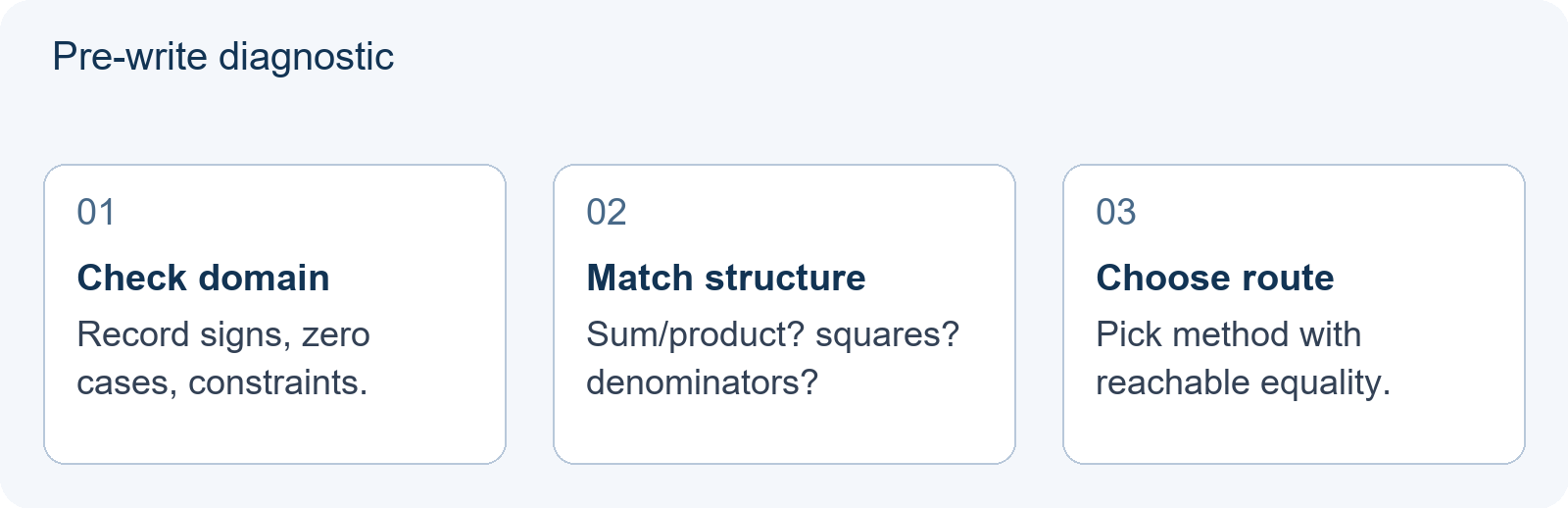
The pre-write diagnostic has three questions. First, what is the exact domain? Are the variables positive, nonnegative, real, integers, or restricted by another condition? Second, what structure does the expression expose: a sum of products, a sum of squares, reciprocal terms, denominators that can be renamed, or a constraint such as xyz = 1? Third, what equality case should be possible? If the target says equality at a = b = c, the proof route must allow that point. If equality is supposed to occur at a boundary value, AM-GM with positive variables may need a limiting argument or a different route.
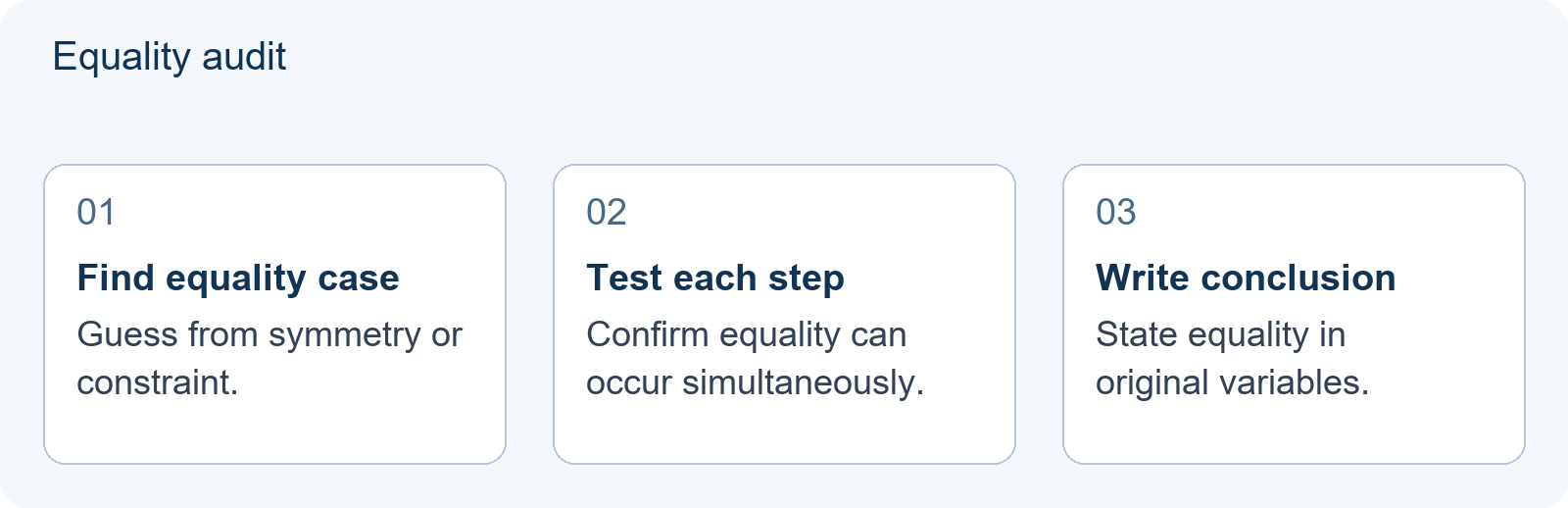
This is also where proof writing separates BMO2 preparation from ordinary answer-hunting. A BMO2 inequality solution needs justified conditions, correct inequality direction, and a final statement about equality. The method name is not the proof. The proof is the sequence of implications from the hypotheses to the target. A useful separate check for the ending is BMO Equality Cases: Finishing an Inequality Proof Completely.
A three-route diagnostic for BMO2 inequalities
| Diagnostic question | AM-GM | Cauchy-Schwarz | Substitution |
|---|---|---|---|
| What domain does it need? | Nonnegative terms; usually positive for strict equality statements. | Any real numbers, because squares are nonnegative. | Whatever domain keeps the new variables equivalent to the old ones. |
| What pattern invites it? | Products with a fixed value; sums of positive terms; paired reciprocals. | Sums of squares; products of sums; dot-product patterns such as (a+b+c)^2. | Denominators, repeated blocks, constraints, or variables that become symmetric after renaming. |
| What equality condition appears? | All terms equal in the unweighted form. | Two vectors proportional. | Equality in the new variables must translate back to the original variables. |
| Main risk | Applying it to negative terms or missing a boundary equality case. | Choosing a pairing whose equality case cannot occur. | Making a non-reversible change and losing information. |
The table is a starting point, not a ranking. Many BMO2 inequalities admit more than one valid route. The best route is often the one whose equality case is easiest to state and whose conditions are easiest to verify under time pressure.
Teaching illustration 1: AM-GM when the product is controlled
Teaching illustration, not an official BMO question. Let a, b and c be positive real numbers. Prove that
a/b + b/c + c/a >= 3.
Pre-write. The domain is positive, so all three terms are positive. Their product is (a/b)(b/c)(c/a) = 1. That is exactly the pattern AM-GM controls: three nonnegative terms with a fixed product. Equality should occur when each term is 1, which means a = b = c.
Proof. By AM-GM applied to the three positive terms a/b, b/c and c/a,
a/b + b/c + c/a >= 3 * cube_root((a/b)(b/c)(c/a)) = 3 * cube_root(1) = 3.
Equality requires a/b = b/c = c/a = 1, hence a = b = c. The proof is complete because the domain, the inequality direction and the equality case have all been checked.
This example shows why AM-GM is often the first candidate. The product is not an accident; it is the structure that makes the sum collapse. If the product were not controlled, AM-GM might still be useful after pairing terms, but the pre-write would need to show that pairing.
Teaching illustration 2: Cauchy-Schwarz when squares are present
Teaching illustration, not an official BMO question. For real numbers x, y and z, prove that
(x + y + z)^2 <= 3(x^2 + y^2 + z^2).
Pre-write. The variables are real, not necessarily positive, so AM-GM on x, y and z would be invalid. The expression contains a square of a sum on the left and a sum of squares on the right. That is a Cauchy-Schwarz pattern. Take the vectors (1, 1, 1) and (x, y, z). Equality in Cauchy-Schwarz should occur when the vectors are proportional, which gives x = y = z.
Proof. By Cauchy-Schwarz,
(1*x + 1*y + 1*z)^2 <= (1^2 + 1^2 + 1^2)(x^2 + y^2 + z^2).
The left side is (x + y + z)^2 and the first factor on the right is 3, so the required inequality follows. Equality occurs when (x, y, z) is a real multiple of (1, 1, 1), that is, x = y = z. No positivity condition is needed.
This is a useful diagnostic case because a student who tries AM-GM immediately meets a sign problem. The structure, not the name of the chapter, points to Cauchy-Schwarz.
Teaching illustration 3: substitution as a bridge, not a magic trick
Teaching illustration, not an official BMO question. For positive real numbers a, b and c, prove that


a/(b+c) + b/(c+a) + c/(a+b) >= 3/2.
Pre-write. The denominators repeat the same three variables in a cyclic pattern. A substitution can turn the denominators into single letters. Let x = b + c, y = c + a and z = a + b. Since a, b and c are positive, x, y and z are positive. Solving gives a = (y + z – x)/2, b = (z + x – y)/2 and c = (x + y – z)/2.
Proof. The left side becomes
1/2[(y + z – x)/x + (z + x – y)/y + (x + y – z)/z].
Rearrange inside the bracket:
1/2[(y/x + x/y) + (z/x + x/z) + (z/y + y/z) – 3].
Each paired expression is positive. By AM-GM, y/x + x/y >= 2, z/x + x/z >= 2, and z/y + y/z >= 2. Therefore the bracket is at least 1/2(2 + 2 + 2 – 3) = 3/2. Equality in all three AM-GM steps requires x = y = z, which gives a = b = c.
The substitution did not replace the proof. It prepared the expression for AM-GM. That is the right way to think about substitution in BMO2 inequalities: it is a structural rewrite, and every step must remain reversible on the stated domain. Here the new variables are positive, and the equality case translates cleanly back to a = b = c.
A Cauchy-Schwarz route also exists for this same teaching illustration, so the example is not evidence that substitution is mandatory. The diagnostic point is that the substitution route makes the denominator structure transparent and the equality case easy to audit.
What a 20-minute pre-write page should contain
Before writing a full solution, use a single page. It does not need to be neat; it needs to prevent a false start.
- Domain line. Write the exact assumptions: positive, nonnegative, real, integer, or constrained. Mark any variable that can be zero.
- Target line. Copy the inequality without rearranging it yet. Note whether the direction is >= or <=.
- Equality guess. Test the symmetric point, a boundary point, or a simple value pair. Write the equality condition you expect.
- Three candidate first lines. Try one AM-GM application, one Cauchy-Schwarz application and one substitution idea. Do not develop all three fully.
- Reject invalid routes. Cross out any route that needs positivity you do not have, equality you cannot attain, or a substitution that is not reversible.
- Choose the shortest complete chain. Prefer the route whose conditions and equality statement you can write without gaps.
For named results, do not quote a theorem unless you can state its hypotheses and equality condition. A lookup table for named results can help, but it does not replace the check. See State It or Prove It? A Lookup Table of Named Results You Can Use in a BMO Write-Up for that boundary between quoting and proving.
Common invalid starts to reject
- AM-GM on signed terms. The statement x + 1/x >= 2 is true for x > 0, but not for every nonzero real x. If the domain is real and nonzero, a positivity step needs separate cases or a different method.
- Cauchy-Schwarz with an impossible equality case. If the pairing forces a relation that contradicts the constraints, the inequality may still be true, but the proof needs a different argument or a strictness discussion.
- Substitution without a reverse map. Renaming x = a + b can simplify an expression, but the new variables may not capture every original choice. State the domain of the new variables and check that equality translates back.
- Examples instead of proof. Testing a = b = c = 1 and one asymmetric triple can reveal a pattern, but it cannot prove a BMO2 inequality. A proof needs a general argument.
How this diagnostic affects preparation choices
A useful BMO2 inequalities lesson should train the pre-write page, not just list theorem names. When evaluating a class, a book or a problem set, ask whether it makes you state domains, test equality cases, and reject invalid first lines. A resource that only shows polished solutions can still be useful, but it is weaker preparation if it never asks you to choose between AM-GM, Cauchy-Schwarz and substitution before the solution is revealed.
In our editorial judgment at Hanlin, the most transferable exercise is to take one solved inequality and rewrite the pre-write page that the solution implies. That is not an official scoring rule. It is a study choice: it forces you to see why the published first line was available and why two other plausible first lines would have failed.
For China-region candidates checking the wider route to BMO2, keep the technical work separate from qualification logistics. The qualification page BMO2 Qualification China: What the 2026 Seven-Point Line Means for 2027 covers that administrative side; this article covers the proof-writing side. Neither replaces the other.
Bottom line: in BMO2 inequalities, AM-GM, Cauchy-Schwarz and substitution are not rivals to memorise in a fixed order. They are candidate routes selected by domain, structure and equality. Write the diagnostic first, then choose the route that gives a complete proof you can defend line by line.
General event background is available at Event background.
This is an independent preparation guide, not affiliated with, endorsed by, or sponsored by UKMT.
Frequently Asked Questions
Should I always try Cauchy-Schwarz first in BMO2 inequalities?
No. Start from the domain and structure. Cauchy-Schwarz fits sums of squares and products of sums; AM-GM fits nonnegative sum-product relations; substitution can simplify constraints or denominators before either method is used. Try routes in an order that lets you reach an attainable equality case and finish a complete proof.
Is substitution a separate method from AM-GM and Cauchy-Schwarz?
Usually it is a bridge rather than a separate final method. A substitution can turn denominators into single letters or expose a fixed product, after which AM-GM or Cauchy-Schwarz becomes easier. Use it only when the new variables preserve the stated domain and the equality case translates back to the original variables.
How do I know an inequality proof is complete?
Check the domain, every inequality condition, the direction of each inequality, and the equality case. Each theorem application must be justified, equality must be attainable under the hypotheses, and the final line must state the original claim. Testing several examples is not a proof.