Short answer. For the China region, the BMO Round 2 qualification line reported for the 2026 cycle was 7 points out of 60 on BMO Round 1. It is a China-specific entry threshold into Round 2 — not an award band, and not the United Kingdom’s route, where roughly the top 100 Round 1 candidates are invited. The line that governs entry to the Round 2 paper sat on 21 January 2027 cannot be fixed before the 19 November 2026 Round 1 paper has been marked, so a seven is a planning benchmark, not a target you can bank.
Who this applies to. The published China-region conditions allow a student in any high-school year to register directly for BMO Round 1 without a prior Senior Mathematical Challenge (SMC) result, while students enrolled in the UK cannot sit the China-region paper. Round 1 registration closes on 9 November 2026, and the China-region paper is on 19 November 2026, 17:00–20:30 — one calendar day after the UK paper, a time-zone consequence rather than a conflicting date.
Three different numbers that get read as one
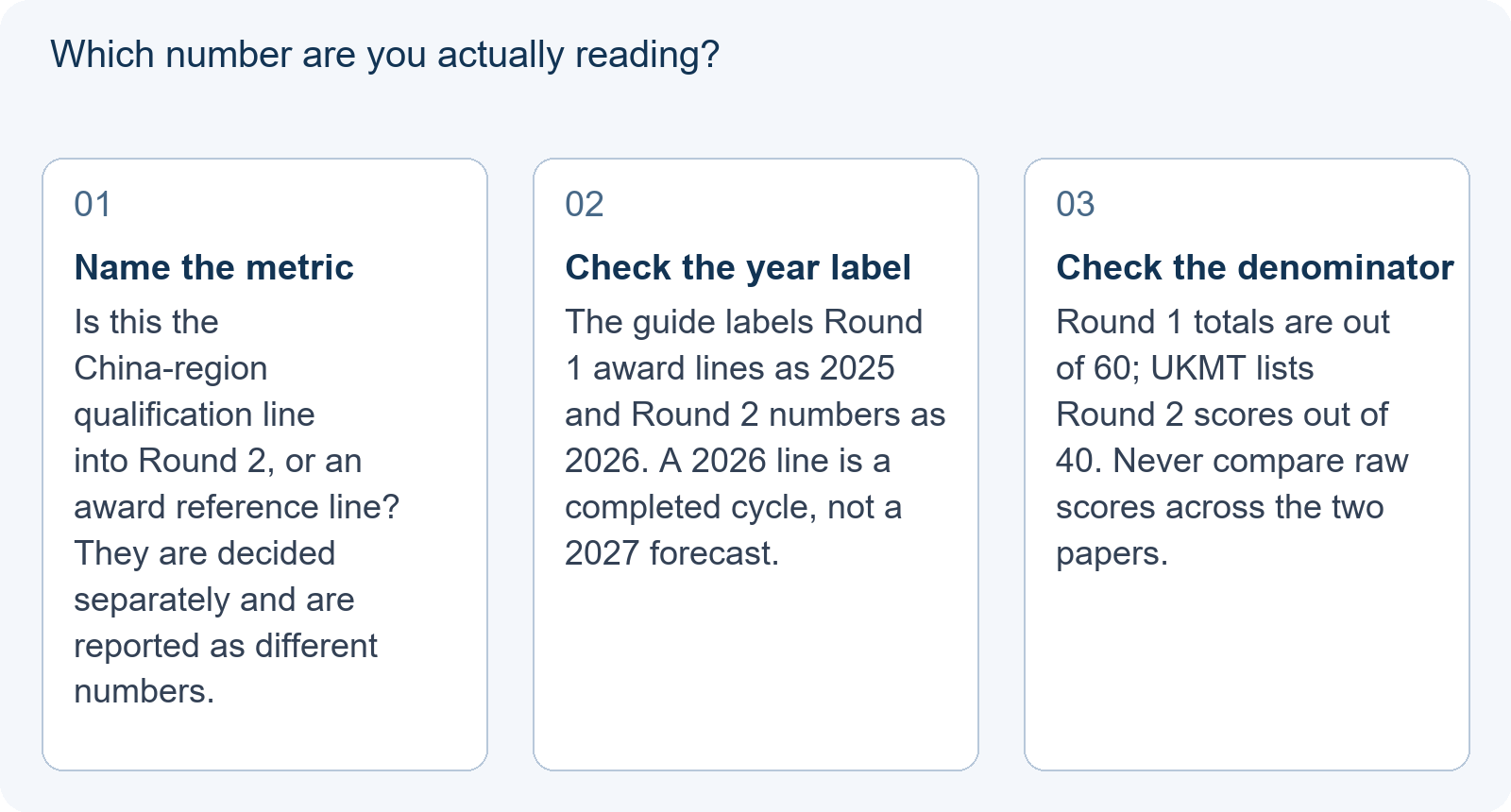
Most confusion around “bmo2 qualification china” comes from collapsing three separate determinations into a single score. They are set for different purposes, sometimes in different years, and on different papers.
| Number | What it decides | China-region relevance |
|---|---|---|
| China BMO2 qualification line | Whether a China-region Round 1 candidate proceeds to Round 2 | Reported as 7 points for the 2026 cycle; independent of the UK ranking method |
| BMO1 award reference lines | Which medal or certificate a Round 1 script is referenced against | China and other international candidates are referenced against the UK lines for Gold, Silver, Bronze, Distinction and Merit |
| UK top-100 route | Which UK candidates are invited to Round 2 | Does not apply to China-region entrants |
The distinction is stated plainly in Hanlin’s BMO guide dated 15 October 2026 (Hanlin Course, WeChat): in the UK, roughly the top 100 Round 1 candidates qualify for Round 2, whereas China determines progression by a published line, and that line is typically far below the Distinction line. In other words, the number that decides your next round and the number that decides your certificate are not the same number, and they are not meant to be.
Which cycle does the seven belong to?
This matters more than the value itself. Hanlin’s 15 October 2026 guide labels its Round 1 award lines as 2025 figures and its Round 2 award lines as 2026 figures, and it labels the China qualification line as 2026 as well. That labelling is consistent with the Round 2 paper that UKMT’s own British Mathematical Olympiad site records as having been taken on Wednesday 21 January 2026. On that reading, the reported seven is the line drawn from the previous November’s Round 1 paper to settle entry into the January 2026 Round 2 — a completed cycle, not the one ahead of you.
The practical consequence is simple. When the guide was published on 15 October 2026, the 2026-27 Round 1 had not yet been sat; it takes place on 19 November 2026. A qualification line drawn from a paper is not available before that paper is written and marked. Treat the seven as evidence about how low a China-region qualification line can sit relative to award bands — not as a forecast of the line for the January 2027 round.
Why the UK top-100 rule does not transfer
Two features of the UK system do not exist in the China-region pathway. First, UK entry to Round 1 is filtered through SMC performance, so the Round 1 cohort is already a selected group of roughly a thousand candidates; the China-region pathway allows direct registration, so the sitting population is built differently. Second, UK progression is by rank — about the top 100 — rather than by a fixed score.
Readers sometimes conclude from this that the China line is “easier” because it is lower. That inference does not follow. A rank-based rule and a score-based line are different instruments applied to different populations; a lower number on one instrument tells you nothing about how the other would have treated the same script. What is safe to say is only what the guide says: the China line is independent and, historically, substantially below the Distinction reference line.
Reading a seven under BMO1’s marking scheme
Round 1 is a proof paper: six questions, each marked out of 10, for a total of 60, with partial credit awarded for correct reasoning that does not reach a full solution. Keeping that structure in view stops the seven from looking arbitrary.
Teaching illustration (a constructed example for explanation, not a real candidate’s result and not official guidance). Suppose a China-region candidate’s Round 1 script earns 4 marks on one problem, 3 on another, and nothing elsewhere, for a total of 7. That total sits at the reported qualification line. The arithmetic is worth pausing over: because each problem carries 10 marks, a single fully correct solution is worth 10 on its own, so 7 points is perfectly compatible with a script that never finished a problem, and equally compatible with a script that nearly finished one. The total alone cannot tell you which. Two clean problems would clear the reported line comfortably; so would one clean problem plus partial progress elsewhere.
The lesson is about preparation, not about targeting a number. A seven is not a skill level; it is a threshold that partial credit happened to cross in one cycle.
The published reference lines, with their years and denominators kept apart
The table below reproduces the reference lines as published in Hanlin’s 15 October 2026 guide, with the labels preserved rather than merged.
| Reference line | Value | Basis stated in the guide |
|---|---|---|
| BMO1 Gold (2025) | 48+ | UK rank top 20 |
| BMO1 Silver (2025) | 37+ | UK rank 21–50 |
| BMO1 Bronze (2025) | 31+ | UK rank 51–100 |
| BMO1 Distinction (2025) | 18+ | Approximately the UK top 25% |
| BMO1 Merit (2025) | 7+ | Approximately the UK top 70% |
| BMO2 Distinction (2026) | 18+ | Approximately the UK top 25% |
| BMO2 Merit (2026) | 9+ | Approximately the UK top 70% |
| China BMO2 qualification (2026) | 7 | China-region entry to Round 2 |
Three cautions follow directly from the table. First, the same numeral appears on different scales: 18+ is used for Round 1 Distinction on a 60-mark paper and for Round 2 Distinction on the shorter Round 2 paper, which UKMT’s site shows as scored out of 40 (its February 2026 high-score list reports candidates at 26 or more out of 40). Because problems are marked out of 10, a 40-mark total implies four problems — so a Round 1 score and a Round 2 score are never compared as raw numbers.


Second, the Merit reference line for 2025 Round 1 is also 7+, while the China qualification line is reported as 7. These are different metrics with different year labels — one is an award reference for a UK distribution, the other is a progression threshold for the China region. Do not read the shared numeral as a shared meaning, and do not assume that clearing the qualification line automatically produces an award, or the reverse. Check your own year’s notice for both.
Third, award bands are not necessarily disjoint. The guide’s percentile descriptions overlap at the edges, and it lists separate category awards such as Best in School and Best in Year alongside the score bands. If you are reading your own result, use the official notice for your sitting rather than inferring from a table of earlier years.
Dates that are already fixed
| Milestone | Date | Note |
|---|---|---|
| BMO Round 1 registration closes (China region) | 9 November 2026 | Applies to candidates not yet registered |
| BMO Round 1 paper (China region) | 19 November 2026, 17:00–20:30 | UK paper is the previous day; time-zone difference |
| BMO Round 2 registration closes | 11 January 2027 | Separate registration step |
| BMO Round 2 paper | 21 January 2027, 17:00–20:30 | Four problems on the 40-mark scale |
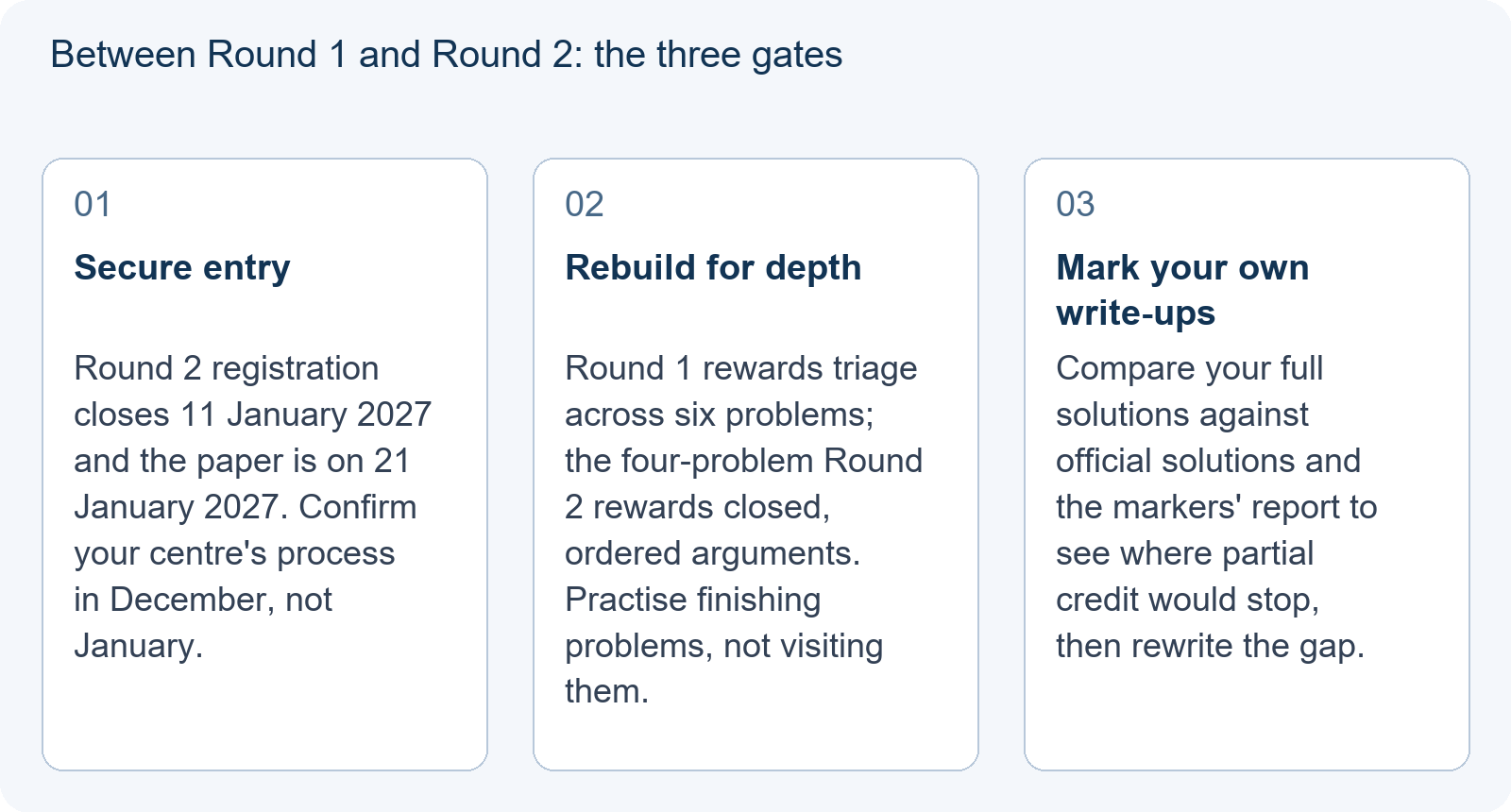
The pitfall worth naming. Candidates who qualify by score often wait for documentation before asking how Round 2 entry is arranged. The Round 2 registration deadline of 11 January 2027 falls immediately after the winter holiday period, and the exam is only ten days later. Whatever the qualification line turns out to be, the administrative step has its own clock. If you sat Round 1, confirm now how your centre handles Round 2 registration, so that a qualifying score is not spent waiting on paperwork. For the full pre-Round 2 planning sequence, see After BMO1, Before BMO2: The Nine-Week Window Planner and Deadline Table for the China Region (19 November to 21 January).
If you are near the historical line, change what you practise
The following is teaching guidance from our coaching work, not an official rule. Round 1 rewards triage: 3.5 hours is enough to touch all six problems only if you keep each attempt thin, and the marking scheme pays partial credit for a correct opening idea. Round 2 pulls in the opposite direction. With four problems on the paper, there is no spread to hide in; each question needs a complete, ordered argument, and a half-written approach earns close to nothing.
Two habits make the transition concrete. First, practise finishing rather than visiting: take one hard problem and refuse to leave it until the argument closes, then compare your write-up against the official solutions and the markers’ report to see exactly where credit would stop. Second, rehearse the full write-up, not just the idea — state the claim, define the objects, justify each step, and give the concluding line that the question asked for. If you want a starting point for interpreting the Round 1 total you are working from, see The BMO1 Readiness Self-Audit: Score Yourself Out of 40 and Fix the Right Thing First.
What the qualification line does and does not evidence
What it evidences is narrow and useful: in the cycle reported, a China-region candidate could reach Round 2 without approaching the Distinction band, because the two numbers are set for different purposes. What it does not evidence is any percentile within the China-region cohort — no such percentile appears in the material reviewed here, and the qualification line is not a ranking. Nor does it constitute a prediction, a guarantee of an award, or a conversion rate into later selection stages, all of which would require matching populations and deduplication that the published figures do not supply.
The same restraint applies to applications. Hanlin’s guide argues that BMO medals and Distinction-level results function as evidence of mathematical ability in competitive G5 applications; treat that as the provider’s stated position rather than an admissions rule, and treat entry into Round 2 as the beginning of the evidence rather than its conclusion. For how the 19 November sitting fits into a live application cycle, see Your China-Region BMO1 Falls on 19 November: A Reach Table for Which Parts of a University Application It Can Still Touch.
Sources
- Hanlin Course (Hanlin), WeChat, published 15 October 2026: “2026 BMO Maths Olympiad: registration closes 9 November! G5 STEM applicants, don’t miss it!” — source for the China-region Round 2 qualification line of 7, the independent-line rule versus the UK top-100 route, the registration and exam dates, and the 2025 Round 1 and 2026 Round 2 award reference lines.
- Hanlin Course (Hanlin), WeChat, published 20 September 2026: “2026 BMO UK maths competition registration opens: 3.5 hours, only six questions — how hard is it really?” — source for direct China-region entry to Round 1 without SMC, the 3.5-hour six-question 60-mark format, and the 18 November UK versus 19 November China sitting dates.
- UKMT, British Mathematical Olympiad site (bmos.ukmt.org.uk), accessed 26 October 2026 — source for the Round 2 paper taken on 21 January 2026 and for BMO Round 2 scores reported out of 40.
What to do next
If you have not yet registered for Round 1, the deadline is 9 November 2026. If you have sat Round 1 and expect to be near the historical line, the two actions that matter are administrative and technical: confirm how your centre processes Round 2 registration before 11 January 2027, and start writing complete proofs now rather than in January. Hanlin’s 15 October 2026 guide also advertises BMO registration assistance and BMO course options for the season; current availability and terms should be confirmed directly with the centre.
General event background is available at Event background.
This is an independent preparation guide, not affiliated with, endorsed by, or sponsored by UKMT.
Frequently Asked Questions
Is the seven-point line guaranteed for 2027?
No. The seven is reported for the 2026 cycle and was drawn from a Round 1 paper already sat and marked. The line for entry to the 21 January 2027 Round 2 depends on the 19 November 2026 paper and the scripts produced on it, so it may differ.
Does qualifying for BMO2 mean I earned a Distinction?
No. They are separate determinations, reported on different scales and under different year labels. The China qualification line reported for 2026 sits well below the Distinction reference line, so reaching Round 2 does not imply a Distinction, and the two should not be quoted as one result.
If I scored 7, do I automatically have a Merit award?
Do not assume it. The guide’s 2025 Round 1 Merit reference line was also 7+, but that is an award reference for the UK distribution in a labelled year, not the progression threshold, and the numerals only coincide. Check the official notice for your own sitting instead of matching numbers across tables.